
Handout (428.8 kB)
In this model there is no surface: radiation leaves the system on both sides. For planetary application, a black-radiating surface should be introduced, and the atmospheric plate should be infrared-opaque, but solar-transparent. In this presentation we show that in this geometric Earth-like case, the greenhouse effect and the corresponding greenhouse factor is the same as in the real-Earth’s clear-sky case.
This recognition is remarkable for several reasons: the Earth atmosphere is not completely transparent for solar radiation, it is not opaque to terrestrial radiation, and, most importantly, our greenhouse effect is thought to be a function of the concentration of greenhouse gases, while the greenhouse effect of the “plate-state” depends solely on the geometry.
To indicate the magnitudes:
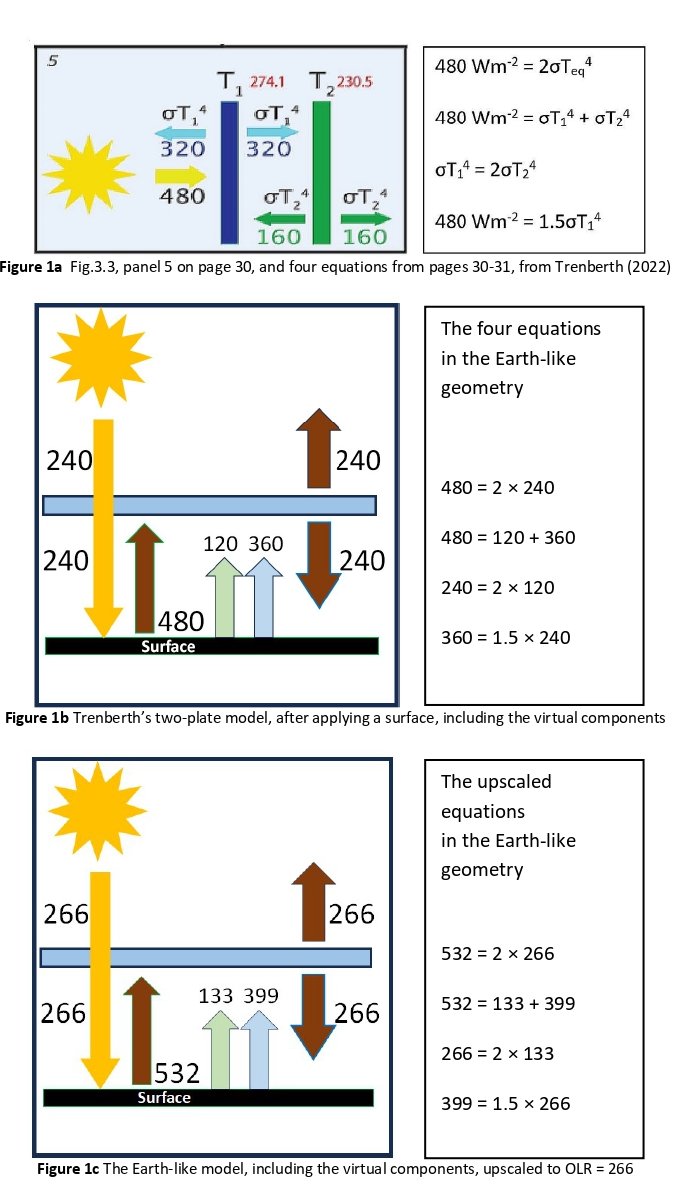
Our Figure 1a shows Panel 5 of Fig. 3.3 from Trenberth (2022, page 30), and the four equations (pages 30-31): incoming solar = 480, first plate equilibrium state = 240, first plate final state = 320, greenhouse effect = 320 – 240 = 80 [Wm-2].
In Figure 1b we show the geometry in the Earth-like case: incoming solar = 240; surface equilibrium state = 240; outgoing LW (OLR) = 240; surface final state = 360, total energy absorbed (and emitted) by the surface = 480; greenhouse effect (G) = 360 – 240 = 120. The normalized greenhouse factor of the Earth-like state is g = 120/360 = 1/3. The “virtual” components (G = 120 and Surface LW up = 360) are also included.
In Figure 1c we upscale the unit from 240 to 266, to represent the clear-sky OLR, but keeping the same ratios: incoming solar 266, outgoing LW 266, surface LW up (ULW) final state 399, greenhouse effect 399 – 266 = 133; total energy absorbed and emitted by the surface (SFC Tot) = 532, greenhouse factor = 133/399 = 1/3.
This Earth-like geometric case might be compared to CERES EBAF Edition 4.2 version 2 data (23-year mean): surface LW up (ULW) = 398.82, outgoing LW (clear-sky OLR) = 265.95, greenhouse effect (G) = 132.80 [all units Wm-2], so the greenhouse factor is g(clear-sky) = 132.80/398.82 = 0.33313. Notice that the geometric ratio of 1.5OLR = ULW is reproduced with a difference of 0.1 Wm-2 in the real-Earth global mean energy flow system.
This close equivalence between the real-Earth data and the geometric system rises the question: does this similarity apply only the flux components involved in the greenhouse effect, or can it be extended to other irradiances?
After a thorough historical and theoretical investigation we find that the original radiative equilibrium model may be applied to radiative-convective equilibrium conditions as well, and the convective flux component also finds its place in the global mean integer ratio system.
This result encourages us to extend the geometric system further, by including other (shortwave and longwave) components into the clear-sky global mean integer ratio system, and the comparison with CERES data verifies these attempts.
As an unexpected gift for our efforts, solar reflection at the top of the atmosphere (TOA) proved to be occupying an integer position in the clear-sky, with a convincing accuracy of 0.1 Wm-2 difference.
For our greatest surprise, this clear-sky integer ratio system may be transformed into an all-sky energy flow system in the global mean, by observing that the longwave cloud radiative effect (LWCRE) does not simply connect clear-sky OLR to all-sky OLR at TOA (and clear-sky downward longwave radiation, DLR, to its all-sky counterpart at the surface), but serves as the pacer, or pace-maker, of the whole clear-sky and all-sky energy flow systems as unit flux, both for the shortwave and the longwave irradiances — and, finally, for the non-radiative (convective) flux components as well.
Establishing the ultimate connection between the geometric system and the real-Earth global mean energy flow system, the recognition that the all-sky solar reflection at TOA also fits into the integer ratio structure allows to assign a definite position to total solar irradiance (TSI), thus completing the arithmetic description.
In the Supplementary Material (video presentation) [2] we document the whole process of the comparison of the geometric and the real-Earth data; we give a detailed deduction of the observed energy flow system starting from the simplest geometric greenhouse model and introducing the realistic features step by step in the course of the deduction; compare the results to available datasets like the CERES two decades of satellite observations, IPCC assessments and the 30+ years of GEWEX global energy and water cycle research. Finally, a theoretical background is offered in form of four equations, based on Schwarzschild’s two-stream radiative transfer relationships.
So the “philosophy” is: First principles define the governing equations; the governing equations define the global mean radiation process; the radiation process defines both the net and the total radiation at the surface; the net radiation at the surface defines the convective process and the total radiation defines the blackbody emission of the surface; together, the convective process and the surface radiation define the atmospheric properties (water vapor, cloudiness, distribution, lapse rate) to generate and maintain the required greenhouse effect. Not the other way around.
References:
[1] Trenberth, K. E. (2022), The Changing Flow of Energy Through the Climate System. Cambridge University Press. ISBN: 978-1-108-97246-8
[2] Zagoni, M. (2024): Trenberth’s (2022) Greenhouse Geometry. EGU General Assembly 2024, Vienna, Austria, 14–19 Apr 2024, EGU24-7, https://doi.org/10.5194/egusphere-egu24-7 and Supplementary Material (video):
https://www.earthenergyflows.com/Zagoni-EGU2024-Trenberths-Greenhouse-Geometry_Full-v03-480.mp4
Supplementary URL: https://earthenergyflows.com/
 - Indicates paper has been withdrawn from meeting
 - Indicates an Award Winner