Monday, 13 January 2025: 1:45 PM
334 (New Orleans Ernest N. Morial Convention Center)
Michael A. Palecki, NOAA/NESDIS/NCEI, Asheville, NC
The first two stations in the U.S. Climate Reference Network (USCRN) were commissioned in the Asheville, North Carolina, area during December 2000. By early 2006, a robust 60% of the CONUS portion of the network was in place, with the final target of 114 stations achieved in 2008. The following year, the installation of soil moisture observation instruments began in the CONUS, and was completed in 2011. The expansion of the USCRN to Alaska has resulted in 25 additional station installations without soil moisture. Therefore, a set of time series of triple redundant, research quality air temperature, precipitation, and conterminous U.S. (CONUS) soil moisture/temperature is now available over a considerable time period. Hundreds of scientific studies have utilized USCRN observations for validation of remotely sensed and modelled data, or as input to regionally specific applications.
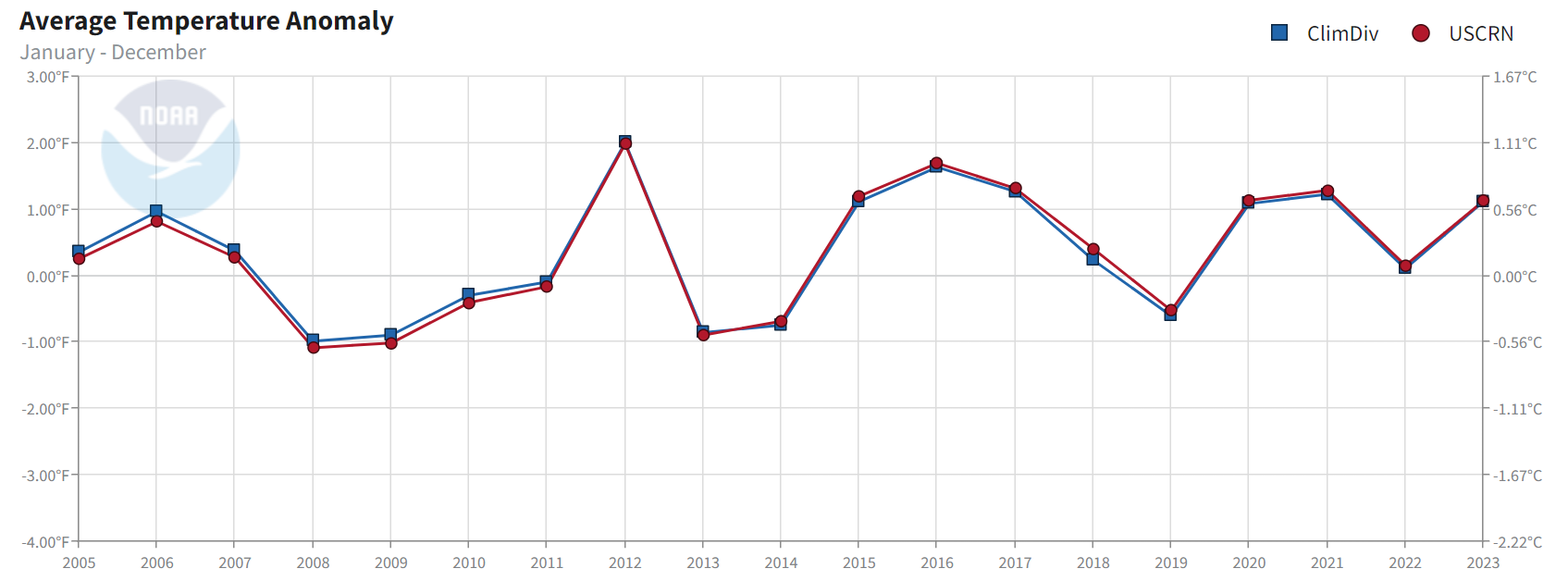
This presentation will discuss the basic tendencies in temperature, precipitation and soil moisture seen in the CONUS from 2005 onward, and also changes in extremes over the period. There have been substantial upward trends in CONUS annual average air temperature and precipitation from 2005 to 2023. Trends are not notable in soil moisture on a national basis. All three primary variables demonstrate variations in the frequency of extreme events that are quite substantial, especially at a regional level. Importantly, the unadjusted temperature anomalies of the USCRN network correspond well to those of the homogenized standard set of thousands of station observations, confirming the validity of the approaches used in making these adjustments over their longer period of record. Finally, new time series of climate extremes derived from USCRN observations will be presented and their findings discussed.

- Indicates paper has been withdrawn from meeting

- Indicates an Award Winner
