
Monday, 13 January 2025: 8:45 AM
229 (New Orleans Ernest N. Morial Convention Center)
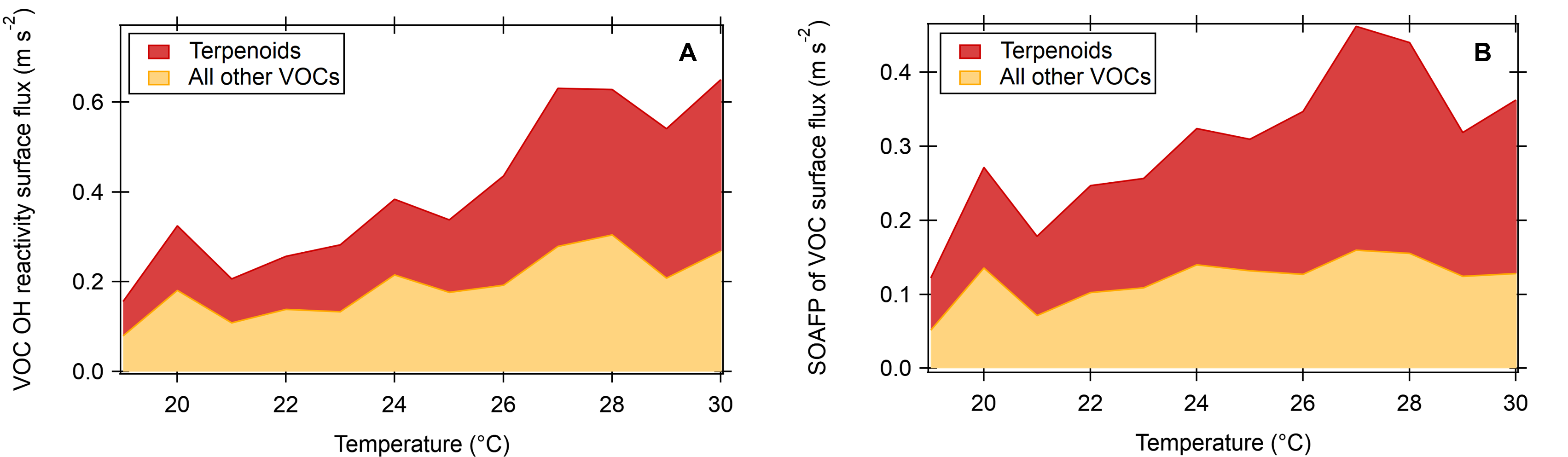
Despite declines in transportation emissions, air pollution in urban North America and Europe remains at unhealthy levels. This has challenged conventional understanding of the sources of their volatile organic compound (VOC) precursors. Using airborne flux measurements to map emissions of an unprecedented range of VOCs, we demonstrate that biogenic terpenoid emissions account for ~60% of emitted VOC OH reactivity, of ozone, and of secondary organic aerosol formation potential in summertime Los Angeles, and that this contribution strongly increases with temperature. This implies that NOx control is the most promising way to reduce ozone formation in Los Angeles. We also show that some important anthropogenic VOC emissions increase with temperature, an effect which is not represented in current inventories. Efforts to mitigate urban air pollution need to take into account that climate warming will strongly change emission amounts and composition.
 - Indicates paper has been withdrawn from meeting
 - Indicates an Award Winner