
Handout (852.4 kB)
Accurate observation of atmospheric water vapor with high temporal resolution is critical to improve the forecasting of cumulonimbus clouds and mesoscale convective systems. To achieve this goal, we have developed a ground-based microwave radiometer, named KASMI (Minowa et al., 2025), which passively observes atmospheric radiation with 44 channels from 18 to 26 GHz to estimate precipitable water vapor and vertical profiles of water vapor density through machine learning technique.
Brightness temperature is a fundamental variable observed by ground-based microwave radiometers and is necessary for accurate estimation of atmospheric water vapor and temperature (e.g., Araki et al., 2015). In general, brightness temperature is derived from interpolating received radiation intensities with relationship between liquid nitrogen and black body temperature at the calibration of the radiometer. Since the characteristics of the radiometer's received intensity change over time, semi-annual calibration with liquid nitrogen is recommended for accurate brightness temperature observations. This calibration, however, would be difficult in remote observation sites or during prolonged ship-based observations. To solve this problem, we developed a machine-learning method for estimating brightness temperature that eliminates the need to calibrate microwave radiometers using liquid nitrogen.
Method and Data
In this study, we developed a supervised machine learning model using Principal Component Analysis (PCA) and multiple regression analysis. The KASMI was installed at the Meteorological Research Institute (36.05°N 140.13°E) and have observed microwave intensity and surface air temperature, pressure, and relative humidity with attached weather sensor. These data underwent PCA, producing new coordinate axis data.
Using the 'am' radiative transfer simulator (Paine, 2019), brightness temperature was calculated from hourly ERA5 data as training data. Machine learning was performed with new coordinate axis data from March to April 2024 as the explanatory variable for multiple regression analysis and the objective variable as the brightness temperature of “am” at one frequency. 44 machine learning models were created for the number of KASMI observation frequencies.
The results of the 44 machine learning models were evaluated using brightness temperature derived by ERA5 for May 2024. Observation data obtained from a microwave radiometer RPG-HATPRO-G5 (RPG) were also compared. In HATPRO, brightness temperatures at five frequency pairs with differences below 0.1 GHz were used for comparison (Table 1). Since rain causes errors in microwave radiometer observations, quality control was performed by removing data for 8 hours before and after the time rain was observed by the rain sensor attached to KASMI in both training and evaluation.
Results
Scatter plots of brightness temperatures estimated from KASMI compared with those of ERA5 and HATPRO are shown in Figs. 1a and 1b. For ERA5, the Root Mean Square Error (RMSE) and the bias were respectively 2.61 K and -0.72 K. The correlation coefficient (r) was 0.98. As for HATPRO, the RMSE, bias, and r were 2.11 K, 0.36 K, and 0.98, respectively, suggesting a strong positive relationship between the data of KASMI and that of both ERA5 and HATPRO.
Brightness temperature obtained by KASMI shows some outliers compared to that by ERA5 and HATPRO (Figs. 1a and 1b). It has been noted that the presence of cloud water affects the accuracy of microwave radiometer observations. In order to confirm the accuracy when the effect of cloud water is excluded, we also validated the data from the infrared radiometer attached to HATPRO with cloud base temperature of less than 0°C (Fig. 1c, d). As a result, the RMSE, bias, and r of brightness temperature by KASMI for ERA5 data were 2.39 K, -0.6 K, and 0.98, respectively. For HATPRO data, the RMSE, bias, and r were respectively 1.62 K, 0.7 K, and 0.99. This result indicates that the machine-learned brightness temperature in this study has high estimation accuracy in the absence of cloud water.
Through the case study, machine learning method using KASMI was validated (Fig. 2), and brightness temperature from KASMI tended to be similar in time to that from ERA5 and HATPRO. In addition, brightness temperatures by KASMI and HATPRO analyzed more detailed temporal variation than ERA5. In each data, the brightness temperatures of the channels sensitive to water vapor increased before precipitation, but differences were observed in the brightness temperatures of KASMI and HATPRO. A possible reason for this difference could be the presence of cloud water, but further detailed investigation is needed.
Conclusions
We proposed a machine learning method to estimate the brightness temperature using KASMI. In absence of cloud water, KASMI's brightness temperature could be estimated with accuracy comparable to ERA5 and HATPRO.
Applying this method potentially allows for accurate brightness temperature estimation remotely or even on ships, by updating the machine learning models without the need for calibration with liquid nitrogen. This could significantly reduce the maintenance costs associated with ground-based microwave radiometer observation systems.
References
Araki, K., M. Murakami, H. Ishimoto, and T. Tajiri, 2015: Ground-based microwave radiometer variational analysis during no-rain and rain conditions. SOLA, 11, 108–112.
Minowa, M., Y. Takashima, T. Sakaguchi, K. Araki, and A. Kuwano-Yoshida, 2025: Development of a compact microwave radiometer for water vapor estimation with machine learning method. Presented at the Annual Meeting of the American Meteorological Society, 12-16 Jan., New Orleans, LA.
Paine, S., 2019: The am atmospheric model (v. 11.0). https://zenodo.org/records/3406496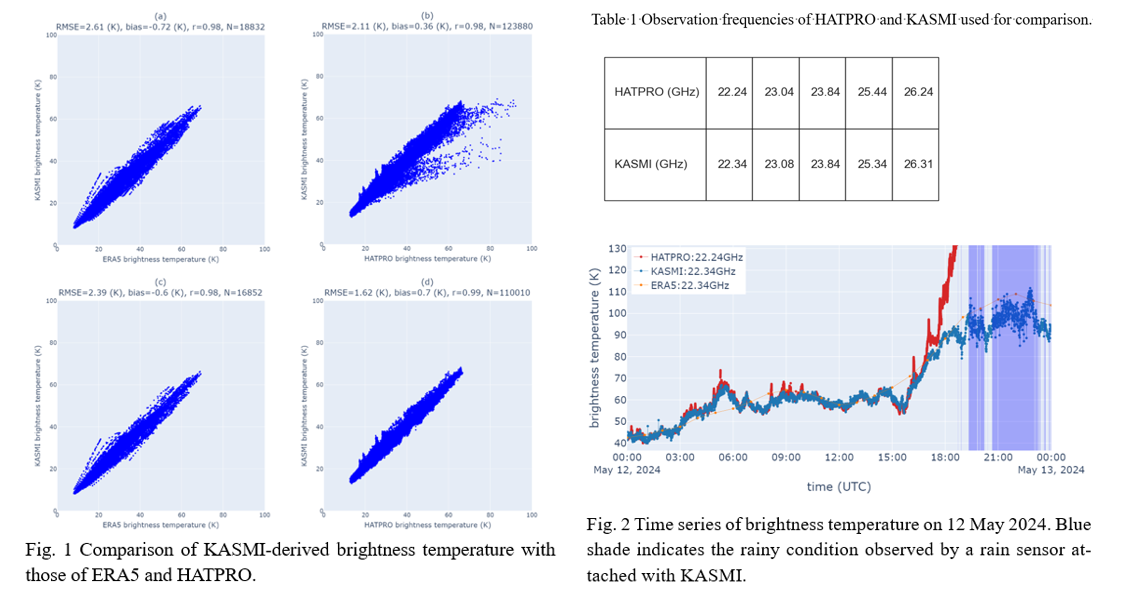
Supplementary URL: http://furuno-weather.com/portfolio/02_index_vapor_01.html
 - Indicates paper has been withdrawn from meeting
 - Indicates an Award Winner