
Tuesday, 14 January 2025: 4:30 PM
226 (New Orleans Ernest N. Morial Convention Center)
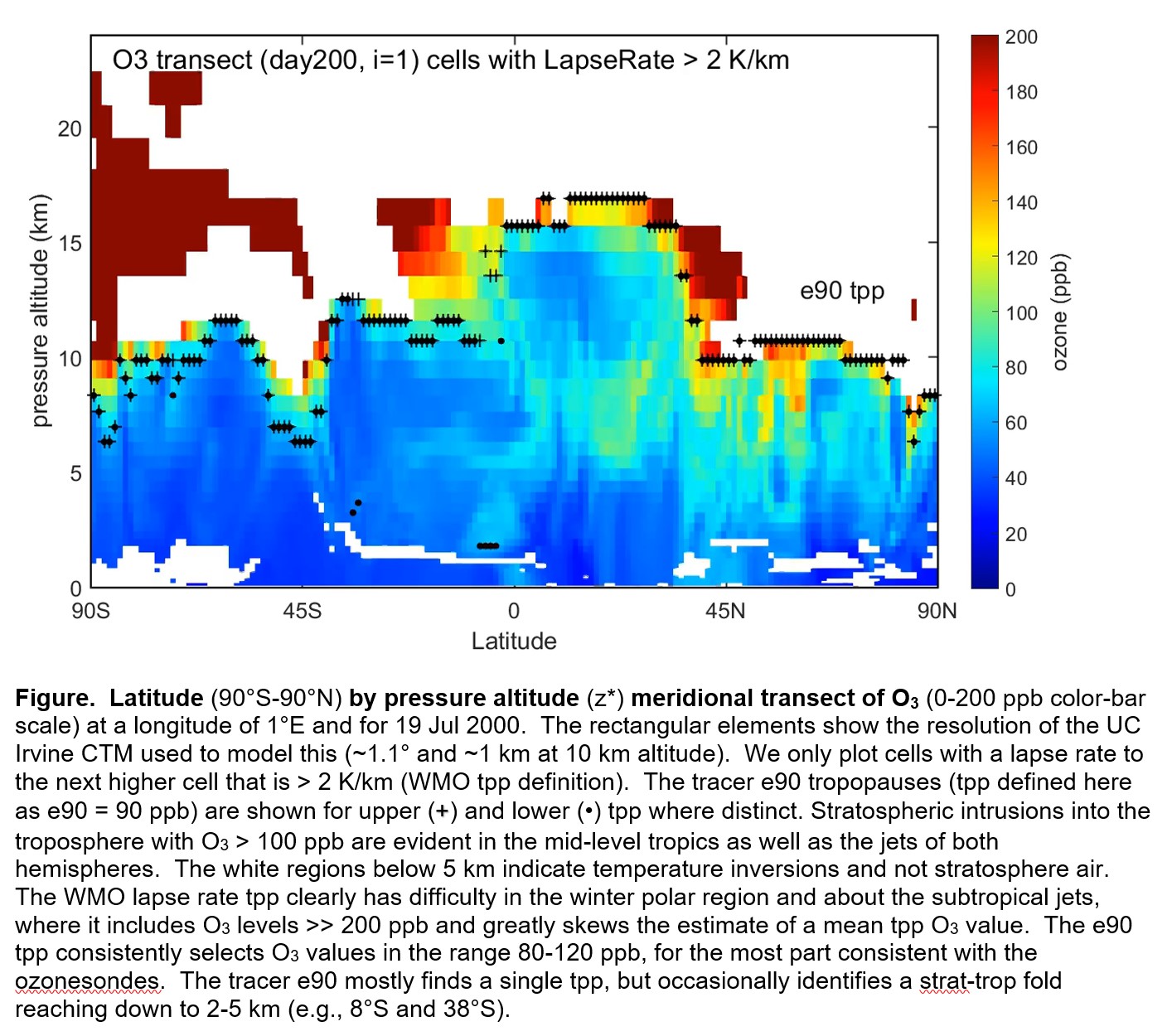
The tropopause (tpp) boundary separating troposphere and stratosphere is a useful demarcation between two very different chemical regimes, each with its own problems of anthropogenic pollution, and each with its own responses to climate change. If we want to track atmospheric composition (i.e., trace gas burdens, production, loss, exchange) and separate causes of global change in atmospheric chemistry, then we need a clear and consistent boundary definition that can be used in diagnosing observations and models. The established thermal (WMO) tropopause boundary is defined by the temperature lapse rate and is measured globally with balloon sondes, but there are known problems with identifying the lapse rate tropopause (LRT) in polar regions and around the sub-tropical jet. See Figure. A dynamical tropopause based on potential vorticity (PVT) provides a solution to the LRT problems near the poles and jet, but it cannot be used in the tropics and has a somewhat arbitrary calibration. A promising new approach based on the vertical gradient of potential temperature (PTGT) has been recently calibrated using trace-gas patterns (ozone and water vapor). For models, one expedient approach uses a synthetic trace gas (e90), whose decay measures the average age of the air since being emitted at the Earth's surface. The e90T method has several advantages: it truly measures a mixing gradient; it provides a property designation (stratosphere vs. troposphere) for each air parcel that is not based on gradients calculated from neighboring parcels. Unfortunately, it has a serious flaw: it is not an observable, real species. Here we merge modeled and observed near-tropopause quantities, seeking to calibrate the synthetic e90 tracer, and then we use it to test the consistency of the physically observed quantities in defining the tropopause mixing barrier.
 - Indicates paper has been withdrawn from meeting
 - Indicates an Award Winner