
High Spectral Resolution (monostatic) Lidars (HSRLs) are capable of separating aerosol and molecular backscatter, permitting an accurate and unambiguous measurement of the aerosol backscatter coefficient (βa) [2]. To date, such systems primarily operate at 532nm [3], although there are efforts to extend this capability to 1064nm as well. Most existing systems include a 1064nm channel and also include a measurement of the (de)polarization in the 532nm backscatter channel (∆532). Such systems provide two primary signatures for characterizing the aerosol type: “color ratio” (βa,1064/ βa,532) and depolarization. In principle, they also provide a measurement of the extinction α a,532, but with somewhat lower accuracy. Even with more capability (such as multiple wavelengths), typing of the aerosols with a monostatic system is underdetermined [4]. The late Michael Mishchenko pointed out that adding a secondary receiver would provide significant additional information in the form of Mueller scattering matrix elements [5, 6], of which there are five quasi-independent non-zero elements per wavelength (four when normalized). These parameters, which are accessible even at modest off-axis angles (10-30°), are highly sensitive to aerosol size, shape, and complex index of refraction, adding discrimination features for identifying aerosols at each altitude. Depending on the requirements, the cost of adding an additional receiver is relatively modest, perhaps <10% of the cost of the HSRL itself.
We report here on measurements acquired in coordination with the HSRL operated by University of Wisconsin Lidar Group in Madison using a nearby secondary ground-based BiPAL receiver. The BiPAL system was installed in June 2024 with the goal of acquiring as much data as possible. This presentation will describe the BiPAL instrument and present an analysis of the data along with that of the HSRL and other local sensor networks.
1 Reagan JA, et al., IEEE Trans. on Geosci. and Remote Sens. GE-20(3), p229 (1982)
2 Eloranta, EW, et al., Opt. Eng., 30(1) p6 (1991)
3 Razenkov, II, et al., EPJ Web of Conferences 176, 01024 (2018)
4 Chemyakin, E., et al., Appl. Opt., 55 (9) p2188 (2016)
5 Alexandrov, M.D., and Mishchenko, M.I., Opt. Expr., 25 (4), pA134 (2017)
6 Mishchenko, M.I., et al., J. of Quant. Spect. and Rad. Trans., 184, p180 (2016)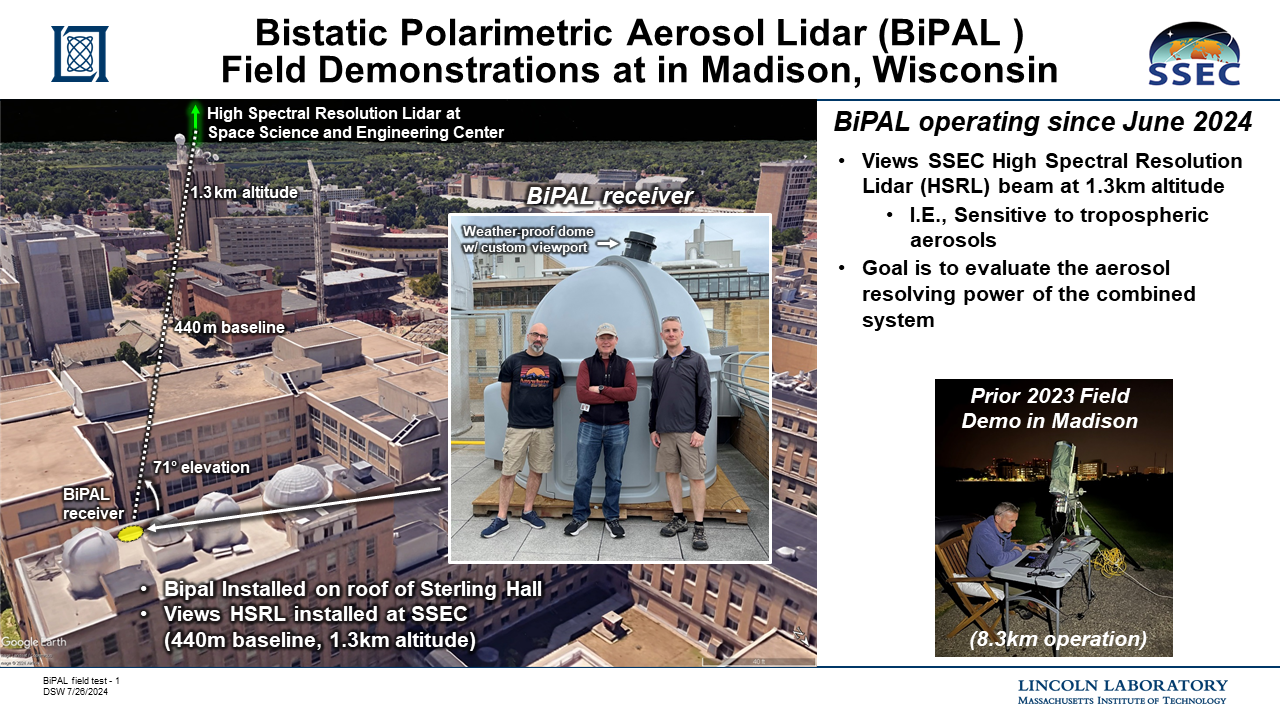
 - Indicates paper has been withdrawn from meeting
 - Indicates an Award Winner