
This study analyzes the potential root causes of the striping in NOAA-20 M1 SDR images, focusing on two factors: (1) polarization effect induced striping over clear-sky oceans, and (2) imperfect on-orbit radiometric calibration induced striping. According to the prelaunch test data, the differences in NOAA-20 VIIRS M1 detector level relative spectral response functions (RSR) are small. On the other hand, M1 is more sensitive to the polarized lights compared to other VisNIR bands, as well as compared to the VisNIR bands on the Suomi NPP and NOAA-21 VIIRS. The polarization sensitivity of NOAA-20 M1 varies strongly with detectors and scan angles, up to ~6.4%. The M1 top of atmosphere radiance is dominated by Rayleigh scattering and can be up to ~70% polarized. In this study, the impact of polarization effect on M1 striping was analyzed using radiative transfer simulations and a polarization correction method used by the NOAA ocean color team (Sun et al. 2019). M1 Stokes vectors (I, U, V) at representative solar illumination and sensor view geometries, wind speed, and surface pressures were simulated using the Second Simulation of a Satellite Signal in the Solar Spectrum Vector Code, version 1.1 (6SV) and M1 band averaged RSR. Stokes vectors for individual M1 observations were interpolated using the 6SV simulated data and NASA MERRA reanalysis data. Muller matrix components, which describe the interaction between polarized light and optical system, were derived using prelaunch measured polarization amplitudes and phase angles. Our results suggest that the M1 striping can be reduced from up to 3.5% to ~1.5% or less at near nadir aggregation zone (±31.7°) over clear-sky oceans, after applying the polarization correction.
After the correction of the polarization effect, residual NOAA-20 M1 striping patterns over clear-sky oceans suggests that there may exist Half Angle Mirror (HAM)-side and detector dependent striping, potentially caused by imperfect on-orbit radiometric calibration with solar diffuser. HAM-side and detector dependent striping correction factors were derived using Deep Convective Cloud (DCC) observations (low gain, high radiances) and verified over the Libyan-4 site (low gain, mid-level radiance). Both DCC and Libyan-4 Earth targets are not significantly affected by the polarization effect. After the correction of the polarization effect, the DCC-based striping correction factors can further reduce striping over clear-sky ocean scenes by ~0.5%. Moreover, the magnitude of residual striping in M1 becomes similar to those in other NOAA-20 VisNIR bands. Note that the polarization correction and DCC-based striping correction are independent of each other. The polarization correction method used in this study works only over clear-sky oceans dominated by the Rayleigh scattering radiance, and it cannot be applied during the operational SDR processing. On the other hand, the DCC-based M1 striping correction factors work well at all radiance levels and can be deployed operationally to improve the quality of the NOAA-20 M1 SDR product.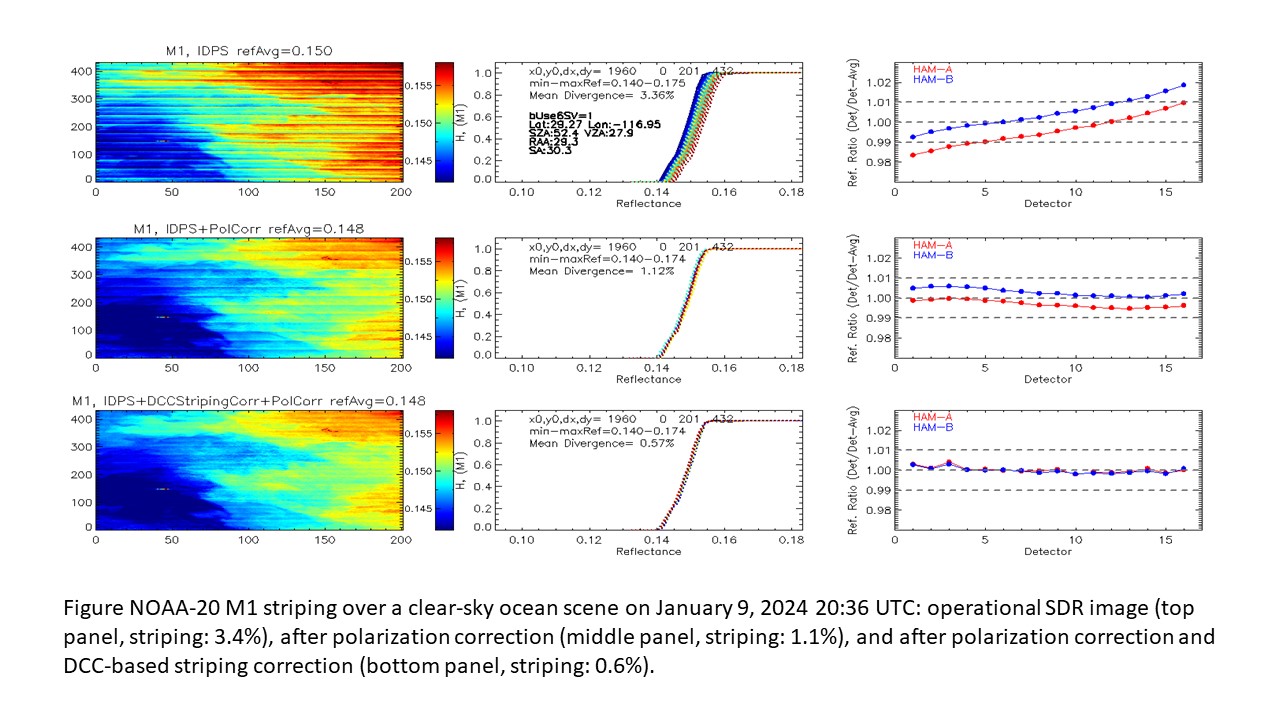
 - Indicates paper has been withdrawn from meeting
 - Indicates an Award Winner