
The underlying processes of RIEs remain as an active research field, and characterization of RIEs has been reported by several authors in terms of global distribution, local time and solar cycle variations. A commonly used algorithm for RIE correction in the DA system is called kappa-method, which expresses the bending angle RIE as a function of a squared difference of the bending angles observed from two RO frequency bands. The kappa-method relies on the climatological model of ionosphere electron density to produce the RIE distribution and variation. An alternative method is presented in this study for estimating the RIE, which derives the RIE empirically on a profile-by-profile basis. The new method, called vertical-gradient method, is based on the vertical derivative of each RO excess phase profile itself and extracts the empirically determined RIE value to the measurements in the lower atmosphere. The vertical-gradient method takes into account the fact that radio wave propagation in the ionosphere can have both bending and phase advance effects in a homogeneous and multi-path environment. It is fundamentally different from the kappa-method that assumes only the ionospheric bending effect. As a result, the RIEs derived from the vertical-gradient method can have both positive and negative values with a strong day-night variation. The mean RIE values are generally < 2 microrad with large latitude dependence. The standard deviation of RIE can be greater than its mean in some local-time and latitude bins.
RIE impacts are evaluated by comparing the data from experiments using the Goddard Earth Observing System (GEOS) DA system with and without the RIE. The RIE impacts on the DA temperature were found mostly in the polar stratosphere with a bias as large as 2-4 K at 1 hPa and ~1 K at 10 hPa. There is a small (±0.3 K) temperature bias in the troposphere. The diurnally varying RIE does not appear to impact on the migrating tides in the upper stratosphere and mesosphere, because the tidal waves are locked to the solar forcings from the lower atmosphere. RIE impacts were also found in the RO excess phase measurements where the observed profile is compared with an expected exponential decrease with height. In addition, RIEs are likely responsible for artificial solar cycle variations in the small-scale GW variance of temperature retrievals (see attached figure from MetOp RO temperature at 67.5S). In both cases, the RIE amplitudes appear to increase with height and become a significant source of error in the upper stratosphere. The findings from this study further emphasize the needs to treat RIEs carefully, especially with the growing infusion of commercial GNSS-RO data for climate studies.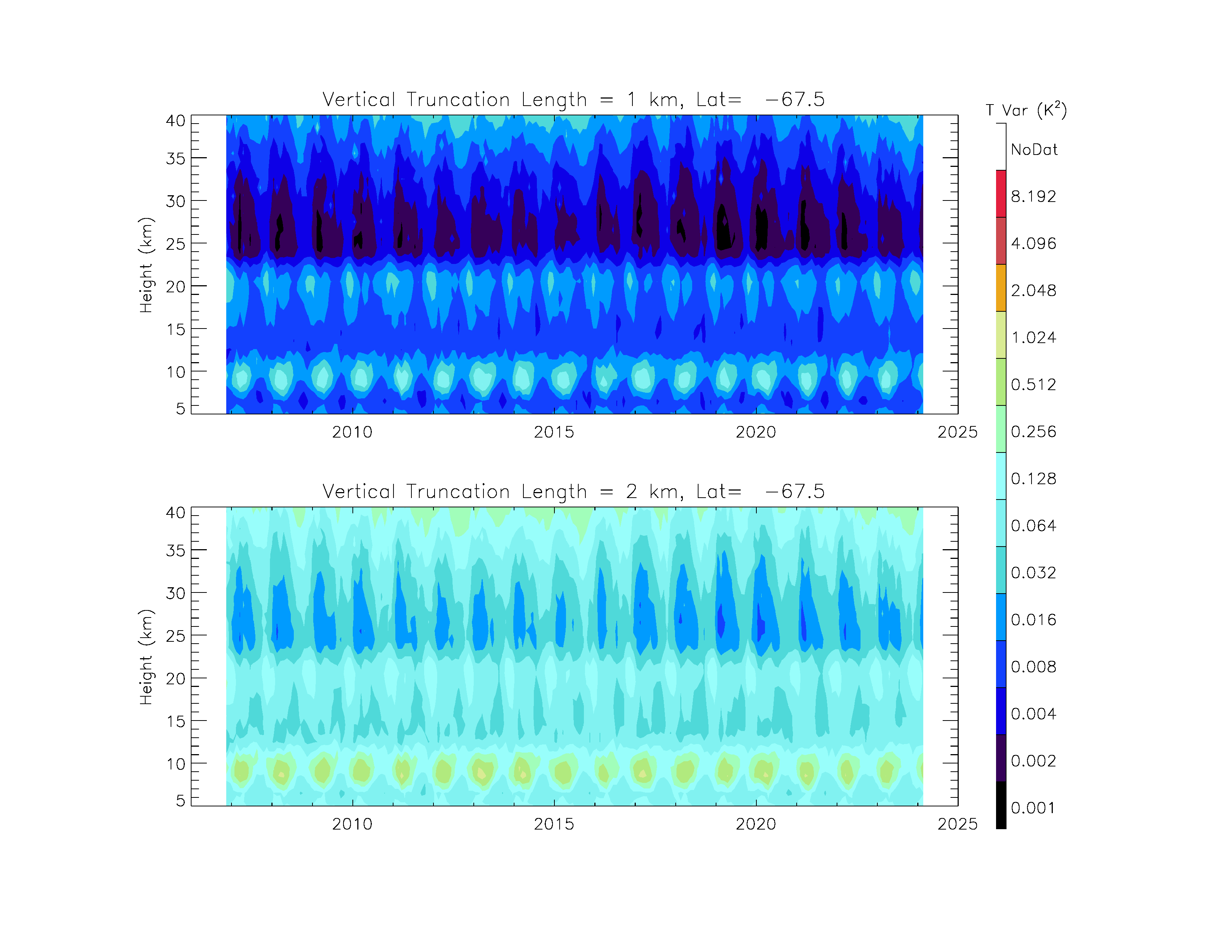
 - Indicates paper has been withdrawn from meeting
 - Indicates an Award Winner