
The Orbiting Carbon Observatory 3 (OCO-3), launched to the International Space Station (ISS) in 05/2019, has been making routine measurements of column average CO2 dry air mole fraction (XCO2) and solar-induced chlorophyll fluorescence (SIF). OCO-3 observes globally between sunrise and sunset within a latitude band of ±52°, a limit imposed by the inclination of the ISS orbit. Originally built as a spare copy of the OCO-2 sensor, the OCO-3 spectrometer is nearly identical to that of OCO-2 but includes external modifications to facilitate operation on the ISS, most notable a Pointing Mirror Assembly (PMA) to flexibly position the instrument optics at specific locations on the Earth’s surface. Owing to the PMA, OCO-3 capabilities include a Snapshot Area Map observation mode, primarily dedicated to mapping polluted urban environments and other localized emission hotspots, like volcanoes, power plant facilities, etc. They typical size of an OCO-3 Snapshot Area observation is 80×80 km2, taken within 120 seconds. The Geostationary Environmental Monitoring Spectrometer (GEMS), launched 02/2020, and the Tropospheric Emissions: Monitoring of Pollution (TEMPO), launched 04/2023 hourly observe air quality constituents like ozone and NO2 from geostationary orbit centered over the Korean peninsula and the continental US.
We report results from near-simultaneous OCO-3 XCO2 and GEMS and TEMPO NO2 correlations over Asian and U.S. megacities using the recently released OCO-3 v11, GEMS v2.0, and TEMPO v3β data products. This includes the identification of observation pairs during the period of joint operation, temporal matching, spatial resampling onto a common grid, and XCO2–NO2 correlations in polluted environments. Selected OCO-2 XCO2 target mode observations will be included. The OCO-3 mission has been extended until “ISS end-of-life” (currently expected for 2029/30) and, after a temporary storage period of 2023/11/12 through 2024/07/04, is back in operations with all systems performing nominal. The OCO-3/GEMS and OCO-3/TEMPO co-location data records is being continuously updated as new observations become available.
The image shows OCO-3 v10.4 XCO2 and GEMS v2.0 NO2 over Seoul, Korea on 2022/04/08, taken about 23 minutes apart.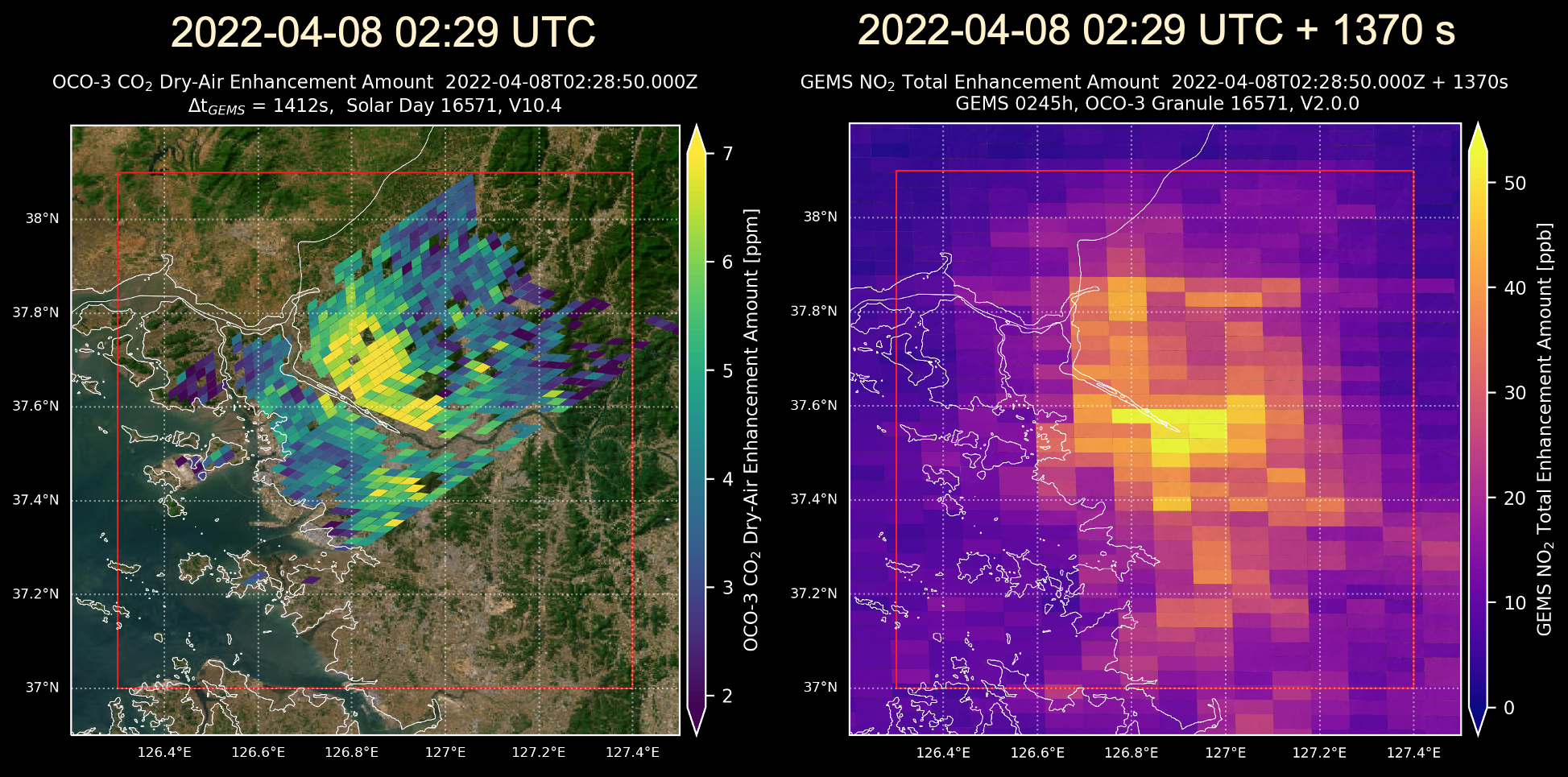
 - Indicates paper has been withdrawn from meeting
 - Indicates an Award Winner