
Connecting these dots is critical. Tropical cyclones—especially landfalling storms with high intensities—can act as “focusing events”' that draw public attention, creating unique opportunities for climate communications that influence public perceptions of climate risk and decision-making. Key for such messaging is a pre-existing attribution system that can rapidly and reliably estimate climate's influence on particular events.
Using observations, climate models, potential intensity theory, and established attribution techniques, we develop and apply a novel rapid attribution framework that quantifies the impact of historically-warming sea surface temperatures (SSTs) on observed tropical cyclone maximum wind speeds. The framework employs a storyline attribution approach exploring a comprehensive set of counterfactual scenarios and considering atmospheric variability. A range of counterfactual scenarios are used to estimate how different characterizations of historical SST warming might affect the quantification and significance of attributable changes in tropical cyclone potential and observed actual intensities since the pre-industrial period.
An application to recent North Atlantic hurricane seasons, including the recent 2024 season (e.g. Hurricane Beryl), shows that human-driven SST warming is already responsible for robust increases in recent hurricane intensities. Hurricanes during the past five seasons were up to a Saffir-Simpson category faster, on average, than they would have been in a world where SSTs had not been warmed by climate change. We will conclude by considering the framework’s limitations, and discuss future communication goals using tropical cyclone attribution science.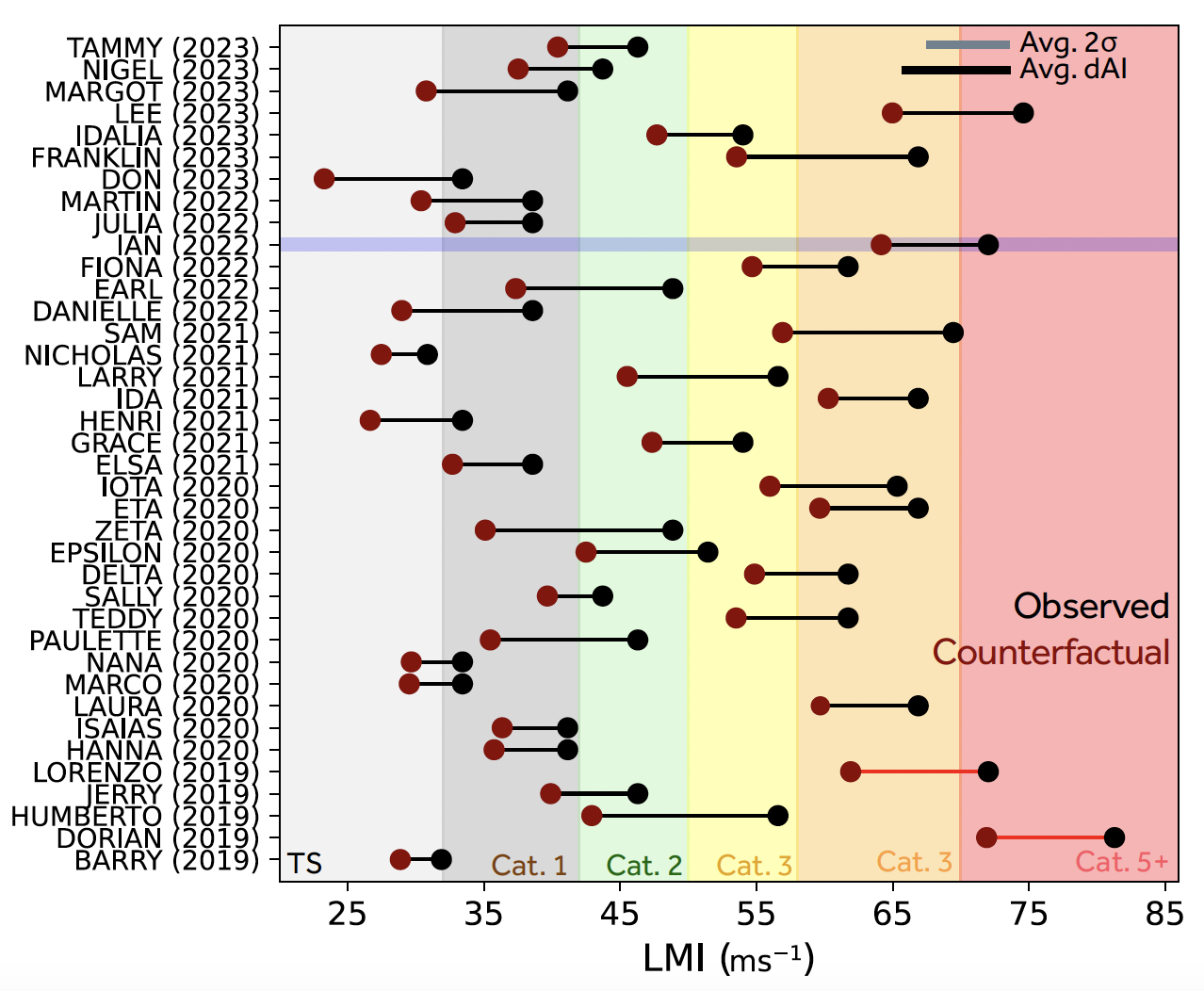
 - Indicates paper has been withdrawn from meeting
 - Indicates an Award Winner