
Monday, 13 January 2025: 9:45 AM
339 (New Orleans Ernest N. Morial Convention Center)
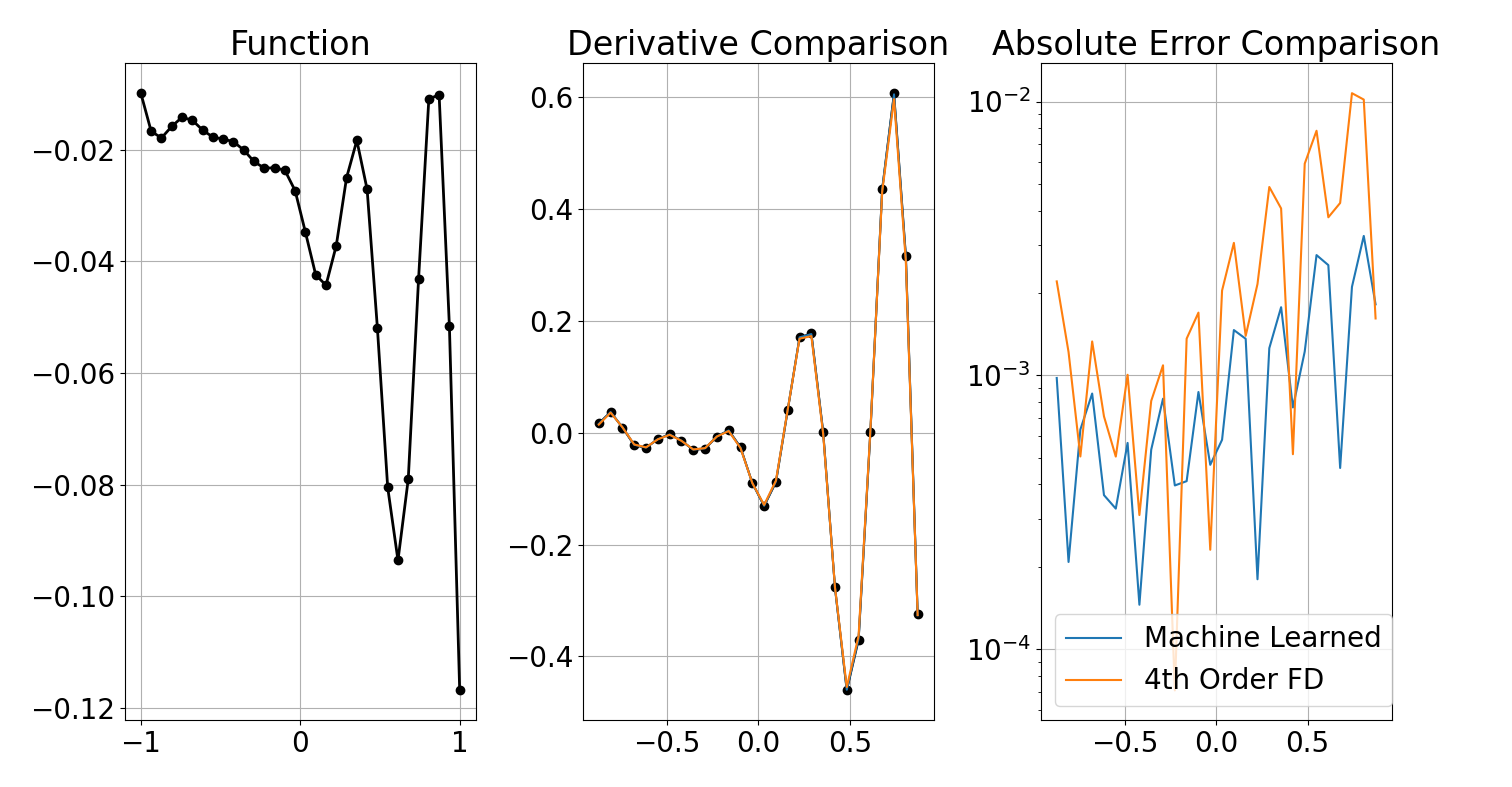
As we encounter a moment of rapid adoption of Machine Learning (ML) as an alternative toolkit for the forecasting of environmental systems, questions remain about the interpretability and physicality of end-to-end ML forecasting engines. In order to continue an effort to bring greater interpretability and adoption of ML techniques, we present a framework for equivalence between Convolutional Neural Network (CNN) and Graph Neural Network (GNN) architectures and discrete calculus operators on 2-D uniform and 2-D unstructured grids respectively. We are able to cast numerical differentiation in the context of Symbolic Regression models where constraints and desired properties (improved dispersion) can be directly incorporated into the regression sequence of an ML setup. The data training pairs are generated from closed analytical expressions in the form of functions and their derivatives and the spectral content of the data is controlled such that oscillations are always well resolved in the sampling. We present several examples of differencing schemes and other existing discretization methods that are tuned via ML training regression to achieve greater accuracy in approximating derivatives and more favorable dispersion profiles related to transport. This targeted, small-data approach can improve upon existing NWP models in a minimally invasive manner using modest computational resources.
 - Indicates paper has been withdrawn from meeting
 - Indicates an Award Winner