
By varying flow rates, wind speeds, and misted area ratios, we examined the effects of mister systems on mitigating human thermal stress, and proposed optimization strategies to maximize cooling performance from the perspectives of urban microclimate and mister system design. Our tests confirm that misters can considerably reduce maximum urban canyon air temperature (up to 17.5°C) and human skin temperature (up to 0.48°C) in a hot and dry city (Phoenix, AZ). They continue to effectively reduce thermal stress, albeit with half of the cooling benefits, in a hot and humid city (Houston, TX). Notably, these thermal stress impacts are contingent upon wind speeds: an intermediate wind speed is optimal for mitigating thermal stress in a misted street, based on the non-monotonic relationship (‘U-shaped’ curve) between temperature reduction and wind speeds. The optimal wind speed depends on the specific flow rate: higher flow rates (e.g., 1 L/min) require a more ventilated environment (e.g., moderate breeze) for complete evaporation, and lower flow rates (e.g., 0.01 L/min) fits better with a calmer wind condition (e.g., light air) to preserve local cooling effects.
We then incorporate misting into a broader comparison of blue (i.e., water-based) cooling strategies, including irrigation (on vegetation) and sprinkling (on pavements). With abundant water resources, sprinkling on asphalt and misting are the most effective cooling solutions, particularly suitable for middays and late afternoons, respectively. With limited water resources, temperature-activated misting schemes can save at least 5500 kg/day of water compared to continuous misting for a 100-m stretch of street, equivalent to the water demand of five typical American households. Therefore, we examined the possibility of using misting and sprinkling as emergency measures to mitigate extreme heat only during the hottest hour. Our results show that misting and sprinkling at a sufficiently high flow rate (e.g., 1 L/min) can effectively cool down canyon air (by up to 15°C) and ground surface (by up to 28°C), respectively, within 10 minutes. These results can be of significance for urban planners, water engineers, landscape designers, businesses, and policy makers on how to effectively use water to cool cities, proactively contributing to more comprehensive and sustainable urban blue cooling portfolios.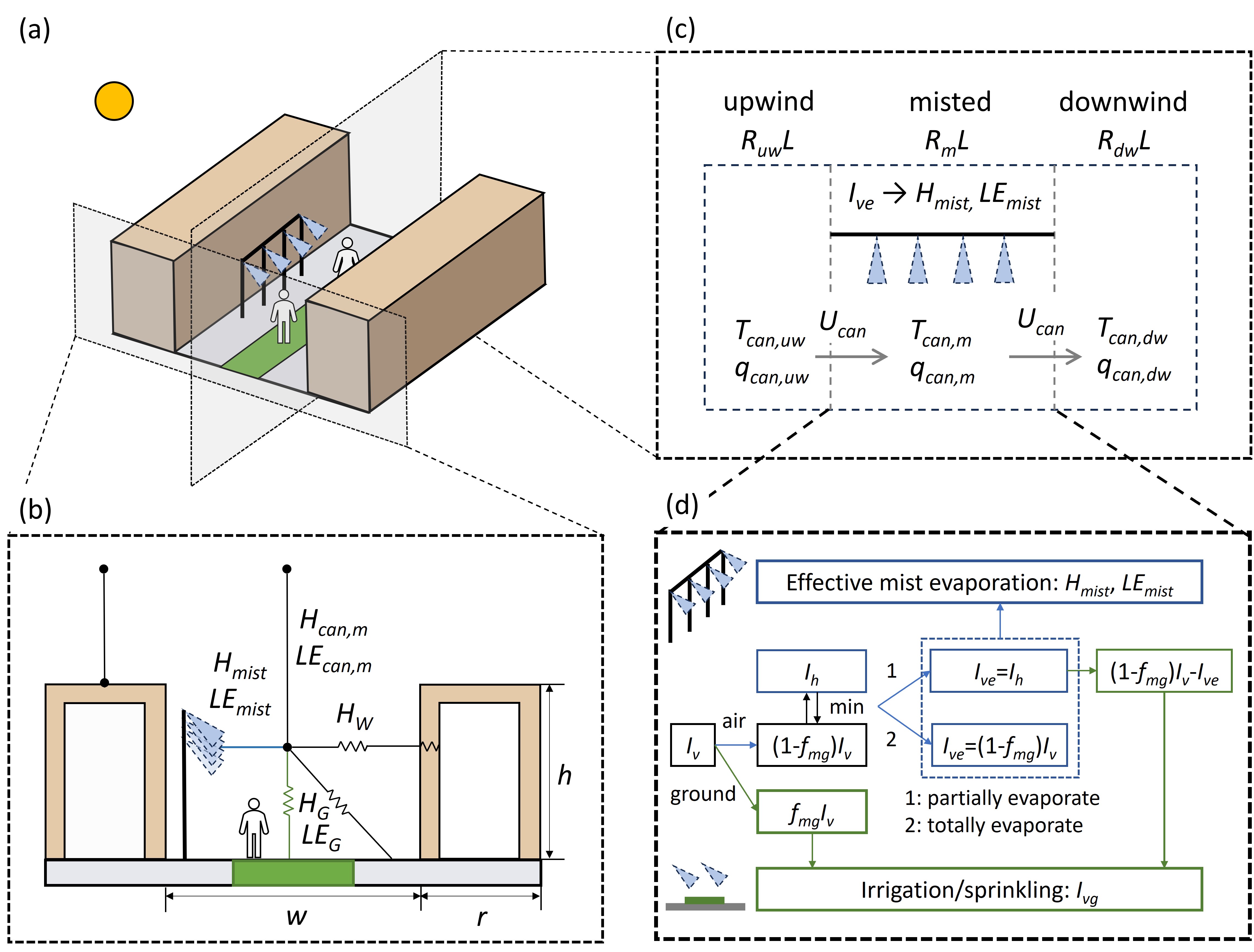
 - Indicates paper has been withdrawn from meeting
 - Indicates an Award Winner