
To meet today’s good practices for metadata indexing, discovery and interoperability, the Centre has decided to migrate its operations to the data format recommended by WMO for international exchange: GRIB edition 2. This is a complex task as it involves migrating our entire dataflow: from the I/O routines in our models to the dissemination, indexing, interpolating, archiving and plotting of data. For existing historical data, it was decided to provide on-the-fly conversion to GRIB2 to offer a consolidated, unified service to users. In a second stage, we are also planning to offer conversion to other popular formats like netCDF.
The preparatory work for the migration started in 2022 and is scheduled for completion in early 2026 with the release of IFS[9] Cycle 50r2. As the migration progresses, several datasets will be released in GRIB2, including our next Reanalysis ERA6, our next atmospheric composition reanalysis EAC5, and our new seasonal forecasting system SEAS6. This contribution will present the work accomplished so far to migrate to GRIB2, highlighting the challenges we have faced. The richness of the GRIB2 metadata will be showcased using examples taken from the upcoming ERA6, EAC5 and SEAS6 datasets and IFS Cycle 50r2.
[1] Copernicus Climate Change Service https://cds.climate.copernicus.eu/#!/home
[2] Copernicus Atmosphere Monitoring Service https://ads.atmosphere.copernicus.eu/#!/home
[3] Destination Earth European initiative: https://destination-earth.eu
[4] Meteorological Archival and Retrieval System
[5] https://platform.destine.eu/
[6] ECMWF Open data portal: https://www.ecmwf.int/en/forecasts/datasets/open-data
[7] WMO Information System 2: https://community.wmo.int/en/activity-areas/wis/WIS2-overview
[8] Software as a Service
[9] Integrated Forecasting System, ECMWF’s operational model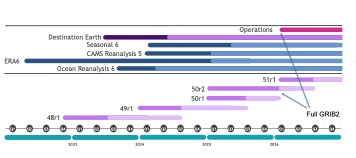
 - Indicates paper has been withdrawn from meeting
 - Indicates an Award Winner