
Thursday, 16 January 2025: 11:45 AM
343 (New Orleans Ernest N. Morial Convention Center)
When the negatively buoyant air in the cloud downdrafts reaches the surface, it spreads out horizontally, forming cold pools. A cold pool can initiate new convective cells. However, when combined with the surrounding vertical wind shear, it can also connect and upscale them into large mesoscale convective systems (MCS). Given the wide range of scales of the atmospheric phenomenon involving the interaction between cold pools and the MCS, Freitas et al. (2024) developed a cold pool edge parameterization (CPEP) to be applied in an atmospheric model with insufficient spatial resolution to explicitly resolve convection and the subcloud layer. Previous results presented in this paper indicate that the CPEP improves the organization, longevity, propagation, and severity of simulated MCS over the Amazon and other continental regions. Here, the authors have further extended the parameterization by coupling it to the MYNN surface layer scheme. In this coupling, the horizontal speed of the gust front estimated by the CPEP is used to calculate the friction velocity (u*), which significantly increases the surface fluxes between the atmosphere and the underlying surface. This new feature was then applied to simulate the recent Beryl hurricane (28 Jun - 08 Jul 2024) using the MPAS/MONAN global circulation model. Model results show a significant gain in simulation realism with the CPEP compared to the control experiment, even at horizontal resolutions as low as 50 km.
Freitas, S. R et al (2024). A parameterization for cloud organization and propagation by evaporation-driven cold pool edges. Journal of Advances in Modeling Earth Systems, 16, e2023MS003982. https://doi.org/10.1029/2023MS003982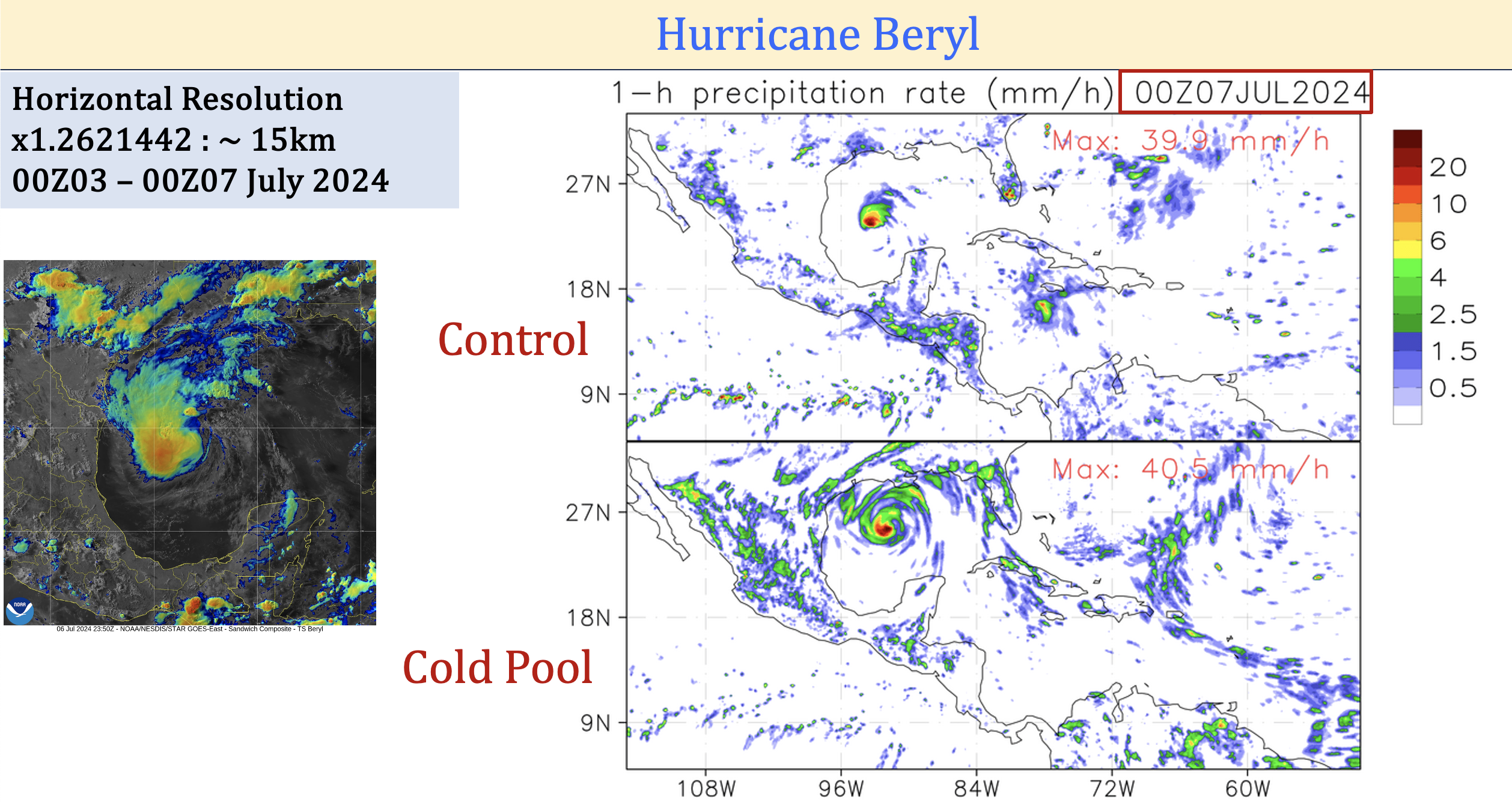
 - Indicates paper has been withdrawn from meeting
 - Indicates an Award Winner