
First, we will show the impacts of surface waves on HBL dynamics using wave-resolving LESs. It was found that the ocean waves can significantly modulate the surface layer dynamics of HBLs as shown in the attached figure. The steep waves in hurricanes were found to remarkably influence the HBL turbulence up to ~800 m away from the surface. The impacts of waves on turbulent eddies are high near the surface (up to ~100 m) as shown in the 3D spatial correlation of the attached figure. Typical low wave ages enhance surface drag and decrease the HBL wind, while higher wave ages can intensify the local surface winds. Moreover, the Turbulent Kinetic Energy (TKE) is increased by the enhanced drag of young waves, while older higher speed waves can decrease the TKE compared to the flat non-wavy case. We also found that higher wave heights, which are more prevalent in hurricanes, magnify these effects.
The implications of these results on surface layer parameterizations in large-scale hurricane forecasts will also be briefly discussed using the Weather Research and Forecasting (WRF) model. We will present that the current aerodynamic roughness length parameterizations in WRF overestimate the observational estimates and theoretical hurricane intensity models for high wind regimes over the ocean (≳ 45 m/s). By adjusting the roughness length values in WRF, we were able to improve the intensity forecasts of five strong hurricane cases (category 3-5) by more than 20% on average compared to the default models (Li et al. 2023). These insights and findings can be useful for improving hurricane forecasts in numerical weather prediction models, eventually aiding in disaster preparedness efforts.
References:
Li, M., J. A. Zhang, L. Matak, and M. Momen, 2023: The impacts of adjusting momentum roughness length on strong and weak hurricanes forecasts: a comprehensive analysis of weather simulations and observations. Mon Weather Rev, https://doi.org/10.1175/MWR-D-22-0191.1.
Momen, M., M. B. Parlange, and M. G. Giometto, 2021: Scrambling and reorientation of classical boundary layer turbulence in hurricane winds. Geophys Res Lett, 48, https://doi.org/https://doi.org/10.1029/2020GL091695.
Sabet, F., Y. R. Yi, L. Thomas, and M. Momen, 2022: Characterizing mean and turbulent structures of hurricane winds via large-eddy simulations. Proceedings of the Summer Program 2022, Stanford, Center for Turbulence Research, Stanford University, 311–321.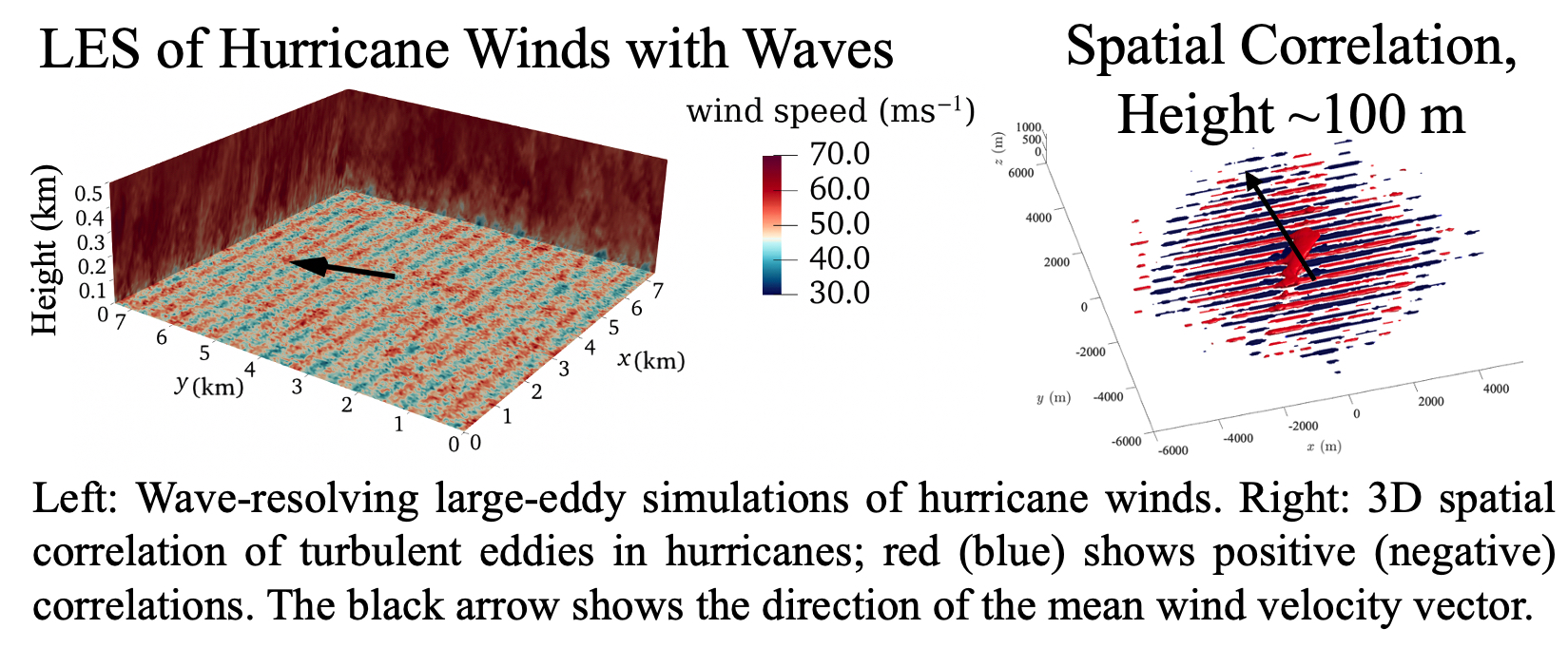
 - Indicates paper has been withdrawn from meeting
 - Indicates an Award Winner