
Tuesday, 14 January 2025: 8:30 AM
242 (New Orleans Ernest N. Morial Convention Center)
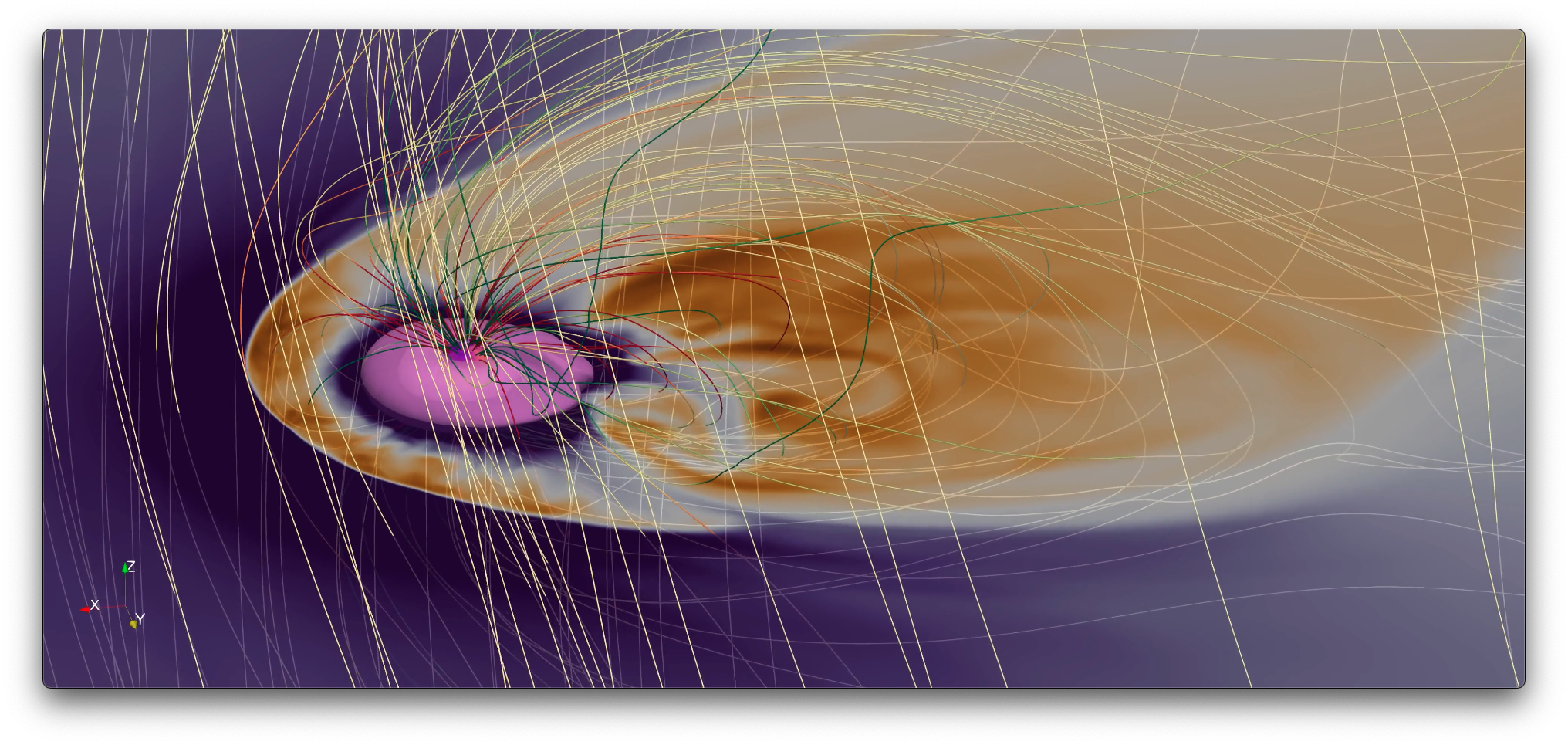
Geomagnetic storms represent a complex and non-linear action across multiple temporal and spatial scales that must be understood in order to enable accurate and reliable space weather forecasting. As one of the three DRIVE centers funded by NASA, we at the Center for Geospace Storms (CGS) are developing the Multiscale Atmosphere-Geospace Environment (MAGE) model to untangle these complex interactions. MAGE addresses three key challenges of modeling geospace dynamics: i) it describes geospace holistically; ii) it resolves critical mesoscale processes across all geospace domains; iii) it two-way couples geospace to the lower atmosphere. This presentation will highlight key results from MAGE simulations of the May 10, 2024, 'Gannon' Superstorm, a severe space weather event that tested the model's ability to capture complex geospace dynamics. We will also explore the generation of giant auroral undulations, their relationship to inner-magnetospheric instabilities, as well the sub-auroral optical emissions driven by high-energy particle injections. In addition to these findings, we will discuss the model's availability for Runs on Request at the Community Coordinated Modeling Center (CCMC) and introduce the newly released python analysis package, kaipy, which enhances the accessibility and usability of MAGE data for the research community.
 - Indicates paper has been withdrawn from meeting
 - Indicates an Award Winner