Monday, 13 January 2025: 5:45 PM
215 (New Orleans Ernest N. Morial Convention Center)
Adam Varble, PhD, PNNL, Richland, WA; and Z. Feng, A. L. Igel, J. Marquis, H. Morrison, R. Oktem, D. M. Romps, M. W. Stanford, S. Giangrande, W. W. Grabowski, J. Hardin, E. Jo, Z. J. Lebo, and J. M. Peters
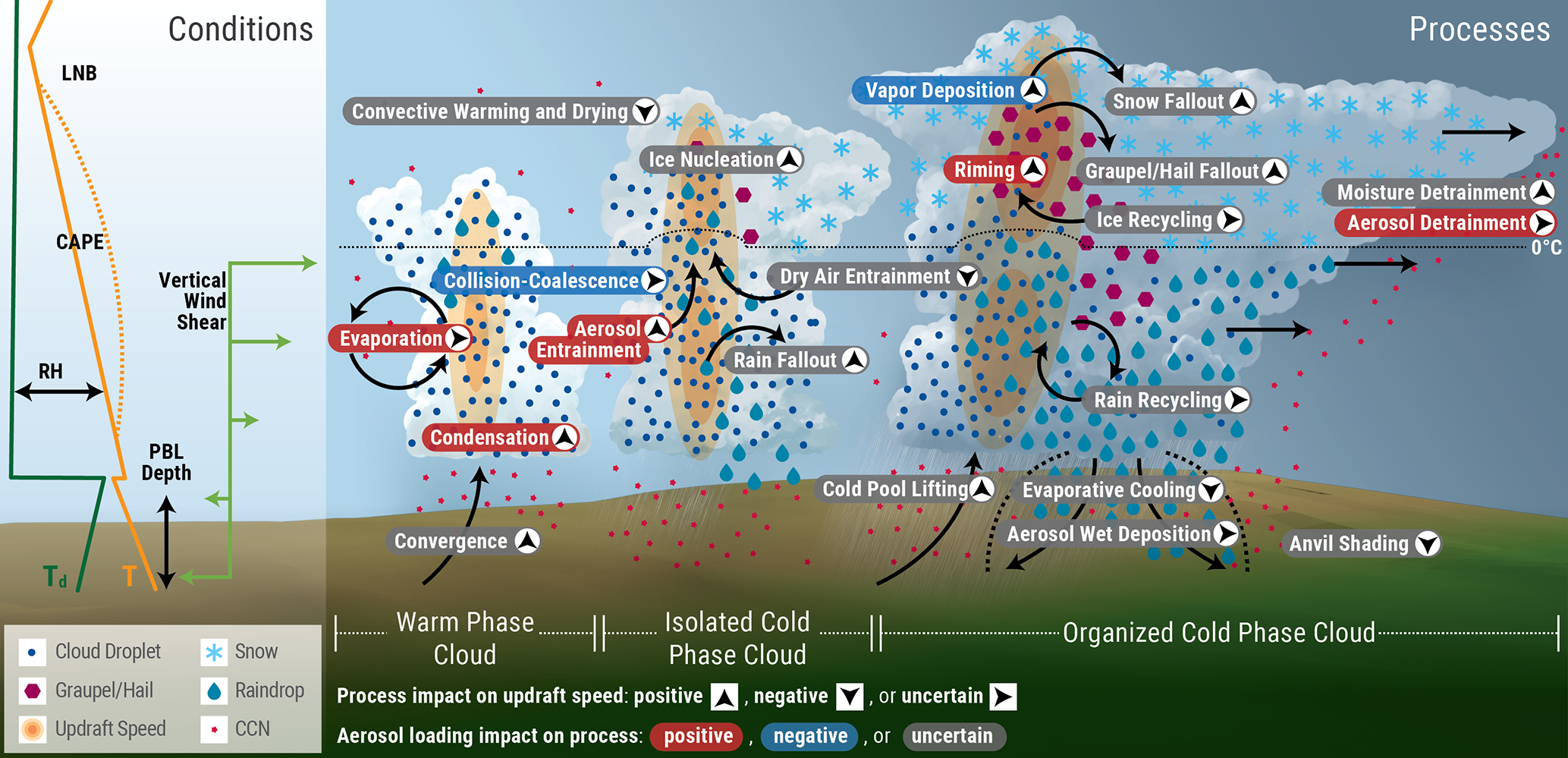
The sign of aerosol indirect effects on convective intensity is often implicit with usage of “invigoration” terminology. However, recent studies demonstrate that aerosols can also theoretically weaken convective updrafts depending on factors such as condensate unloading, freezing temperature, and entrainment. Thus, discussion in terms of invigoration alone is potentially misleading. Greater constraints on a vast range of processes that modulate aerosol-convection relationships are required to more confidently assess net aerosol effects on convective intensity as a function of scale and forcing. Models and observations both have important roles in advancing understanding, but both have critical weaknesses that require careful consideration along with methodological choices when interpreting analyses and generalizing conclusions. Notably, variable definitions of convective intensity, conflation of different effects due to usage of imperfect aerosol and intensity proxies, and difficulties in controlling for first-order meteorological sensitivities hinder observational analyses. Models can theoretically overcome such difficulties, but are hindered by tradeoffs between resolution, generalizability, and robustness coupled with persistent convective cloud microphysical biases.
We investigate several issues in greater detail that hinder robust assessment of aerosol effects on deep convection. First, we show how meteorological conditions that affect deep convective intensity become correlated with aerosol conditions via processes such as horizontal advection and precipitation, which undermines assignment of causality to aerosol-deep convection relationships. Second, we show how mesoscale clustering of convective cells alters the microphysical evolution of growing updrafts due to processes such as hydrometeor recycling, which alters aerosol-deep convection relationships. Such dependencies on convective system morphology could be important because most of the global deep convective mass flux resides in mesoscale convective systems. Finally, we show how different methodological choices can produce disparate conclusions when using identical datasets. Because of the many complexities that limit the generalizability of aerosol effects on convective intensity, we stress the importance of reproducibility and publishing of null results that improve uncertainty characterization, scientific interpretations, and design of novel experiments.

- Indicates paper has been withdrawn from meeting

- Indicates an Award Winner
