
This study illustrates the relative strengths and weaknesses of these two competing forecasting paradigms using the GEM (Global Environmental Multiscale) and GraphCast models to represent physics-based and AI-based approaches, respectively. By analyzing global predictions from GEM and GraphCast against observations and analyses in both physical and spectral spaces, this study demonstrates that GraphCast-predicted large scales outperform GEM, particularly for longer lead times. Building on this insight, a hybrid NWP-AI system is proposed, wherein GEM-predicted large-scale state variables (e.g., temperature, horizontal wind) are spectrally nudged toward GraphCast inferences, while allowing GEM to freely generate fine-scale details, which is often critical for weather extremes.
Results from different verifications reveal that this hybrid approach is capable of leveraging the strengths of GraphCast to enhance the prediction skill of the GEM model. For example, RMSE of the 500-hPa geopotential height is reduced by 5-10 %, with an overall predictability improvement of 12-18 hours, peaking at day 7 of a 10-day forecast. Notably, trajectories of tropical cyclones are predicted with enhanced accuracy without significant changes in intensity. In addition to improving the forecasting skill, this new hybrid system ensures that meteorologists have access to all the forecast variables, including those relevant for high-impact weather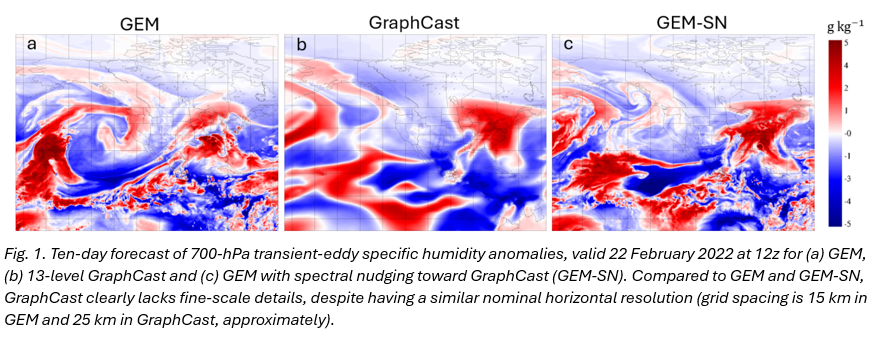
 - Indicates paper has been withdrawn from meeting
 - Indicates an Award Winner