
The seasonal and annual mean spatial patterns of liquid water content (LWC), cloud fraction, MLD, and SSHA differences between NOS and SON are strongly linked to the spatial pattern differences in SST and TAU across the entire domain, particularly over the South Pacific Ocean. Compared to NOS, SON significantly improves the seasonal and annual mean SSHA, cloud cover, and LWC, which are associated with enhanced SST and TAU in the trade-wind regions. In SON, the mean absolute bias of SSHA over the subtropical and tropical Pacific is reduced by up to 35% compared to NOS, relative to observations. When compared with CMIP5 models, the ensemble mean absolute biases of SST and SSHA in SON are similar to those in NOS, especially over the South Pacific Ocean, with 90% of CMIP5 models not including FIREs. Despite biases in SST and SSHA over the southern and northern flanks of the equator in SON, the seasonal variations in improved SSHA are closely related to changes in TAU and SST due to FIREs. Specifically, increased cloud cover, higher SSHA, and deeper MLD are associated with weaker TAU and warmer SST changes in the trade-wind regions, and vice versa.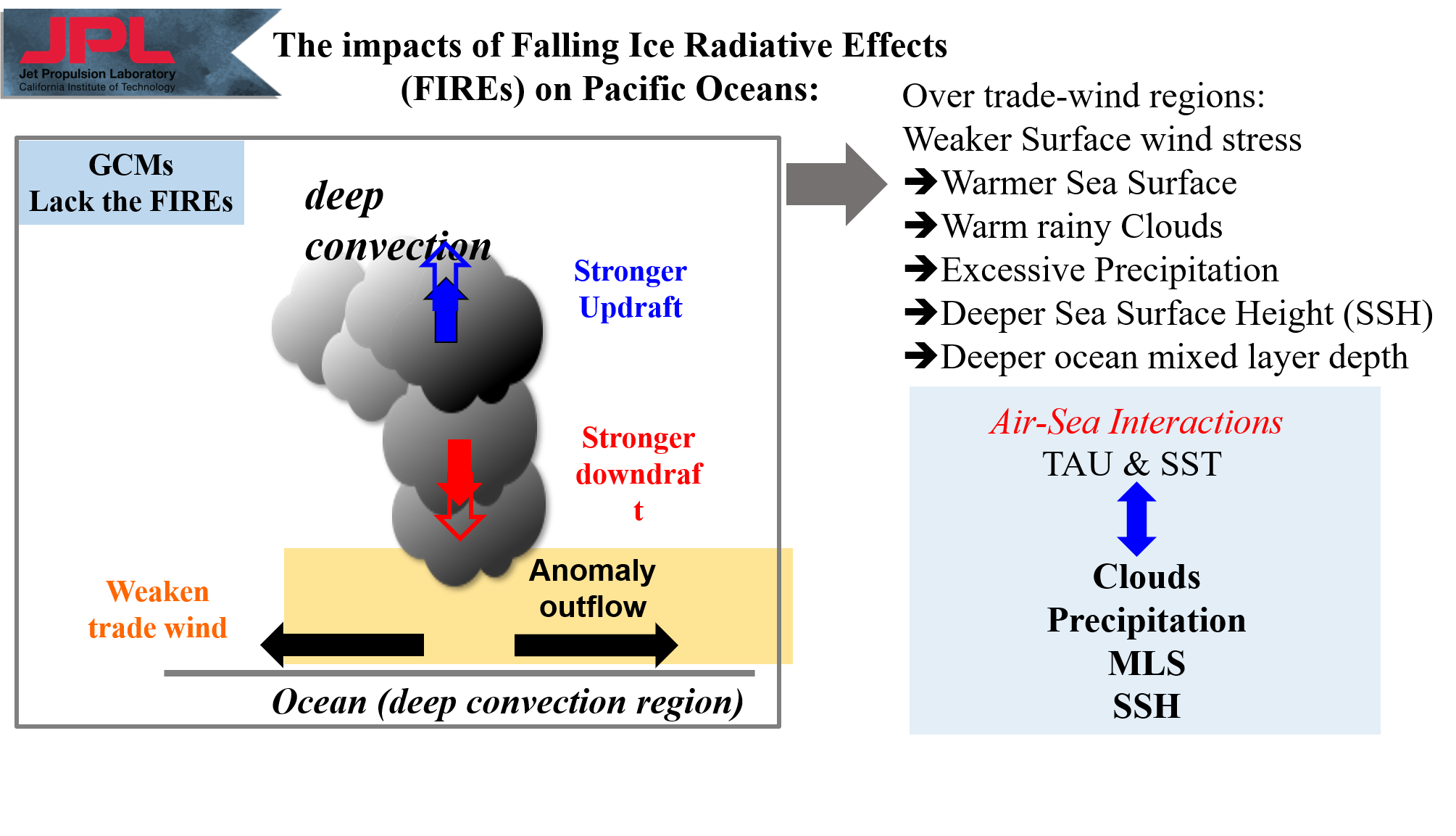
 - Indicates paper has been withdrawn from meeting
 - Indicates an Award Winner