
Handout (2.1 MB)
Traditional tube-based radars use high peak power and short unmodulated pulses with constant frequency. In contrast, SSPA radars use lower peak power and much longer pulses to achieve the same average power and measurement performance. However, long pulse durations would result in degraded range resolution, meaning the radar would not resolve closely located targets. Pulse compression techniques are used to achieve range resolutions comparable to tube-based radars. Pulse compression involves transmitting linear (LFM) or non-linear (NLFM) frequency modulated pulses and applying matched filtering detection at the receiver. This processing compresses the pulse, allowing radar targets with small range separation to be individually detected with excellent accuracy.
One challenge with SSPA radars using long pulses is the blind range, where observations are not available in a region around the radar due to the transmitted signal leakage to the receiver. The hybrid pulsing technique addresses this issue by combining short and long radar pulses for their complementary advantages. The radar transmits a frequency modulated long pulse followed by a short unmodulated pulse with a different frequency. The frequency difference is typically a few MHz to provide isolation so the returned radar echoes can be filtered and processed separately. The long pulse observes ranges beyond the blind range, while the short pulse provides observations in the near region. The transition between the near and far pulse regions is made gradually to avoid discernible steps in radar images.
The radar sensitivity, a fundamental performance metric, describes the weakest weather target that can be detected by the radar at a certain range. Sensitivity can be computed theoretically from the radar equation and validated with real radar measurements. The comparison result of the sensitivity curve of Vaisala C-band SSPA radar with the Vaisala C-band magnetron radar is presented in this study and proves that the SSPA radar has better detection capability in most of the measurement range, without compromising range resolution. The sensitivity values indicate that the radar performance is sufficient for detecting all rain and drizzle intensity levels at all ranges.
Accurate calibration procedures are essential for SSPA weather radar data products. SSPAs are generally sensitive to temperature variations, and Vaisala SSPA radars have independent transmitters for horizontal and vertical polarizations, making them more susceptible to transmit power drifts. Calibration errors are important especially with hybrid pulsing, where discrepancies between short and long pulse waveforms can be noticeable in radar images. The Vaisala calibration procedure consists of an annual calibration and a real-time transmit power correction. The annual reflectivity calibration involves measuring the receiver gain and transmit pulse energy and accounting for the digital filter loss. During continuous calibration, the signal processor measures and corrects transmit power drifts for both polarizations in real time. The calibration methods have been extensively validated with actual weather measurements and have been found to work very well.
To conclude, the incorporation of solid-state power amplifier technology, combined with advanced signal processing methods and precise calibration procedures, has enhanced the operational capabilities of Vaisala weather radars. The data presented in this study demonstrates the accuracy and sensitivity of polarimetric weather radar products, making them highly effective for weather monitoring.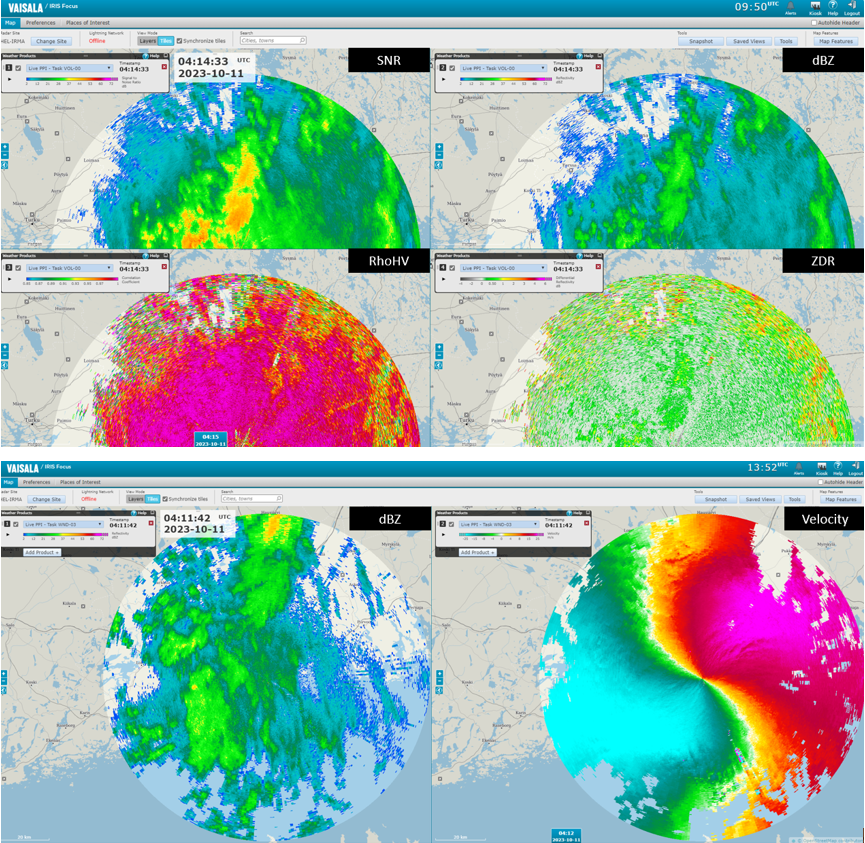
 - Indicates paper has been withdrawn from meeting
 - Indicates an Award Winner