
Tuesday, 14 January 2025: 1:45 PM
215 (New Orleans Ernest N. Morial Convention Center)
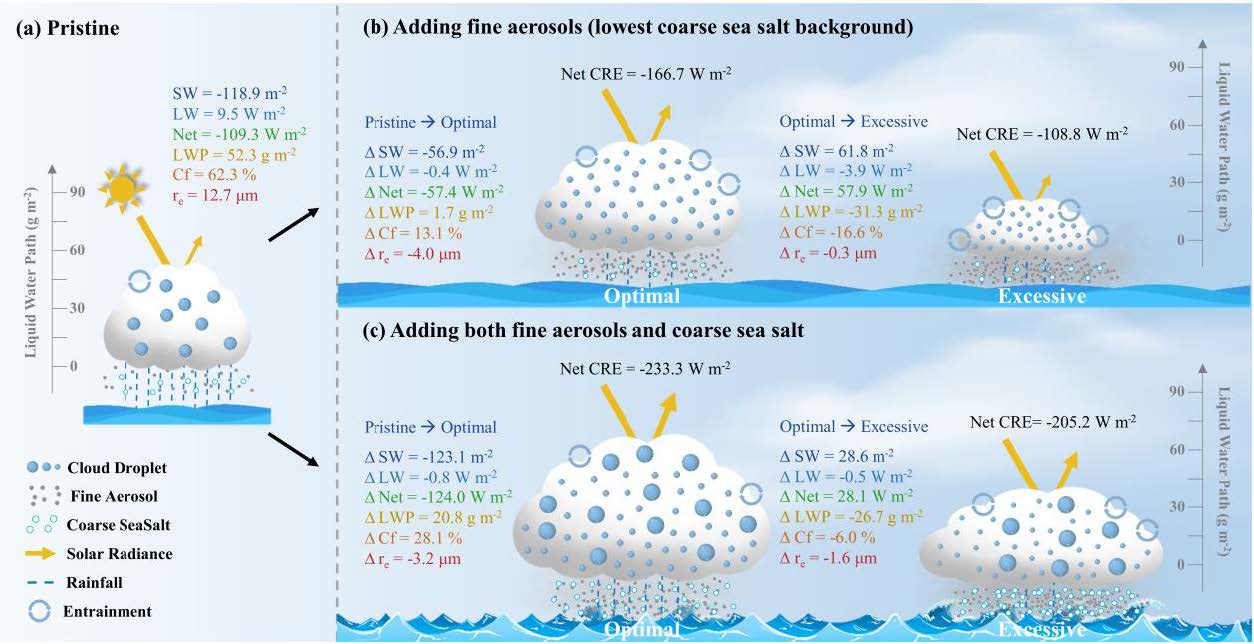
The separate and combined effects of fine aerosols (FA, radius>1 µm) and coarse salt aerosols (CSA, radius>1 µm) on marine low cloud properties were quantified based on 9 years of METEOSAT 2nd Generation data bounded by 30S-30N and 50W-50E combined with MERRA-2 aerosol and reanalysis data. Added FA from cleanest to an optimum of 3 μg m-3 is associated with an average factor of ×2.5 radiative cooling. This is in line with the marine cloud brightening (MCB) concept. Added CSA of up to 30 μg m-3 led to additional radiative cooling of ×1.6, leading to an overall cooling of up to a factor of ×4. Only the addition of CSA beyond the optimum of 30 μg m-3 led to a decrease in the radiative cooling. This means that the combined addition of FA and CSA can induce greater cooling than FA can achieve alone. This contradicts the common perception that added CSA is expected to reduce radiative cooling. The enhanced radiative cooling is ascribed to the observation that with more CSA, up to the optimal concentration, the effective radius of cloud drops was increased, and cloud cover and water path were enhanced. The enhanced cloud cover and water path were probably caused by the reduced evaporation of the larger cloud drops. Only at CSA concentrations > 30 μg m-3 does the development of rain start to reduce the radiative cooling. The observed associations of aerosols and cloud properties are causal because they are repeated for various classes of cloud-controlling factors. Another important lesson is that the effects of CSA are as important as FA, and must be incorporated in climate studies. The figure illustrates a conceptual illustration of the combined effects of fine aerosols (FA) and coarse sea spray aerosols (CSA) on marine warm clouds and their net cloud radiative forcing.
 - Indicates paper has been withdrawn from meeting
 - Indicates an Award Winner