
Monday, 13 January 2025: 9:30 AM
229 (New Orleans Ernest N. Morial Convention Center)
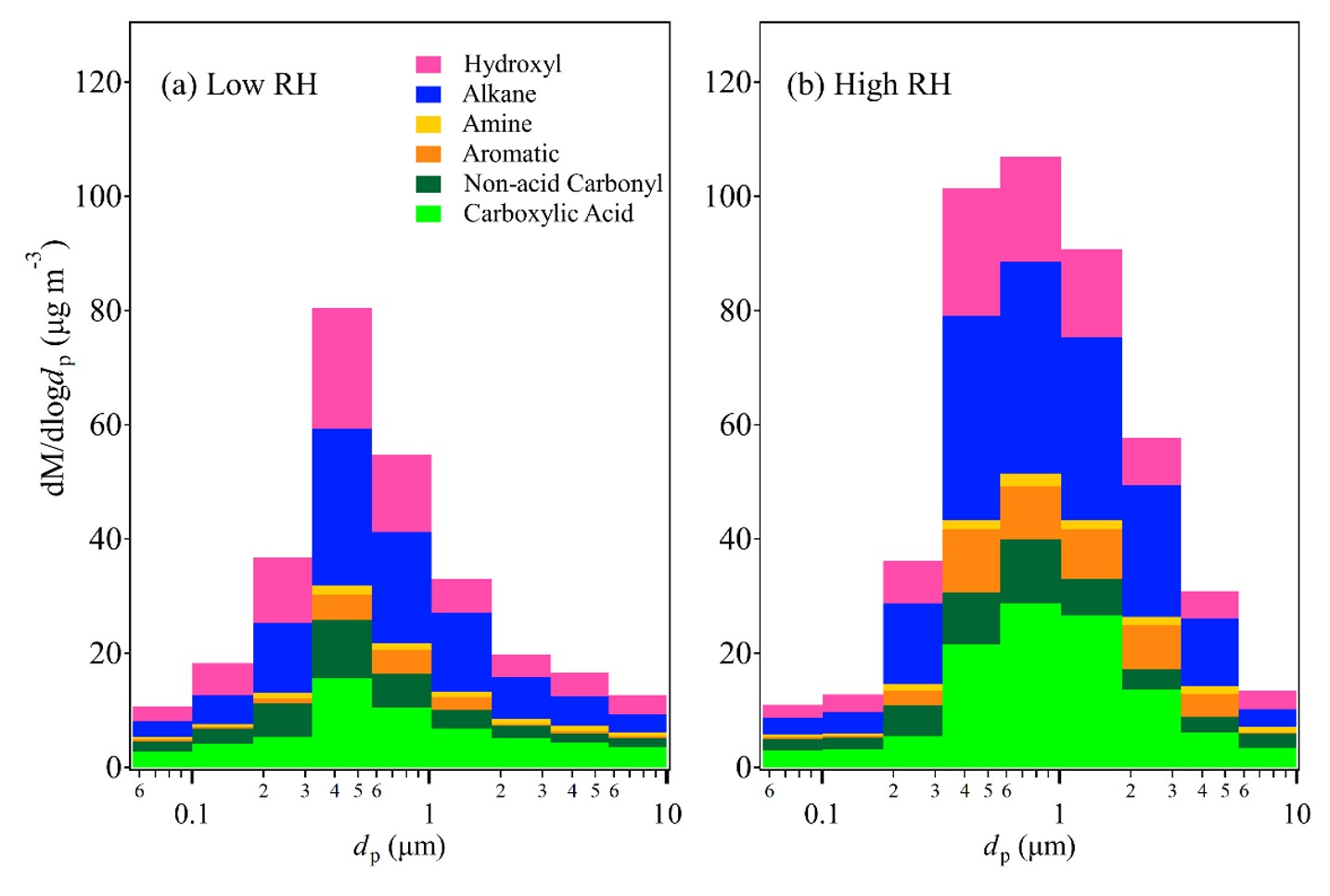
Size-resolved organic functional group (OFG) concentrations in aerosol particles were measured during January−February 2019 in Hefei, a major urban city in Eastern China. The OFGs were quantified using a Fourier Transform Infrared (FTIR) spectrometer. Alkane, carboxylic acid, and hydroxyl groups were the main components of the organic aerosol (OA), contributing 35.0%, 22.5%, and 21.8%, respectively. The mass concentrations and size distributions of the OFGs strongly depended on ambient relative humidity (RH). Specifically, the OFG mass concentrations were 50% higher during the high-RH periods compared to the low-RH periods. The peak size of the OFGs size distribution was 0.56–1 µm during the high-RH periods, while a peak size of 0.32–0.56 µm was observed during the low-RH periods (Figure 1). In addition, the concentration of the total OA, carboxylic acid, and hydroxyl groups were positively correlated with the photochemical age (PCA), with the high-RH samples increasing faster with PCA and being associated with a higher oxygen-to-carbon ratio (O/C). These results suggest that aqueous-phase processing likely enhanced the production of the OFGs. Further analysis of size distribution of the oxygenated OFGs and the viscosity of aerosols indicates that the secondary OFGs were formed via surface-limited mechanisms under low-RH conditions and volume-limited mechanisms under high-RH conditions. These findings reinforce the important role of multi-phase chemistry in the formation and evolution of OAs.
 - Indicates paper has been withdrawn from meeting
 - Indicates an Award Winner