
In this presentation, I will (a) discuss two non-Gaussian artefacts and their formation pathways, (b) illustrate those artefacts' detrimental impacts on DA performance, and (c) demonstrate easy-to-implement artefact mitigation strategies. These non-Gaussian artefacts are: (1) unphysically dry clouds created by non-Gaussian hydrometeor forecast statistics, and (2) negatively biased specific humidity analysis increments caused by skewed IR innovation statistics. During forecast model integration, the evaporation and sublimation of hydrometeors convert these artefacts into cold temperature biases. These biases accumulate over DA cycles and ultimately result in (a) performances worse than a free-running ensemble, and (b) severe filter divergence. Two mitigation strategies are then tested: (1) preventing unphysical cloud creation by disabling hydrometeor analysis increments, and (2) refining the QC scheme to weaken the biasing impacts of skewed innovation statistics. Applying these mitigation strategies dramatically improves the performance of IR DA under perfect model conditions. This study thus advances EnKF-based IR DA, particularly for long term continuously cycled EnKF setups. Future work will extend these findings to real data conditions.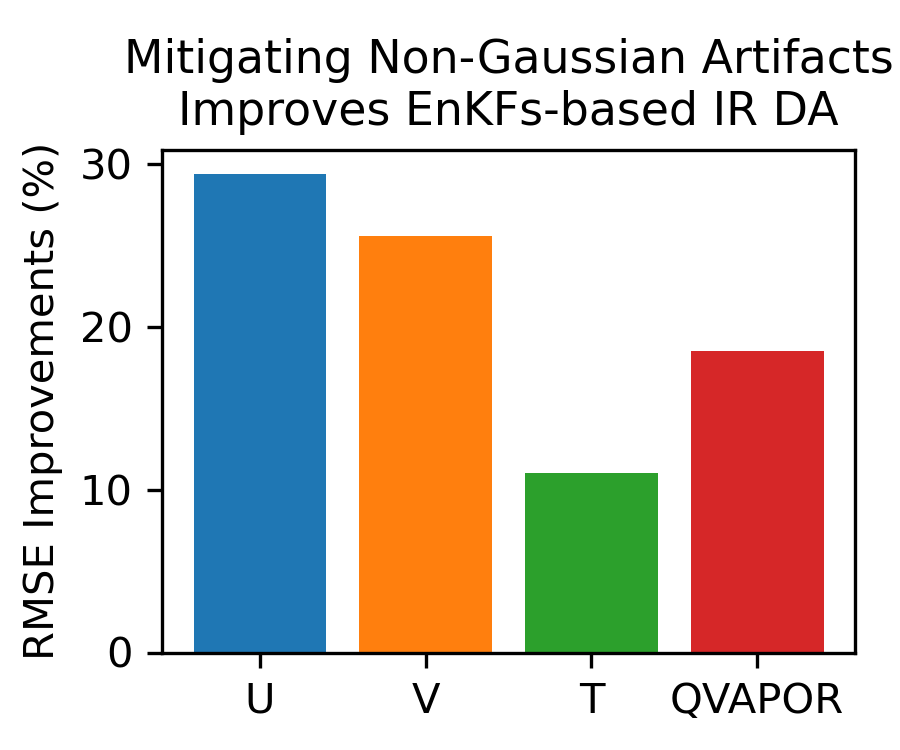
 - Indicates paper has been withdrawn from meeting
 - Indicates an Award Winner