
However, widely used open source and commercial visualization and analysis tools in the meteorological community do not operate natively on such unstructured computational meshes. Their use requires a pre-processing step to interpolate data produced by MPAS-A, for example, to a topological regular grid that can be ingested by such software. This creates a two-fold problem. First, images and animations produced by such tools are potentially unreliable. Features depicted in the visualizations may be artifacts of the interpolation as opposed to those in the actual data. Important signatures in the data may be smoothed away by the interpolation process. Further, there is additional computational and storage costs associated with that pre-processing step, which will not scale linearly with an increase in the model resolution. Fortunately, given established methods in the scientific visualization community, in practice, these issues should be avoidable since unstructured meshes have been used in modelling and simulation for decades (e.g., computational fluid dynamics, finite element analysis) compared to their more recent adoption in the meteorological community.
Following an introduction to unstructured meshes, the results of a survey of available, open-source tools and community efforts that work natively with such data will be presented. An evaluation of each of the identified tools will be discussed, including their effectiveness in enabling visualization directly of native MPAS-A output.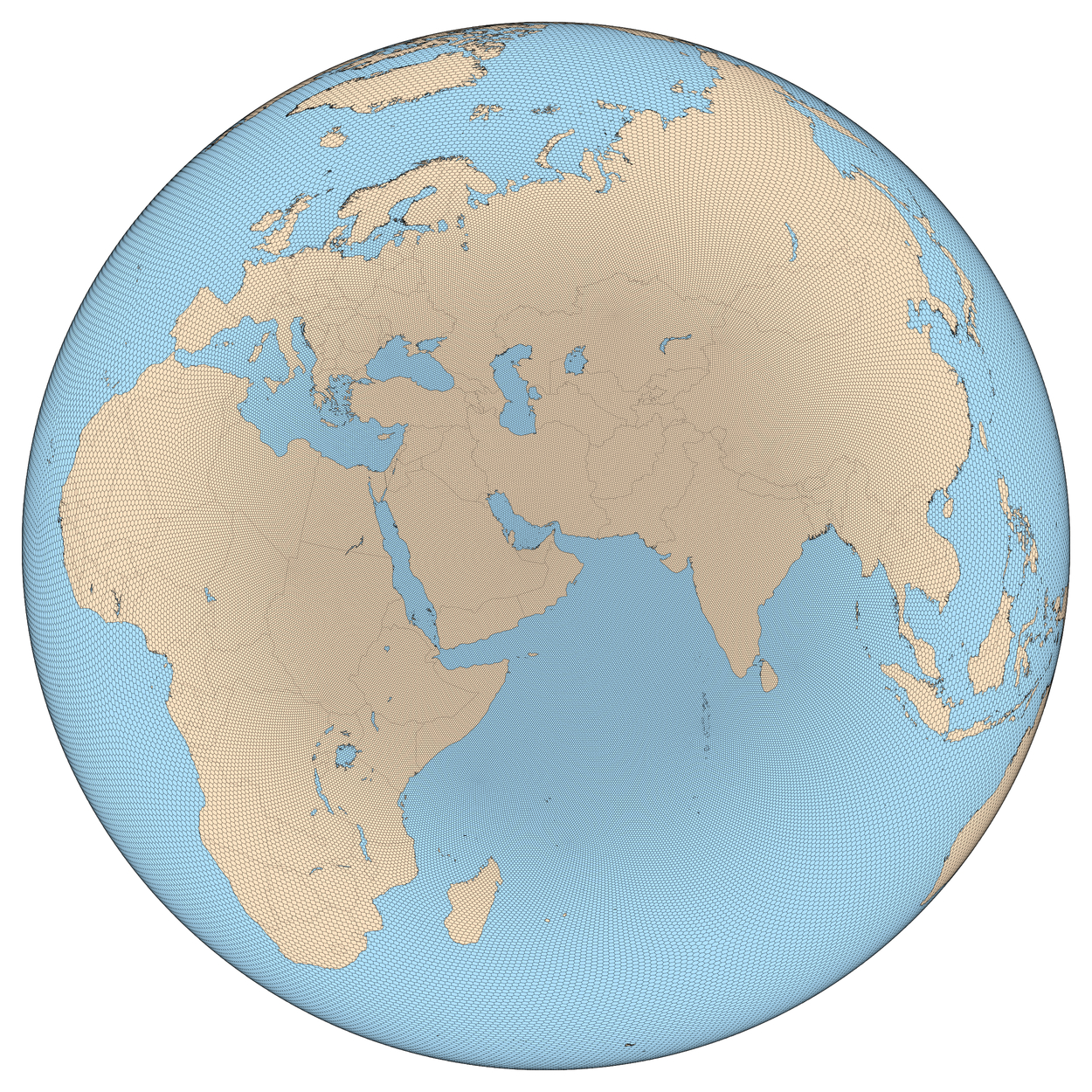
 - Indicates paper has been withdrawn from meeting
 - Indicates an Award Winner