
Wednesday, 15 January 2025: 5:00 PM
356 (New Orleans Ernest N. Morial Convention Center)
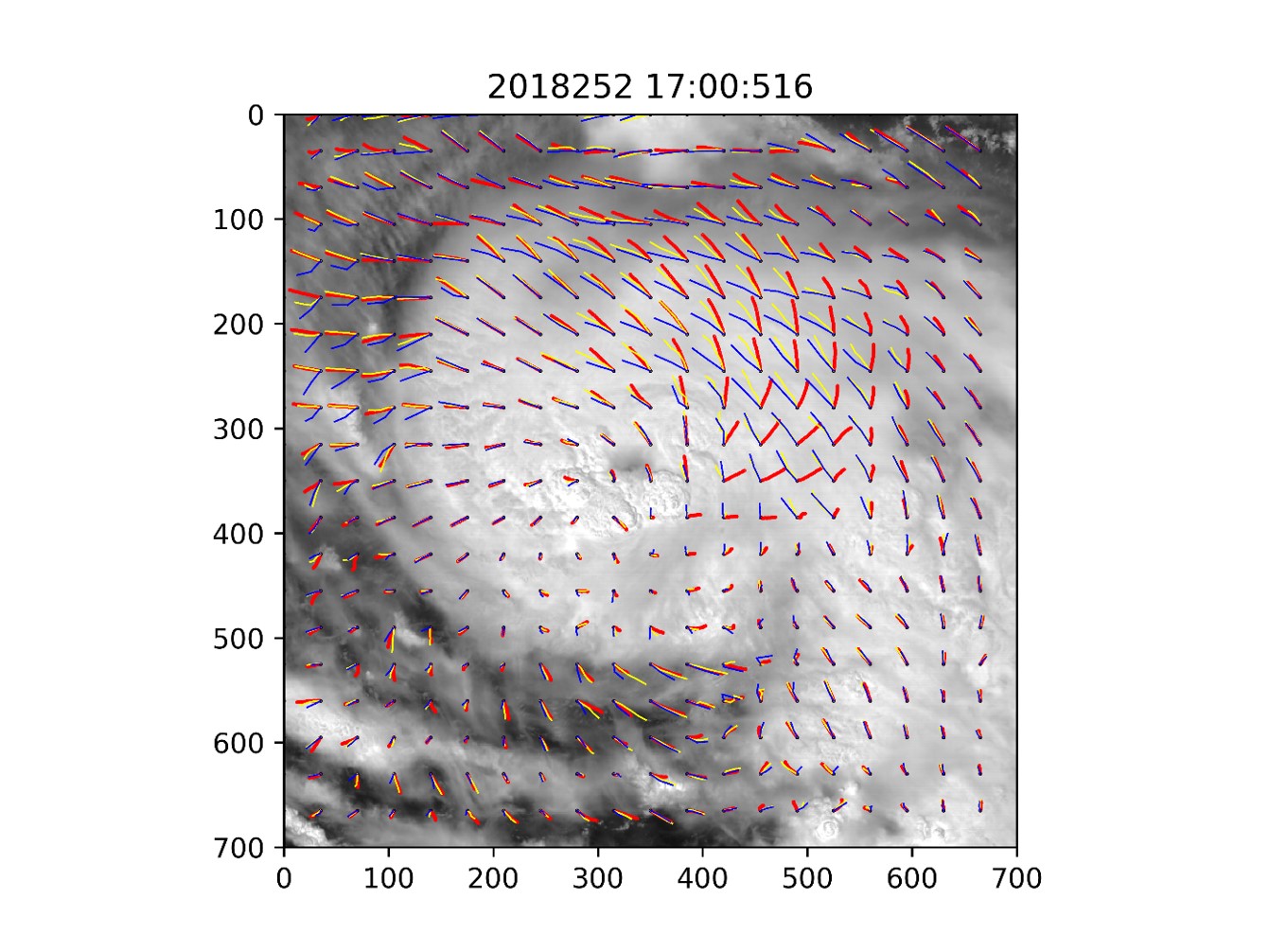
Modern optical flow techniques have recently been used to retrieve cloud-top motion around convective updrafts and to compute divergent flow using visible satellite imagery. Multiple time steps between images, representing the different scan modes of the sensor, are tested as inputs for determining the feasibility of using imager scans with larger spatial coverage, such as full hemispheric view. This work projects onto future satellite missions, such as GeoXO, as potential future science and operational applications dictate that temporal and scan characteristics be carefully considered. This study applies these novel methods to multiple convective phenomena, including multiple pyrocumulonimbus (pyroCb) events, to retrieve cloud-top motions. Optical-flow-retrieved wind vectors are compared in order to provide quantitative context and test the baseline functionality of optical-flow-retrieved parameters as investigative tools for all types of deep convection. Emphasis is placed on pyroCb events, which are increasingly recognized for impacts spanning the upper-troposphere to stratosphere, including perturbations in chemistry, cloud nucleation, and climate circulation. Results reveal that multiple factors must be considered for determining when and where optical-flow techniques can retrieve reliable motion vectors. For example, as the speed of the motion increases, the ability to use lower scan frequencies decreases. The location within the storm (i.e. anvil vs convective core) and the complexity of the target motion are also important considerations. The use of longer scan frequencies, such as 5-minutes, shows viability, even for computing downstream quantities such as divergence, which greatly increases the area over which these optical-flow techniques can be used to retrieve motion vectors and allows for more widespread use for a range of applications, from smoke transport modeling to convective hazard characterization.
 - Indicates paper has been withdrawn from meeting
 - Indicates an Award Winner