
Thursday, 16 January 2025: 8:45 AM
355 (New Orleans Ernest N. Morial Convention Center)
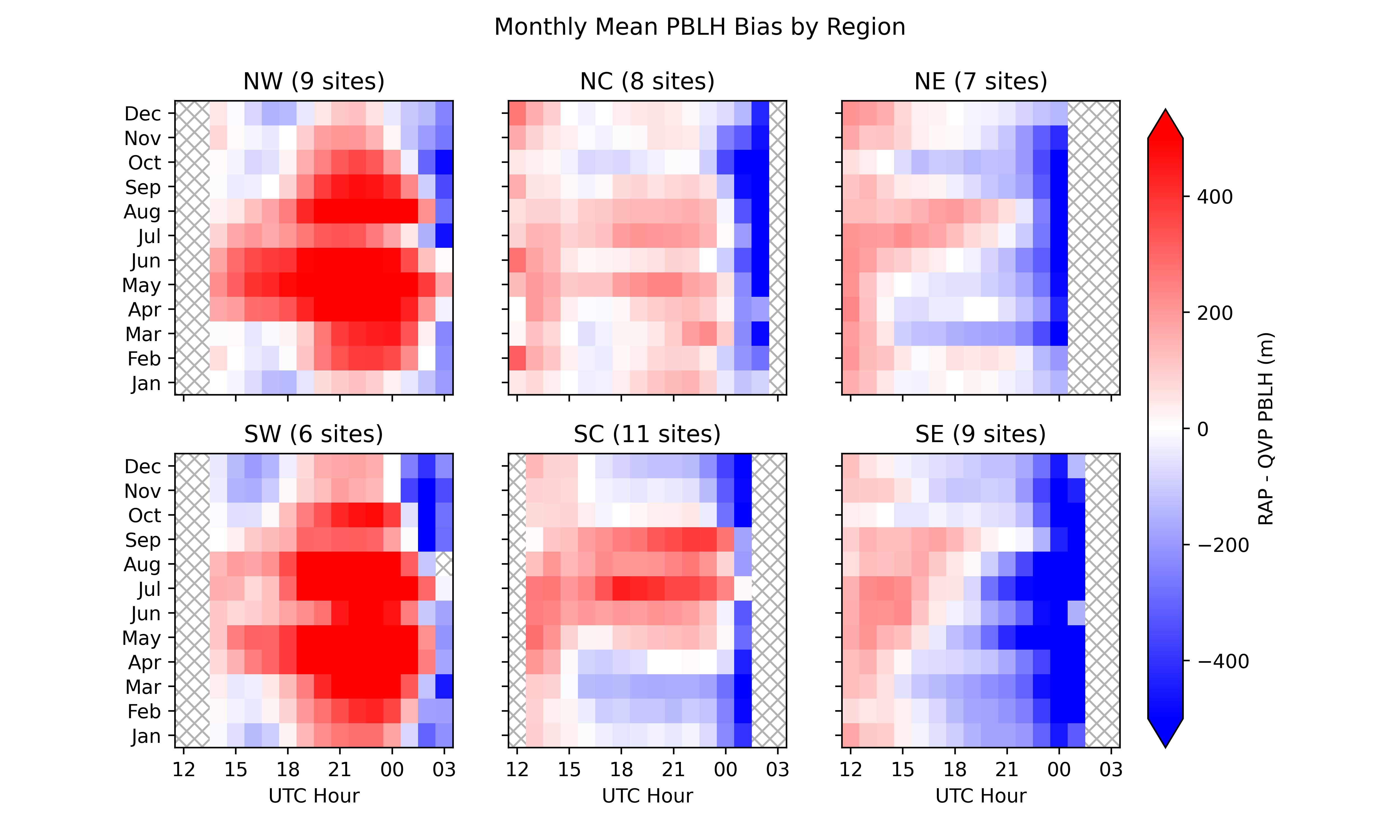
Recent work has taken advantage of the existing network of dual-polarization WSR-88D radars to produce accurate daytime planetary boundary layer (PBL) depth estimates for every radar volume scan (roughly every 10 minutes or less) at WSR-88D sites across the United States. We expand on this work by comparing hourly 0600 UTC Rapid Refresh (RAP) forecasts of daytime PBL depth to estimates obtained from WSR-88D observations. We find that daily RAP forecasts of the PBL can differ significantly from WSR-88D observations in both timing of growth and maximum depth of the PBL. RAP forecasts are also found to exhibit consistent biases in PBL depth across regions and seasons. These biases are then evaluated through the comparison of modeled surface sensible and latent heat fluxes to those observed by flux towers located near selected radar sites. We find that errors in predicted PBL depths are strongly correlated to the over/underestimation of surface sensible heat flux. Further assessment of modeled soil moisture reveals that the land surface model utilized by RAP is likely contributing to PBL depth biases in summer months through erroneous drying of soil which increases surface sensible heat flux and therefore PBL depth.
 - Indicates paper has been withdrawn from meeting
 - Indicates an Award Winner