
Analysis of the advection of the MJO wind by the background wind demonstrates that the upper tropospheric circulation signal of the MJO would move eastward at between 13 and 17 m/s in a resting basic state, and demonstrates that Doppler shifting is the dominant mechanism leading to upper tropospheric MJO circulation signals moving eastward at 2-8 m/s relative to the earth. The western Indian Ocean is a primary location of amplification of the upper tropospheric MJO zonal wind by advection of background confluent flow by the MJO (which advects background wind of the same sign as the MJO wind), and the Maritime Continent is a common location of collapse of the MJO wind signal by advection of diffluent flow (which allows the MJO wind to advect background wind of the opposite sign to its own wind). Results suggest that collapse of the MJO zonal wind signal as it advects background wind of the opposite sign explains 70-80% of the Maritime Continent barrier effect.
Although these results do not explain the coupling of the MJO to convection, and the broader roles of moisture in the phenomenon, they demonstrate frequently neglected roles of the dry atmospheric circulation in the observed MJO.
The figures on the left and right show contours representing MJO-associated 200 hPa zonal wind anomalies for all RMM phase 3 events, averaged 10N to 10S for (a), zonally confluent Maritime Continent conditions (b), neutral diffluent Maritime Continent (c), and zonally diffluent Maritime Continent (d). The left set of panels shows the corresponding advection of the background wind by the MJO wind (shading), and the right panels show the advection of the MJO wind by the background wind (also shaded). These results show that when the Maritime Continent is diffluent (panels d), the background Walker circulation is strong over the Indian Ocean, with strong confluence over the western Indian Ocean, strong advection of the MJO circulation to the west over the Indian Ocean, and strong diffluence over the Maritime Continent (by selection). In panel d on both the left and the right, during diffluent Maritime Continent, the MJO upper tropospheric circulation grows most profoundly over the western Indian Ocean. It is then advected strongly westward by the background flow (panel d on the right), and then the whole signal collapses as it arrives over the Maritime Continent as the MJO wind advects background wind of its opposite sign (panel d on the right).
The presentation will show that the principal accelerations associated with the equatorial MJO upper tropospheric zonal wind are driven by the geopotential gradient force (correlated at around 0.7 with the zonal wind tendency), offset by advection by the background wind (correlated around -0.2 to -0.6 to the zonal wind tendency, thus representing Doppler shifting offsetting the observed MJO zonal wind accelerations), and amplified or diminished by advection of the background wind by the MJO wind. These features would evolve largely as they do in the equatorial plane even if the signal was dry but embedded in the same large-scale background flow. The geopotential gradient force is the leading source of accelerations in Kelvin waves. The upper tropospheric zonal wind signal associated with the MJO on the equator over the warm pool is thus dominated by Kelvin wave dynamics at the planetary scale, altered by interaction with the background flow.
This presentation would work in either a 15 or 30 minute slot. A 30 minute slot would allow more detail in the momentum budget analysis demonstrating the dominant mechanisms leading to the eastward propagation of the upper tropospheric circulation signal of the MJO.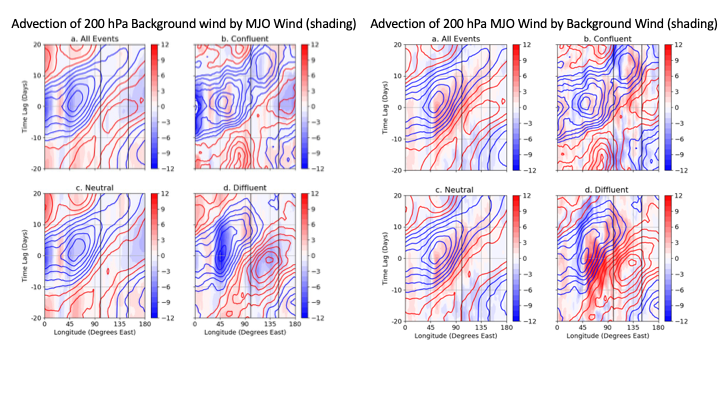
 - Indicates paper has been withdrawn from meeting
 - Indicates an Award Winner