
Wednesday, 15 January 2025: 11:30 AM
245 (New Orleans Ernest N. Morial Convention Center)
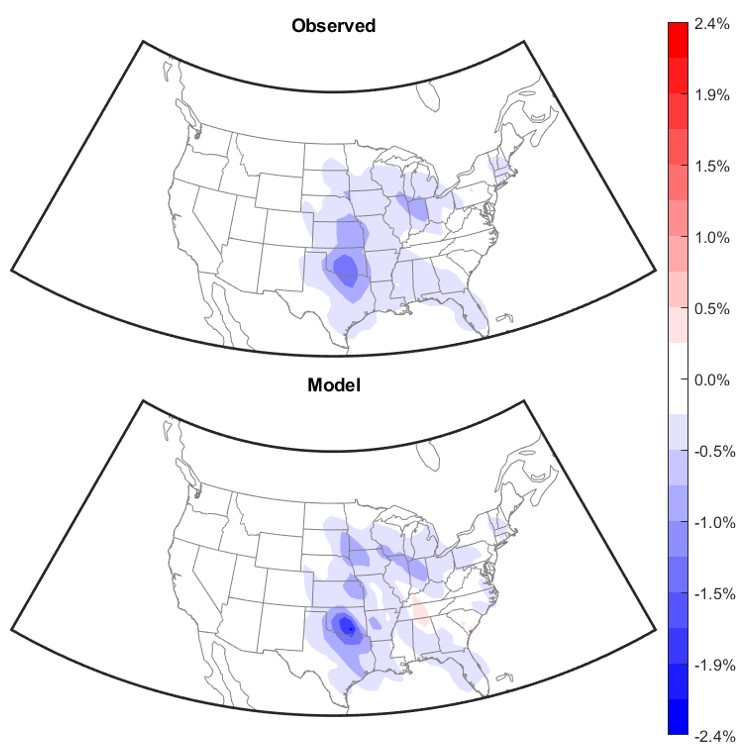
Tornadoes present significant hazards to life and property, making it imperative for various sectors to consider potential future changes in tornado risk accompanying a warming global climate. While there is reasonable confidence in how global climate models (GCMs) project larger-scale atmospheric circulation, many of the processes that lead to tornadoes, and inform real-time tornado prediction, manifest at too small of a scale to be reliably simulated by coarser-scale GCMs. Following this logic, our research utilizes artificial neural networks (ANNs) to overcome these limitations of GCMs, instead leveraging the “scale strengths” of GCMs; focusing on modeling the synoptic-scale environments conducive to tornado formation in order to make more accurate future projections of this small-scale phenomenon that GCMs are just unable to model reliably. Borrowing from the field of synoptic climatology, we utilize a CANDECE-like method. First, 9 regional patterns of daily co-occurring (E)F2+ tornadoes were identified for the eastern half of the United States. Then, a cascade-forward ANN was trained to learn how to predict these 9 tornado-patterns using daily synoptic-scale fields of 2m dew point, mean sea-level pressure, and 500-hPa geopotential heights obtained from ERA5 reanalysis. Finally, a secondary set of ANNs were trained to learn the probability of a tornado-day in each grid-cell based only upon the outputs of the first cascade-forward ANN (i.e., the percent likelihood of each day falling into each of the 9 original tornado patterns). Based upon a held-out validation dataset, this methodology captures the seasonality, spatial patterns, and long-term trends of observed tornadoes quite well. The spatial correlation of trends/slopes is greater than r = 0.9 for 1950 onwards, and many days with significant tornado outbreaks are well-modeled in terms of their spatial pattern of tornado occurrences. Ongoing work is now applying these fully-trained ANNs to GCM data (both historical and future) under a range of emissions scenarios.
 - Indicates paper has been withdrawn from meeting
 - Indicates an Award Winner