
We first approach this question through the use of circulation regimes obtained from boreal summer pentads (1979-2018) of the 850-hPa horizontal wind field over the broad Indian region, as obtained by previous research (Straus 2021). The regimes encompass all data, and the preferred transition paths depict the north-eastward moving regions of excess and deficient rainfall over the Indian region that define the active-break cycle. The composite maps of total diabatic heating throughout the tropical belt depicts the boreal summer intraseasonal oscillation.
We generate composite maps of precipitable water, total diabatic heating and rainfall over all pentads assigned to each cluster during El-Nino (“Warm”) years, La-Nina (“Cold”) years and all non-ENSO years. The differences between the cold and warm ENSO composite maps for each phase of the active-break cycle are nearly independent of the phase of the cycle. Further, the pattern correlation between these phase-dependent difference maps and the overall seasonal mean Cold minus Warm composite maps generally exceeds 0.6 and can exceed 0.8. This suggests that the seasonal mean ENSO effect is to some extent independent of the active-break cycle.
We extend the analysis period to include boreal summers from 1940-2023 from ERA5 reanalyses to test (a) the robustness of the original circulation regime analysis and (b) the possible decadal and longer-term changes in the relationship between ENSO and the Indian Monsoon intra-seasonal fluctuations.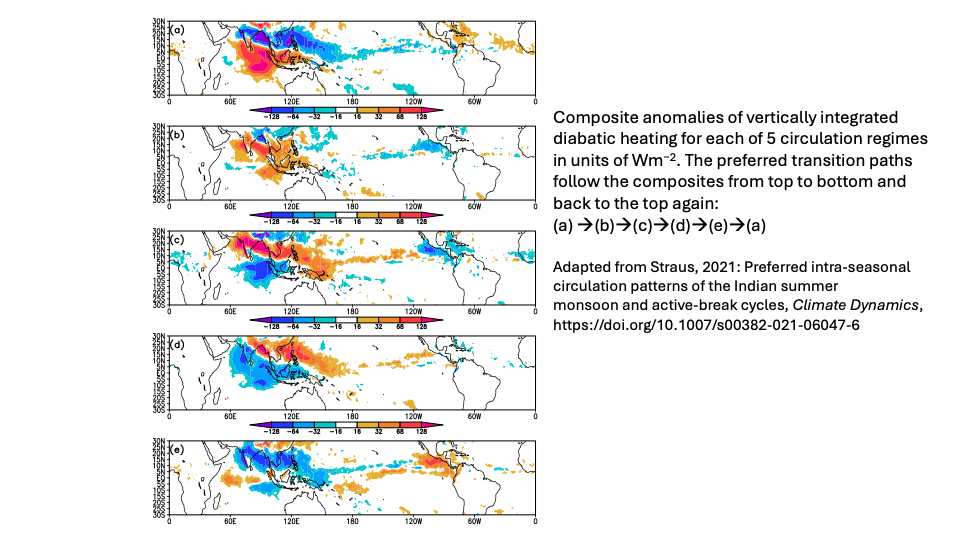
 - Indicates paper has been withdrawn from meeting
 - Indicates an Award Winner