
Our approach has two distinct machine learning steps. First, we train a Self-Organizing Map (SOM) classification to extract features of synoptic-scale circulation from ERA5 daily sea-level pressure (SLP) and 500hPa geopotential (Z) fields (Figure 1a and 1b respectively). Features from the SOM are analyzed with respect to fire weather patterns that are associated with high lightning days. Then, the SOM features, along with regional averages of atmospheric variables, are used to train a random forest (RF) classifier to predict daily lightning intensities with respect to the bottom, middle, and top tercile lightning days. RF hyperparameters are tuned with a grid search 5-fold cross-validation of the F1-score. Historical observational lightning data for 2004-2022 is obtained from the Alaska Lightning Detection Network which is operated by the Alaska Fire Service. Atmospheric variables are obtained from ERA5 reanalysis for 2004-2022. The variables explored in this study include: 500 hPa height, CAPE (convective available potential energy), convective precipitation, SLP, 2-meter temperature, 850 hPa temperature, total column ice fraction, total column water vapor, total column cloud ice water, total column cloud liquid water.
For the test set removed before training, the SOM-RF achieves an F1-score (AUROC) of 0.667 (0.829) for daily lightning intensities over central Alaska. The F1-score balances the precision and recall of predictions and varies from 0.5 to 1 for binary classification models, and 0.333 to 1 for three classes, where a perfect score is 1. The area under the receiver operator characteristic (AUROC) measures the probabilistic predictions of the model and varies from 0.5 for an uninformed model to 1 for perfect predictions. Furthermore, a simple regression over the SLP and 500 hPa Z SOMs shows skill predicting the number of extreme lightning days (greater than 1000 strokes per day) in June-July with a Pearson's rho correlation of 0.82 (cross-validated by fire season). However, the regression is underfit which requires bias correction. Our results are qualitatively consistent with recent work that has shown machine learning parameterizations of lightning benefit from the ability to extract non-local features from spatial data. Future steps include bias correction for the SOM based seasonal predictions and investigating the application of the SOM-RF methodology to S2S forecasts to develop seasonal outlooks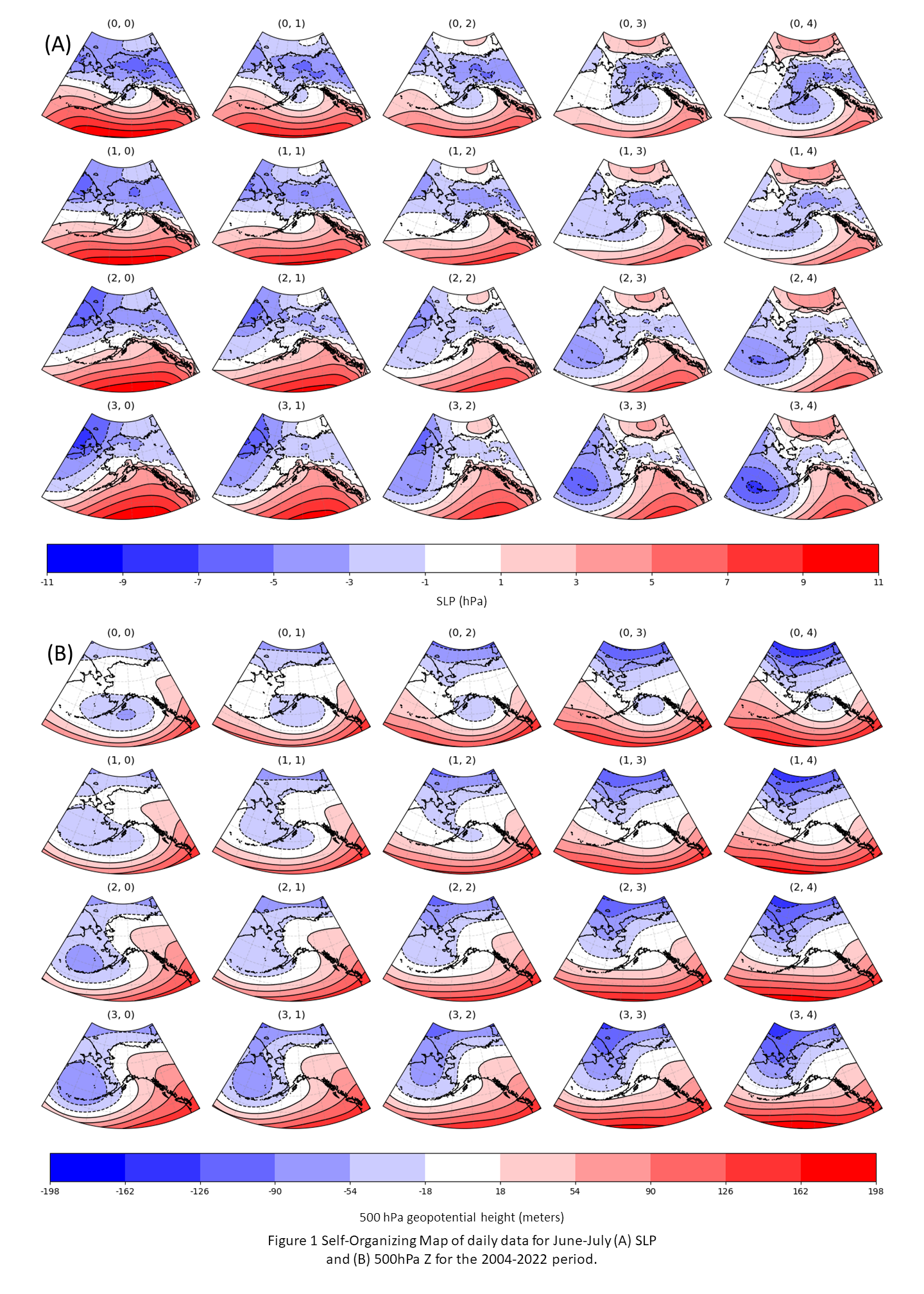
 - Indicates paper has been withdrawn from meeting
 - Indicates an Award Winner