
Tuesday, 14 January 2025
Hall C (New Orleans Ernest N. Morial Convention Center)
Southeast Texas is prone to lightning strikes year round, with activity peaking in the spring and summer months. Two well-known detection methods oversee the area; Geostationary Lightning Mappers (GLMs) aboard the GOES satellites detect the total lightning over the Americas and surrounding bodies of waters through a near-infrared channel. The National Lightning Detection Network (NLDN) as a ground sensor has been shown to have a 94% flash detection efficiency as well as a 75% stroke detection efficiency (Mallick et al., 2014) with a median location error of about 150 m (Murphy et al., 2021).
Over the summer of 2024, a network of two high-speed cameras were used to capture flashes from thunderstorms in the vicinity of College Station. From May 2nd to the 31st, 131 Cloud-to-Ground (CG) strokes were captured, with 29 CG strokes exhibiting Continuing Current (CC) properties with strokes lasting 30 ms to 240 ms. Using the NLDN as a base, the evaluation of the GLM16's performance aligns well with a predetermined geolocation error of up to 5 km (Virts and Koshak, 2020). Additionally, findings suggest that Detection Efficiency (DE) is on par with the GLM DE relative to ENL (Earth Networks Total Lightning Network) (Marchand et al. 2019).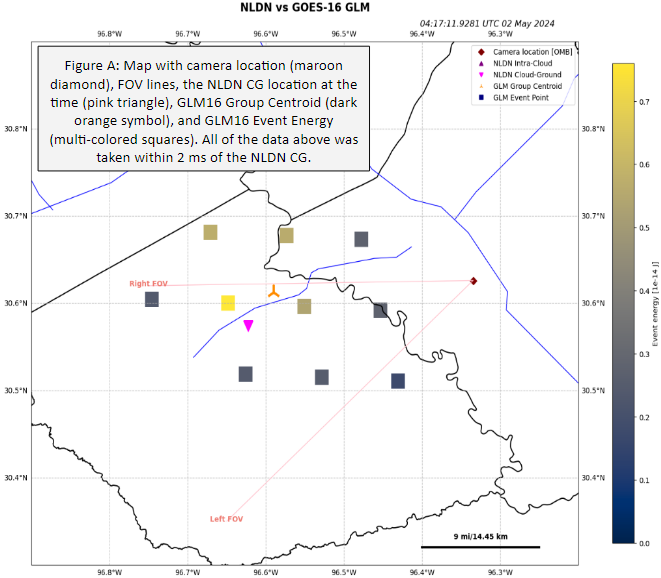
 - Indicates paper has been withdrawn from meeting
 - Indicates an Award Winner