
Wednesday, 15 January 2025: 9:00 AM
212 (New Orleans Ernest N. Morial Convention Center)
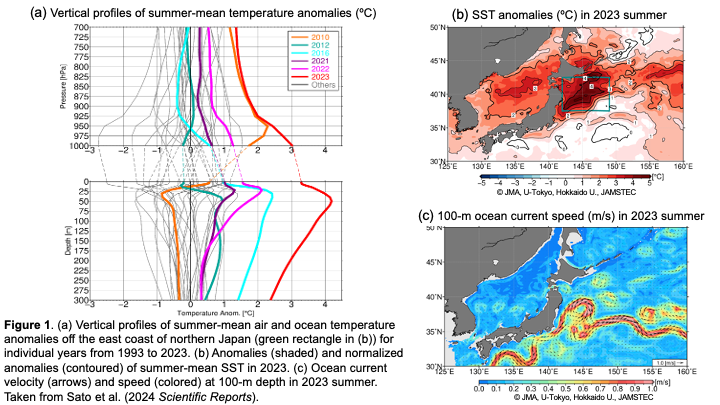
Impact of an extreme marine heatwave is investigated on unprecedentedly hot summer over northern Japan in 2023. In that summer sea-surface temperature (SST) and subsurface ocean temperatures around northern Japan were also unprecedentedly high. This was especially the case off the east coast of northern Japan, where cool Oyashio water was replaced with much warmer water due to a striking poleward meander of the Kuroshio Extension (KE) that persisted from early spring (Fig. 1c). Locally, sub-surface water temperature anomaly reached as much as +10ºC, and the corresponding SST anomaly exceeds +4ºC (Fig. 1b). As shown in Fig. 1a, the particularly amplified near-surface air temperature anomalies and even stronger warm anomalies in the subsurface ocean suggest that the marine heatwave acted to sustain the atmospheric heatwave. Anomalous upward sensible and latent heat fluxes from the warmed sea surface were indicative of local oceanic forcing on the overlying atmosphere. Specifically, the pronounced warm SST anomaly reduced the near-surface stratification to maintain unfavorable condition for low-level cloud formation. In fact, the reduction of satellite-masured low-cloud fraction reached an unprecedented level, which in turn led to increased surface insolation for further SST warming in midsummer as positive feedback. Under the warm SST anomaly, such onshore winds as daily sea breeze or persistent “Yamase” easterlies were less effective in cooling the coastal regions and thus contributed to the extreme warmth. Furthermore, increased moisture in the warmed lower troposphere contributed to the enhanced surface downward infrared radiation even under the reduced cloudiness. This enhanced greenhouse effect acted not only as positive feedback on the warm SST anomalies that increased evaporation but also as a contributor for the extreme warmth over northern Japan landmass. In 2024 summer, the pronounced poleward KE meander still continues, causing another extreme marine heatwave. Its possible impact on another hot summer over northern Japan will also be discussed.
 - Indicates paper has been withdrawn from meeting
 - Indicates an Award Winner