
Beginning in April 2024 GEOS has been run in replay to GEOS-FP in near-realtime with 137 vertical levels on a global stretched grid with 2km resolution over CONUS and 12km resolution over the southern Indian Ocean. This grid provides a smooth refinement of the global GEOS-FP grid to produce convection allowing model forecasts over CONUS and finer than 6km global resolution on the hemisphere centered on CONUS. The replay is run with a spectral filter of T106 (~125km global resolution) on the analysis increments to produce the refined resolution analysis state twice daily at 00z and 12z. 3-day forecasts are run twice daily from these 00z and 12z replayed analysis states.
From April 29 – May 31, 2024 these twice daily forecasts were provided to the 2024 Hazardous Weather Testbed Spring Forecast Experiment (HWT SFE). These global GEOS forecasts were evaluated along side regional models including the HRRRv4, RRFS, GFDL FV3 and the NSSL MPAS HT to study the value of convection allowing forecasts as guidance for the prediction of hazardous convective weather. Following the HWT SFE this GEOS 2km stretched grid replay experiment and forecasts have continued in near realtime producing forecasts twice daily including global tropical cyclone activity, extreme heat and flooding rains among other global weather events.
Global and North American forecast skill for this experiment will be evaluated in comparison with the GEOS-FP system and the NOAA Global Forecast System (GFS). Convective weather evaluations will include: spring convective activity over CONUS looking specifically at the properties of convective cloud clusters as compared with satellite observations, precipitation and radar comparisons, and the spatial and temporal properties of convective model diagnostics such as updraft helicity and NWS severe storm warnings and observations. Global radiation fields from the replay and forecasts will be evaluated across several wavelength bands in comparison with GOES observations including: Band 13 10.3-micron clean long-wave window, Band 9 6.9-micron mid-level water vapor window, and the GeoColor true-color daytime and multispectral IR nighttime windows.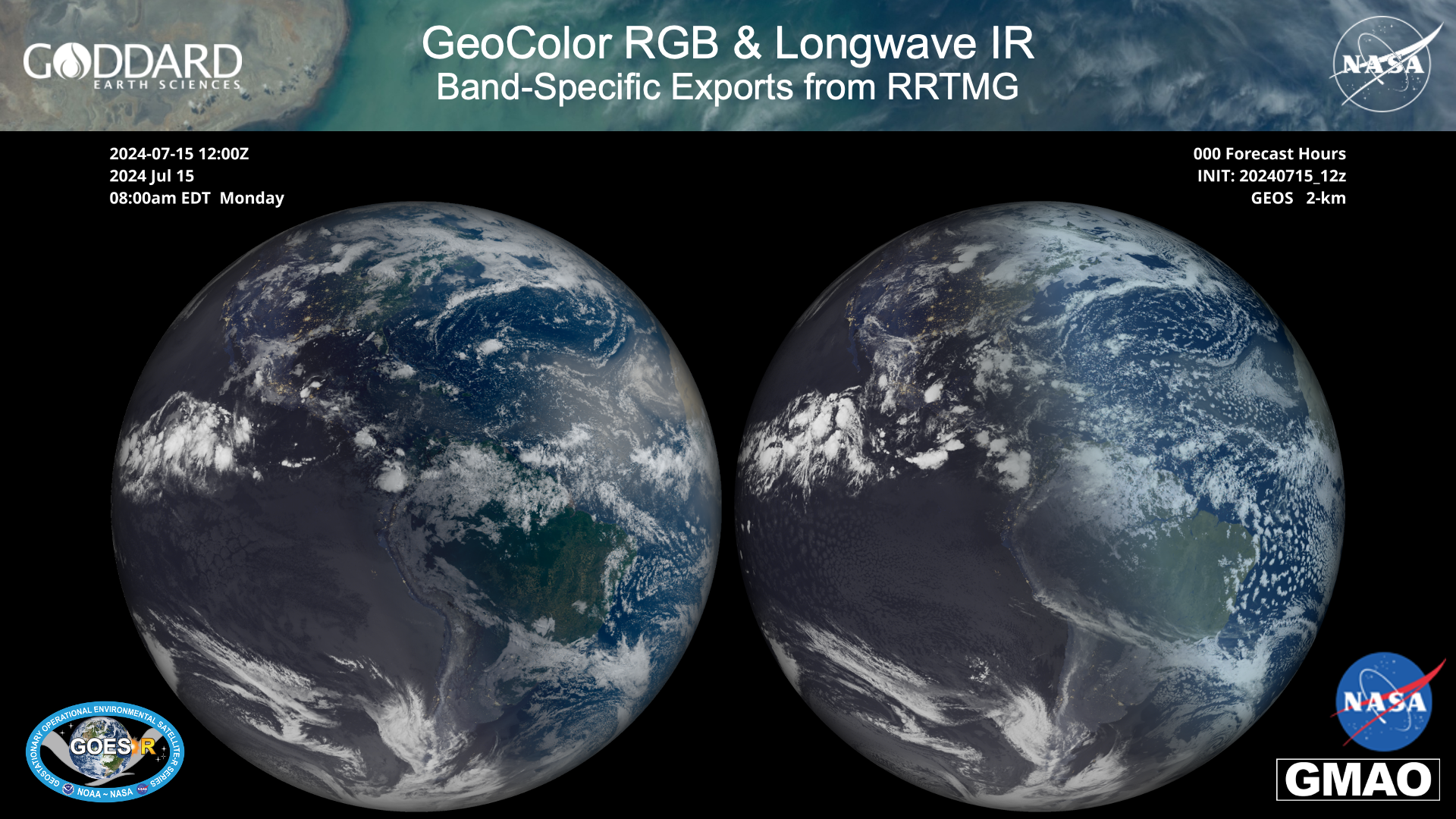
 - Indicates paper has been withdrawn from meeting
 - Indicates an Award Winner