9B.1 Max Planck Windarts: High-Resolution Measurements in the Planetary Boundary Layer with a Tethered Balloon

Wednesday, 15 January 2025: 8:30 AM
348 (New Orleans Ernest N. Morial Convention Center)
Venecia Chavez Medina, MPI, Göttingen, NI, Germany; and H. Khodamoradi, E. Bodenschatz, and G. Bagheri

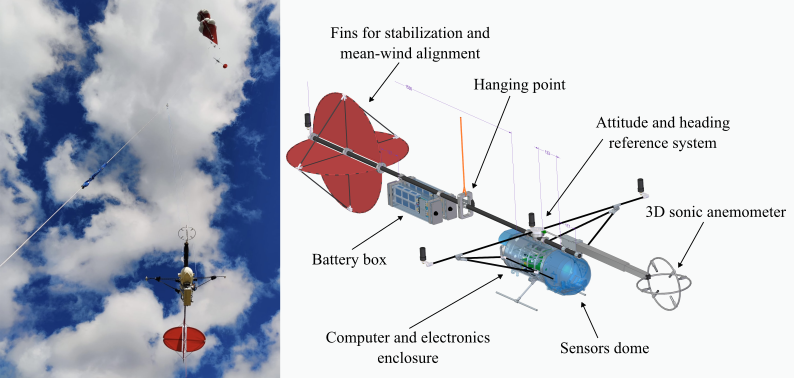
The interaction between temperature and vertical velocity within the planetery boundary layer (PBL) is critical for the understanding of air dynamics, turbulence, and vertical motions (Wyngaard, Turbulence in the Atmosphere Cambridge University Press (2010)). While tower-based observations have delivered useful data from the lower PBL, the upper regions offer exciting opportunities for further exploration, particularly the mixed layer and entrainment zone. To address this gap, we deploy the Max Planck CloudKite, a tethered kite-balloon hybrid equipped with multiple WinDarts (see figure) that probe the PBL with unprecedented precision. The WinDarts are versatile instruments that can be deployed at various heights and can continuously monitor the PBL for up to 20 hours. Each WinDart is supplied to measure three-dimensional wind speed, particle concentration (0.35-40μm), temperature, relative humidity, pressure, carbon dioxide, and volatile organic compounds, providing detailed profiles of PBL dynamics.

During two recent field campaigns, the Pallas Cloud Experiment (September 2022) and the IMPACT field campaign ("In-situ Measurement of Particles, Atmosphere, Cloud and Turbulence", May-June 2024), both in Pallas, Finland, two generations of WinDarts were deployed. These campaigns, with nearly 90 hours of flight time in the first and 280 hours in the second, yielded valuable data on the PBL structure, including turbulent fluxes of heat and momentum and interactions between the PBL and the free atmosphere.

The figure depicts, on the left, two kite balloons deployed with three WinDarts during a flight in the IMPACT field campaign, while a lateral visualization of the latest generation of WinDarts, highlighting its different components, is shown on the right.

Here, we report results from the latest generation of WinDarts used during the IMPACT field campaign. Our analysis focuses on the complex interactions within the PBL, examining the relationship between velocity and temperature fields under varying atmospheric conditions. These insights contribute to advancing our understanding of PBL processes and highlight the utility of multi-instrument platforms in observing PBL dynamics.
- Indicates paper has been withdrawn from meeting
- Indicates an Award Winner