13B.4 Synoptic-scale Variations of Convective Boundary Layer Depth Diagnosed from Dual-Polarization WSR-88D Radar Observations

Thursday, 16 January 2025: 9:15 AM
355 (New Orleans Ernest N. Morial Convention Center)
David J. Stensrud, Pennsylvania State Univ., University Park, PA; and B. Stouffer, C. L. Comer, and Y. Zhang, PhD

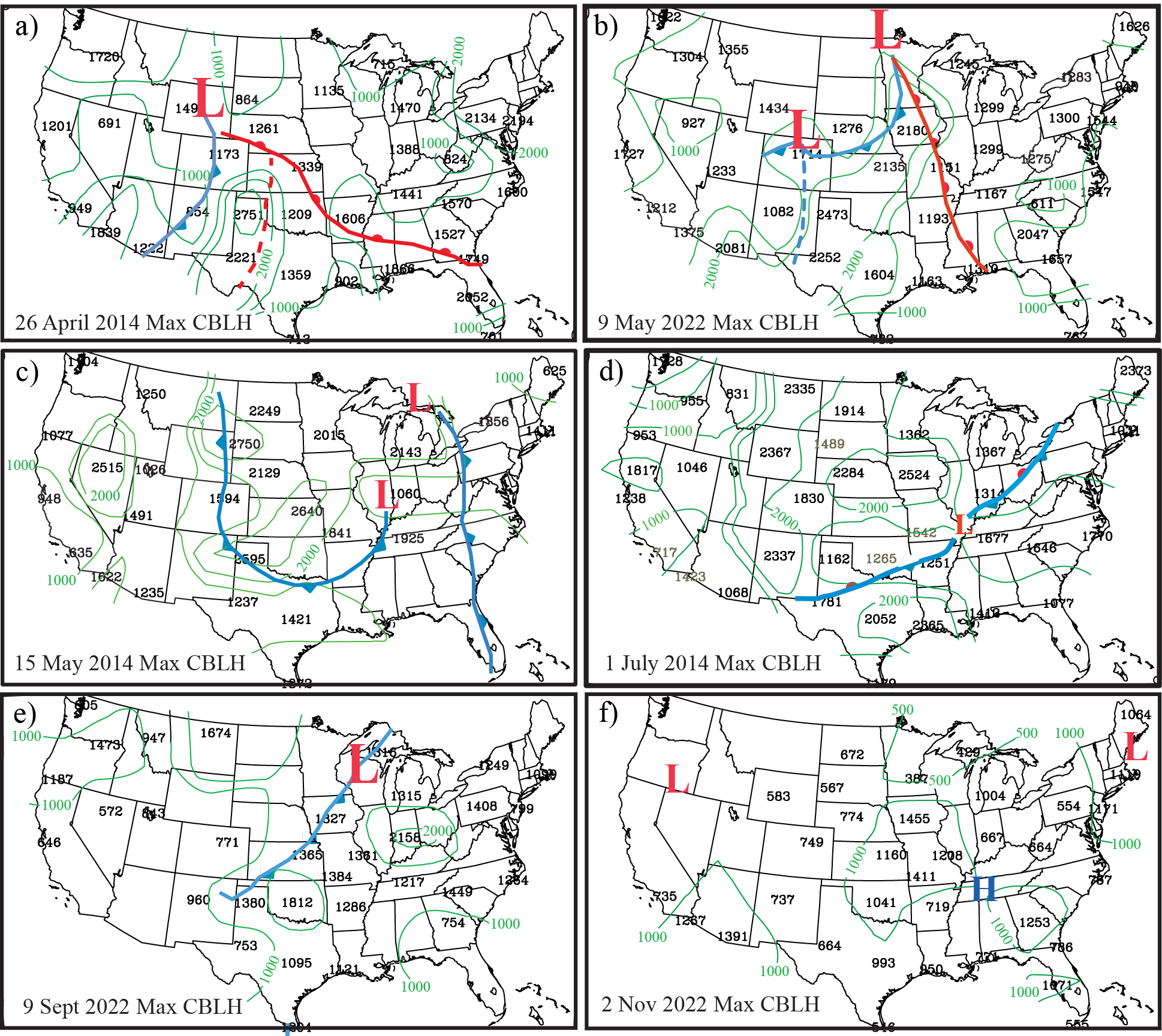
Observations of convective boundary layer (CBL) depth are calculated every 10 min during the daytime hours using the method of Comer et al. (2024) from 48 WSR-88D dual polarization radars spread across CONUS. Results from two calendar years indicate that CBL depth tends to be deeper by 500-1000 m in the warm sector of midlatitude cyclones compared to surrounding regions. Regions on the north side of cold fronts also can produce isolated deep CBL depths as strong insolation and surface heating act to mix out the colder post-frontal air mass.

Analysis of the full two years of data indicates that the time of maximum CBL depth shifts throughout the year, being earliest in the winter months and over an hour later in the summer months with regional variations apparent in the data set. CBL depth increases most rapidly in the hours prior to local noon, with decreases in CBL depth starting 3 h after local noon. The importance of calculating CBL depth routinely from the WSR-88D network will be highlighted and discussed.

Comer, C. L., B. Stouffer, D. J. Stensrud, Y. Zhang, and M. R. Kumjian, 2024: An automated approach to estimating convective boundary layer depth from dual-polarization WSR-88D observations. J. Atmos. Oceanic. Technol.,https://doi.org/10.1175/JTECH-D-23-0166.1
- Indicates paper has been withdrawn from meeting
- Indicates an Award Winner