
Wednesday, 15 January 2025: 9:15 AM
344 (New Orleans Ernest N. Morial Convention Center)
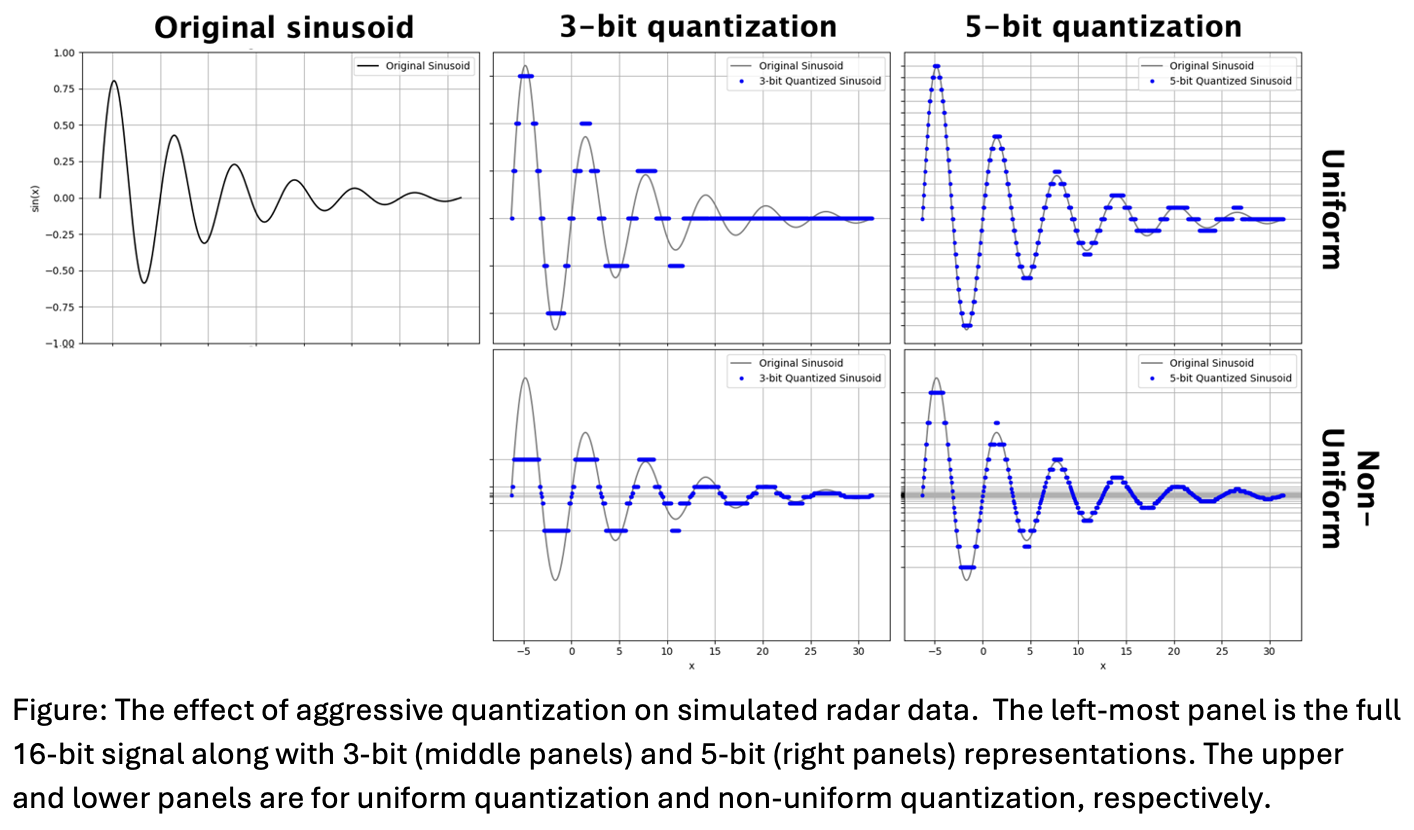
Fully digital phased array radars (PAR) have the potential for improving the temporal resolution and spatial sampling of future PAR-based weather observations. These observations would allow studies of severe weather with advanced methods such as adaptive beamforming, multi-beam imaging methods, etc. Many of these more advanced methods require I/Q processing at the element level, which highlights an important challenge with fully digital PAR: data overload. Fully digital PAR systems can produce vast amounts of I/Q data (typically 32 bits per I/Q sample for each polarization with thousands of elements per radar face and millions of samples per second) causing a significant burden on data transfer, processing, and storage. In this study, the impacts of aggressive quantization on the resulting polarimetric radar products are investigated. It will be shown that non-uniform quantization, as illustrated in the figure below, can be used to minimize the data burden while significantly improving data quality especially for low-amplitude signals. In this context, the impacts of pulse compression and digital beamforming will be demonstrated using actual data from the fully digital Horus PAR system developed at the University of Oklahoma. In addition, numerical simulations will augment the analysis. It will be shown that both pulse compression and digital beamforming act as filters mitigating the negative impact of aggressive quantization. Overall, this work will demonstrate how future PAR systems exploiting non-uniform quantization may allow routine storage/processing of I/Q data and therefore more tractable implementation of advanced signal/array processing algorithms.
 - Indicates paper has been withdrawn from meeting
 - Indicates an Award Winner