
- Jet stream waviness increases under warming when compared at similar-valued isentropes but primarily because the corresponding isentrope is closer to the surface in the warmer climate and waviness climatologically increases downwards in the atmosphere.
- A detailed analysis of the changes in Rossby wave amplitude for different wavenumbers confirms that the amplitude of large waves increases with warming, while that of short waves decreases with warming. The reduction in wave amplitude of short synoptic waves is found to dominate in the jet core region, where jet waviness also decreases and is more pronounced on the equatorward side of the jet. Long waves increase in amplitude on the poleward side of the jet and at upper stratospheric levels, which is consistent with increased jet waviness at these levels. The projected increased amplitude of planetary waves and the reduced amplitude of synoptic waves are thus clear in our aquaplanet simulations and do not require zonal asymmetries or regional warming patterns.
- During so-called high-amplitude wave events, there is no evidence for a preferential phase of Rossby waves of wavenumbers 5 or 7, indicating the crucial role of stationary waves forced by orography or land–sea contrast in establishing previously reported preferential phases.
- We confirm that feature-based block detection requires significant tuning to the warmer climate to avoid the occurrence of spurious trends. After adjustment for changes in tropopause height, the block detection used here shows no trend in the summer hemisphere and an increase in blocking in the colder hemisphere.
- We also confirm previous findings that the number of surface cyclones tends to decrease globally under warming and that the cyclone lifetimes become shorter, except for very long-lived cyclones.
Our study shows that feature-based detection methods need to be carefully adapted to new climates, in particular those that depend on a vertical coordinate. Moreover, it is shown that some circulation changes reported in the literature are already found in our zonally symmetric simulations under uniform warming, such as the change in wave amplitude of short and long waves, the stronger poleward shift in the storm tracks during summer compared to winter, and the dependence of jet waviness trends on the exact level and vertical coordinate. Other vividly discussed phenomena, however, are absent, such as the preferred phase of certain wavenumber waves during high-amplitude wave events.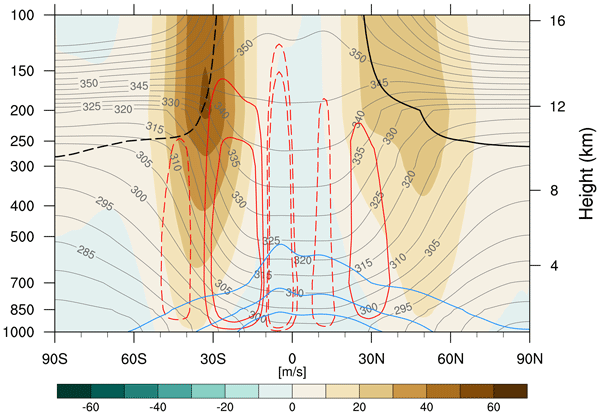
 - Indicates paper has been withdrawn from meeting
 - Indicates an Award Winner