Wednesday, 15 January 2025: 4:30 PM
203 (New Orleans Ernest N. Morial Convention Center)
Jordan Kennedy Robinson, Texas A&M, Bryan, TX
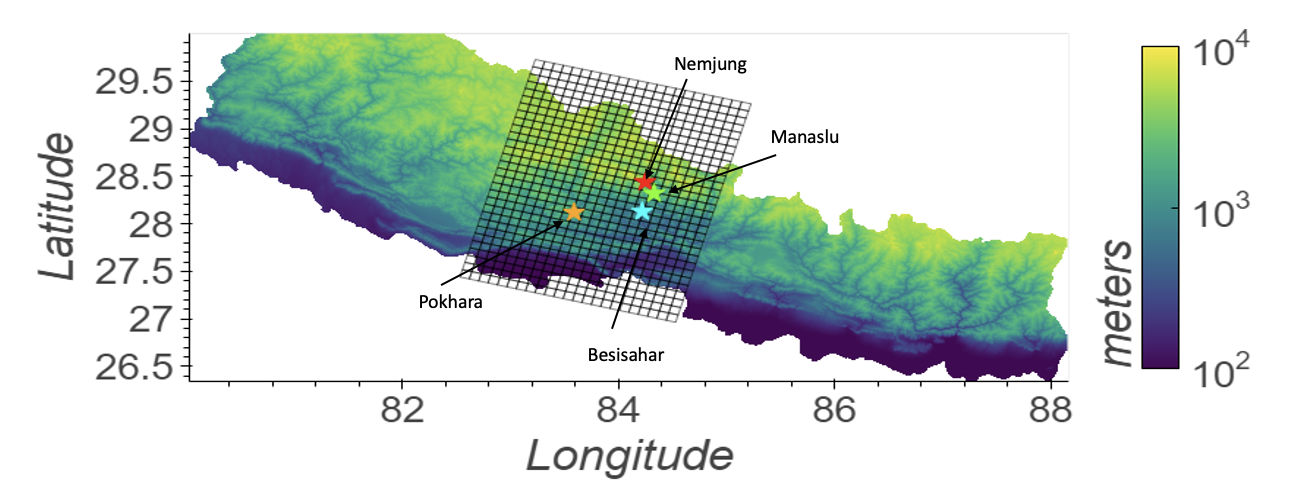
The complex terrain of the Nepali Himalayas provides a natural testbed to evaluate the influences of valley and mountain breezes on convective systems. A topographically forced diurnal wind cycle and its interaction with the large-scale wind pattern play an important role over precipitation in the region. Hourly, 0.25° ERA5 winds from 2018 were rotated to be perpendicular to the orientation of the central Himalayas and filtered to isolate the component of the wind due to diurnal topographic forcing. We refer to these winds as valley and mountain breezes, even if the unfiltered wind direction didn’t shift to be upslope or downslope. Aspects of the valley and mountain breezes, such as onset time, duration, and maximum speed, were calculated using an automated detection algorithm. Results were compiled for the entire year and by season. Half-hourly, 0.1° IMERG precipitation data from 2018 was analyzed in relation to the observed valley and mountain breezes to assess the diurnal wind cycle’s impact on upslope and downslope rainfall propagation event characteristics.
Analyzing data for two low elevation sites (Besisahar, 760 m; Pokhara, 822 m) and two high elevation sites (Mt. Manaslu, 8163 m; Mt. Nemjung, 7140 m) reveals more valley than mountain breeze events. Valley breezes tend to be stronger, while mountain breezes last longer. Valley and mountain breezes are both noticeably stronger during the dry season, especially at low elevations. Havmollers of IMERG precipitation were hand analyzed for 2018 to isolate days with rain. Days with rain were further analyzed for upslope and downslope propagation on a rotated grid. Most precipitation was found to occur just downslope of the highest peaks in the central Himalayas, with a nocturnal peak in rain rates at 2 LST. Only 11 upslope and 5 downslope propagation events were identified, all of which occurred during the pre-monsoon/monsoon seasons. The average speed for both upslope and downslope propagation events was 3 m/s. Downslope propagation events were found to exhibit higher precipitation rates and also coincided with significantly weaker mountain breezes, especially at Besisahar.

- Indicates paper has been withdrawn from meeting

- Indicates an Award Winner
