
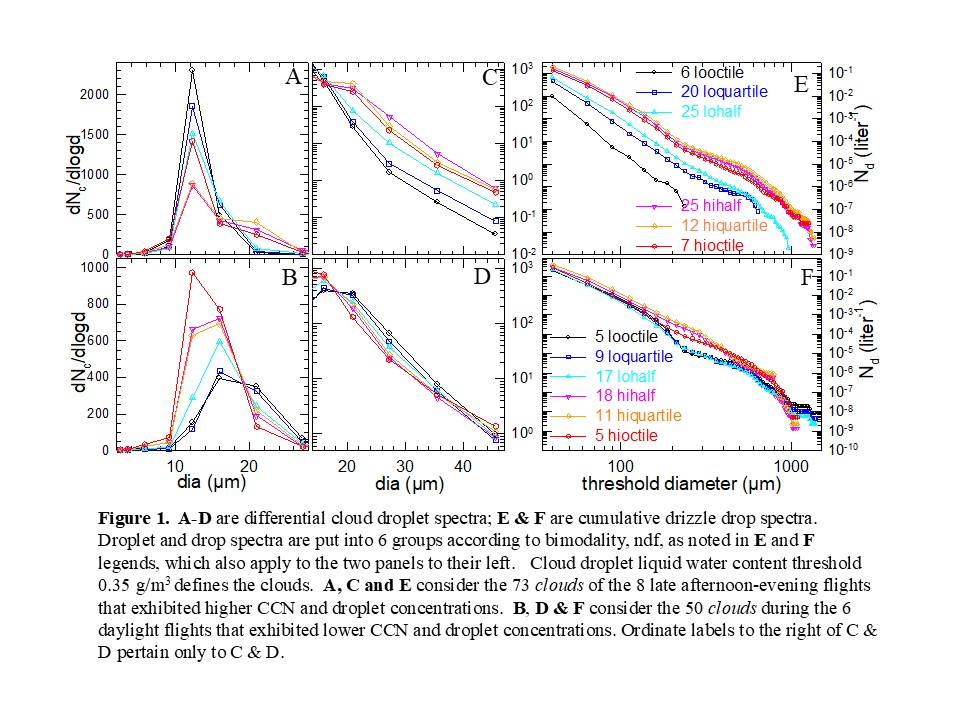
Figure 1 shows mean droplet and drizzle drop spectra from cloud groups that are associated with various CCN spectra. Droplet and drizzle spectra within clouds associated with CCN spectra that are more bimodal are characterized by the darker colors while clouds associated with CCN spectra that are more unimodal are characterized by the reddish tones. The most bimodal CCN spectra with the greatest relative numbers of low critical supersaturation, Sc, CCN (accumulation mode) are represented by black circles. These clouds are associated with the lowest octile of the CCN modality characteristic, ndf, the normalize difference of NCCN within the two modes (Aitken-accumulation) according to Sc. Lower ndf (more accumulation) means greater bimodality while higher ndf (more Aitken) are more unimodal (generally not cloud processed). The next most bimodal CCN cloud group is the lowest ndf quartile blue squares followed by the lower ndf half cyan triangles. The most unimodal highest ndf octile clouds are represented by red octagons while the next unimodal ndf quartile are the orange diamonds followed by the pink inverted triangles representing clouds associated with the higher ndf half.
Figure 1A, C and E are from the eight late afternoon-evening POST flights that exhibited higher NCCN and droplet concentrations. Here clouds associated with bimodal CCN exhibited greater concentrations of smaller droplets (Fig. 1A) but lower concentrations of larger droplets (Fig. 1C) and drizzle drops (Fig. 1E). These panels are similar to those displayed in the MASE polluted stratus. Figure 1B, D and F are from the midday POST flights, which exhibited lower NCCN and droplet concentrations. These opposite greater concentrations of smaller droplets in and lower concentrations of large cloud droplets in clouds associated with unimodal CCN are similar to analogous panels displayed in the ICE-T and RICO cumulus projects. However, drizzle Fig. 1F is opposite of ICE-T and RICO drizzle panels but more similar to panel E and the drizzle panel for MASE. Although there is less drizzle in clouds associated with bimodal CCN the F panel differences are much smaller than panel E or the MASE drizzle panel.
Large droplets in Fig. 1D exhibit a second set of line crossings analogous to those for small droplets in panels A and B. Figure 1D and F thus indicate enhancement of drizzle by higher concentrations of large cloud droplets in unimodal CCN-associated clouds and inhibition of drizzle by lower concentrations of large cloud droplets in bimodal CCN-associated clouds. These results indicate that cloud processes that enhance the accumulation mode and thus bimodality enhance the first indirect aerosol effect (IAE, cloud brightening) in polluted stratus but inhibit first IAE in clean stratus. Cloud processing enhances second IAE (cloud lifetime drizzle suppression) to a greater extent in polluted stratus than clean stratus.
Preliminary analysis of the ACE-1 project south of Australia indicates higher droplet concentrations and lower drizzle concentrations in clouds associated with bimodal CCN. This is similar to MASE and most POST stratus although most ACE-1 clouds appeared to be cumuli.
Hudson, J. G., & Noble, S. (2020). CCN spectral shape and cumulus cloud and drizzle microphysics. JGRA, 125, e2019JD031141. https://doi.org/10.1029/2019JD031141
Hudson, J. G., & Noble, S. (2022). CCN spectral modality compared to droplet spectra and drizzle in RICO cumuli. JGRA, 127, e2022JD037189. https://doi.org/10.1029/2022JD037189
Hudson, J.G., Noble, S., & Tabor, S., (2018). CCN spectral shape and stratus cloud and drizzle microphysics. JGRA, 123, 9635-9651. http://doi.org/10.1029/2017JD027865.
 - Indicates paper has been withdrawn from meeting
 - Indicates an Award Winner