
Monday, 13 January 2025: 8:45 AM
226 (New Orleans Ernest N. Morial Convention Center)
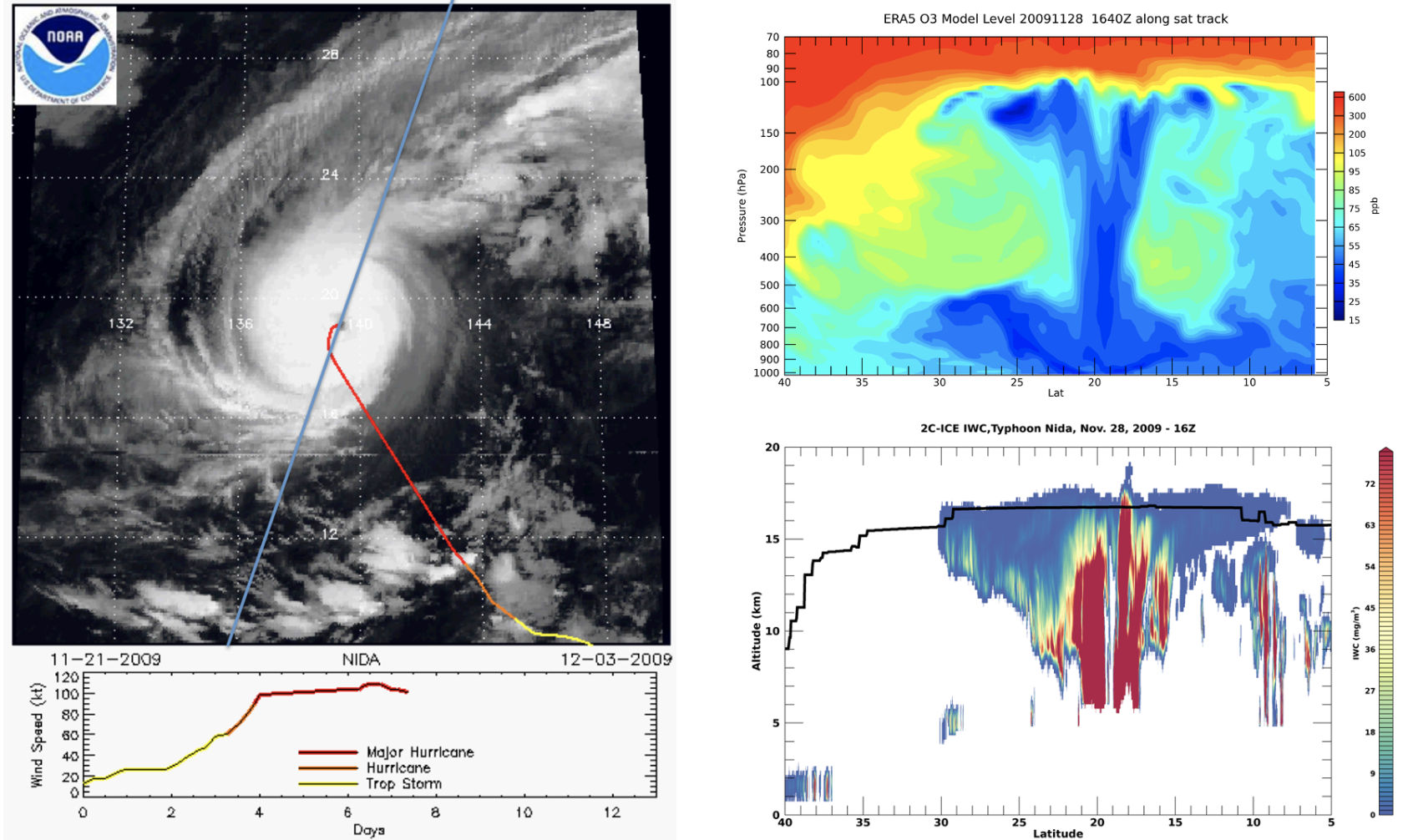
We investigate a robust observed anticorrelation between deep convection in the tropics and low ozone in the tropical tropopause region, featuring observations of clouds from active space-based sensors and a high-resolution reanalysis ozone field. This project is motivated by the decrease in tropical lower-stratospheric ozone projected by climate models due to global warming. This is frequently attributed to an increase in the stratospheric Brewer-Dobson circulation. However, there are also some climate models that indicate an increase in tropical tropopause height and consequent transport of tropospheric tracers, including low ozone, to the tropopause region, including the lowermost stratosphere. We have previously found a robust cloud-ozone anticorrelation by examining in situ data from aircraft in the tropics, sampled during the TC4 and ATom aircraft field campaigns. However, these data sets are limited by the vertical range of the NASA DC-8, which tops out at 180 hPa, significantly below the tropical tropopause. Aircraft and balloons flying at higher altitudes are prevented from sampling in the vicinity of strong, deep convective storms, and therefore these data sets are biased towards sampling in clear air or in thin cirrus clouds. To correct for this, we explored the combination of active remote sensing of clouds from the CALIPSO Lidar and CloudSat Radar with the model-level ozone field from the ERA-5 reanalysis. A first-look case study of a Category 4 tropical storm, Typhoon Nida, occurring in the tropical western Pacific during November, 2009 is shown qualitatively in the figure below. Our analysis reveals that the cloud-ozone anticorrelation observed with in situ data holds for this case study, into the lower stratosphere. We extend the Typhoon Nida case study by matching the CloudSat 2C-ICE combined Radar-Lidar retrievals of cloud ice water content with ERA-5 ozone during this month in the tropical Pacific, between 30N and 30S. In this presentation we show both the ozone-cloud ice relationships and ozone histograms for clear and cloudy air for this region at the ERA-5 model levels.
 - Indicates paper has been withdrawn from meeting
 - Indicates an Award Winner