
Monday, 13 January 2025: 11:30 AM
214 (New Orleans Ernest N. Morial Convention Center)
Extreme heat events are increasing in frequency, duration, and intensity globally as the climate changes. In the Pacific Northwest region of the United States where the climate has historically been temperate, residents are particularly vulnerable to the health impacts of higher temperatures due to lower levels of acclimatization and low penetration of residential air conditioning. The 2021 Pacific Northwest Heat Dome event delivered a stark wake-up call with temperatures reaching 60-68°F above average, resulting in more than 800 deaths regionally, 157 deaths across Washington State, and 30 deaths in King County. The city of Seattle has experienced record-breaking heat every subsequent summer following the 2021 Heat Dome event, signaling the need to better prepare communities to adapt to and reduce the health risks of extreme heat.
King County government has demonstrated a commitment to identifying and implementing solutions to address climate change tracing back to state and county legislation passed in 2006. Responding to the climate impacts that frontline communities face during the summer heat and wildfire seasons, King County agencies have committed to several efforts in the 2023-2025 timeline including the King County Urban Extreme Heat Mitigation Strategy, the King County Wildfire Smoke Strategy, the expansion of Climate + Health Indicators on heat vulnerability, and a regional cross-government collaborative on the public health response to the 2021 Heat Dome. In alignment with these countywide efforts, Public Health-Seattle & King County has come together with researchers from University of Washington and Emory University to initiate a community-based adaptation planning project focused on communities in King County most impacted by extreme heat.
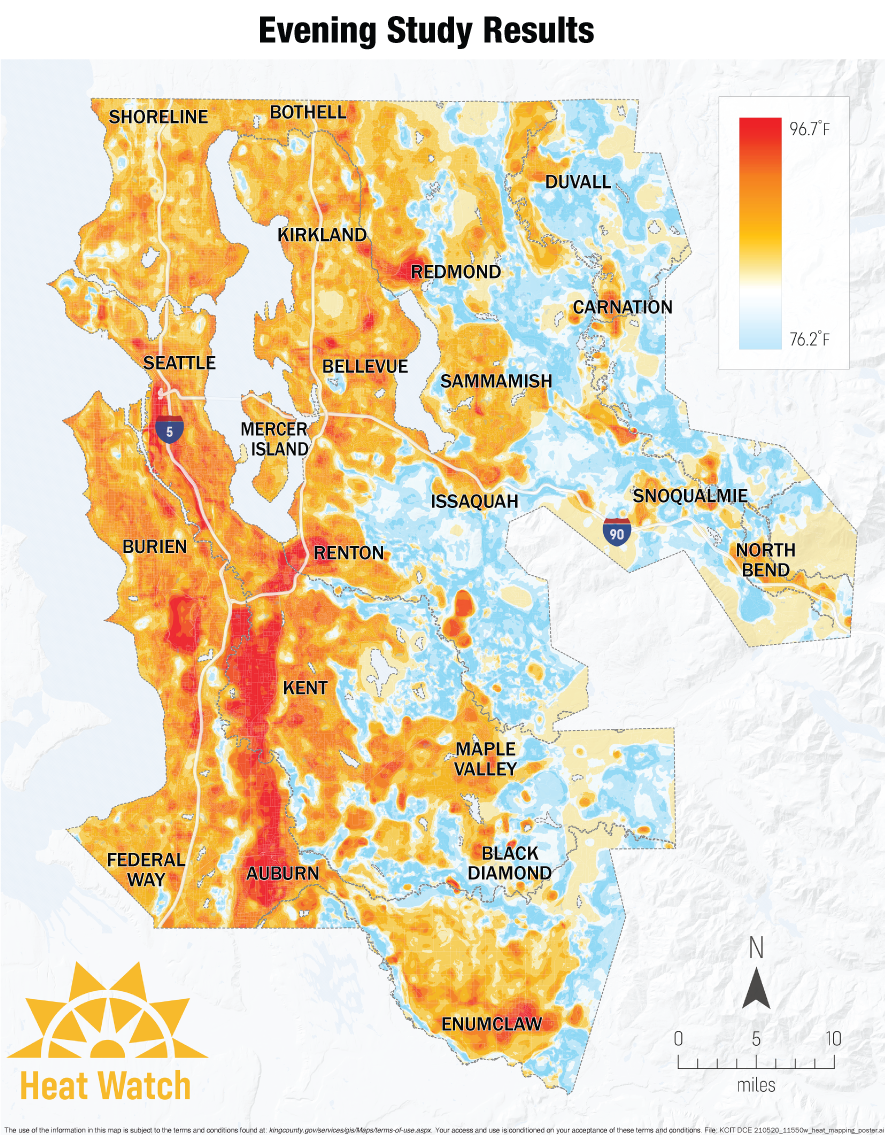
The Climate and Health Adaptation Modeling Project for Community-Determined Solutions (CHAMP-CDS) brings together community members, public health practitioners, climate modelers, and health scientists to engage in an evidence-based group model building approach, a qualitative method utilized in systems science to engage community members and other interested parties to collectively explore the causes and consequence of complex problems. The objective of the CHAMP project is to invite, validate, and amplify community perspectives, priorities, and solutions to reduce the local impacts of extreme heat on health. The city of Auburn was selected to be the community of focus due to its elevated heat-health risk as determined in a heat mapping study that was conducted in 2020, and because of the City of Auburn’s readiness and capacity to participate in the project.
To begin the participatory model-building approach, a 15-person workgroup (“CHAMPions”) representing a variety of perspectives, sectors, and lived experience with extreme heat was assembled in June and July 2024. The CHAMPions workgroup will come together six times between July 2024 and March 2025 to produce a causal loop diagram that facilitates visualization of the relationships between different factors driving heat health risk identified by the group. Each workshop follows a predetermined structure: 1) Setting the Stage; 2) Defining the Problem; 3) Mapping the Variables; 4) Validating the Diagram; 5) Identifying Emerging Themes; and 6) Finalizing Interventions. The final product is a large causal loop diagram that can be used to determine areas for intervention and identify potential negative outcomes or unintended consequences associated with proposed solutions, leading interested parties to prioritize those strategies and policies that promote health equity.
After the causal loop diagram has been finalized, the findings will be shared with decision-makers and other interested parties in the community with the goal of implementing solutions that were prioritized by the CHAMPions workgroup. In addition to the systems diagram model, multimedia narrative stories will be developed to communicate heat and health themes that emerged during the process of model-building.
The first workshop was held on July 27, 2024, and the fourth workshop will be held on December 7, 2024. At the time of the American Meteorological Society’s Annual Meeting in January 2025, the CHAMP-CDS project will be more than halfway through the scheduled workshops. In this oral presentation, we will describe the community based participatory-modeling process to date, from identifying a focus community and assembling a diverse workgroup to the iterative development of the causal loop diagram. During the session, findings from the first four workshops will be shared – including the most current version of the causal loop diagram created by the CHAMPions. We will also share best practices and lessons learned to inform researchers curious about participatory group model building and systems dynamics science.
King County government has demonstrated a commitment to identifying and implementing solutions to address climate change tracing back to state and county legislation passed in 2006. Responding to the climate impacts that frontline communities face during the summer heat and wildfire seasons, King County agencies have committed to several efforts in the 2023-2025 timeline including the King County Urban Extreme Heat Mitigation Strategy, the King County Wildfire Smoke Strategy, the expansion of Climate + Health Indicators on heat vulnerability, and a regional cross-government collaborative on the public health response to the 2021 Heat Dome. In alignment with these countywide efforts, Public Health-Seattle & King County has come together with researchers from University of Washington and Emory University to initiate a community-based adaptation planning project focused on communities in King County most impacted by extreme heat.
The Climate and Health Adaptation Modeling Project for Community-Determined Solutions (CHAMP-CDS) brings together community members, public health practitioners, climate modelers, and health scientists to engage in an evidence-based group model building approach, a qualitative method utilized in systems science to engage community members and other interested parties to collectively explore the causes and consequence of complex problems. The objective of the CHAMP project is to invite, validate, and amplify community perspectives, priorities, and solutions to reduce the local impacts of extreme heat on health. The city of Auburn was selected to be the community of focus due to its elevated heat-health risk as determined in a heat mapping study that was conducted in 2020, and because of the City of Auburn’s readiness and capacity to participate in the project.
To begin the participatory model-building approach, a 15-person workgroup (“CHAMPions”) representing a variety of perspectives, sectors, and lived experience with extreme heat was assembled in June and July 2024. The CHAMPions workgroup will come together six times between July 2024 and March 2025 to produce a causal loop diagram that facilitates visualization of the relationships between different factors driving heat health risk identified by the group. Each workshop follows a predetermined structure: 1) Setting the Stage; 2) Defining the Problem; 3) Mapping the Variables; 4) Validating the Diagram; 5) Identifying Emerging Themes; and 6) Finalizing Interventions. The final product is a large causal loop diagram that can be used to determine areas for intervention and identify potential negative outcomes or unintended consequences associated with proposed solutions, leading interested parties to prioritize those strategies and policies that promote health equity.
After the causal loop diagram has been finalized, the findings will be shared with decision-makers and other interested parties in the community with the goal of implementing solutions that were prioritized by the CHAMPions workgroup. In addition to the systems diagram model, multimedia narrative stories will be developed to communicate heat and health themes that emerged during the process of model-building.
The first workshop was held on July 27, 2024, and the fourth workshop will be held on December 7, 2024. At the time of the American Meteorological Society’s Annual Meeting in January 2025, the CHAMP-CDS project will be more than halfway through the scheduled workshops. In this oral presentation, we will describe the community based participatory-modeling process to date, from identifying a focus community and assembling a diverse workgroup to the iterative development of the causal loop diagram. During the session, findings from the first four workshops will be shared – including the most current version of the causal loop diagram created by the CHAMPions. We will also share best practices and lessons learned to inform researchers curious about participatory group model building and systems dynamics science.
 - Indicates paper has been withdrawn from meeting
 - Indicates an Award Winner