
In this presentation, we review the broader efforts to track, understand, and predict the drift of icebergs and ice islands by the International Ice Patrol, Canadian Ice Service (CIS) and Atmospheric Monitoring Division (AMD) of the Meteorological Service of Canada (MSC), and the US National Ice Center. These agencies collaborate in the North American Ice Service (NAIS), have been tagging icebergs for decades, and developed the NAIS Iceberg Drift Model to predict the drift of icebergs in Baffin Bay and the North Atlantic. We also highlight the recent efforts of the International Cooperative Engagement Program for Polar Research (ICE-PPR), the International Arctic Buoy Programme (IABP) and the MSC to GPS-tag icebergs and ice islands in the Arctic Ocean and its peripheral seas. In May 2021, ICE-PPR and IABP tagged icebergs locked in the landfast ice near Utqiagvik, Alaska, some of which drifted south through the Bering Strait later that year. In August 2021, ICE-PPR and IABP tagged 52 icebergs of various sizes and shapes in Disko Bay, and another six ice islands around Greenland in September 2021. In collaboration with Carleton University and ICE-PPR, the MSC deployed six beacons on ice islands west of Axel Heiberg Island in Nunavut. In September 2023 the MSC collaborated with the University of Ottawa to tag one iceberg near Humboldt Glacier in northeast Greenland. In September 2023, Ice-PPR and IABP tagged 10 icebergs in Sermilik Fjord, Greenland. In January and August of 2024, ICE-PPR and IABP flew with the Alaska Air National Guard to reseed the IABP Arctic Observing Network and tagged four ice islands in the Beaufort and Chukchi seas. From these campaigns, a new (and growing) database of iceberg and ice island drift characteristics, including airborne and satellite imagery of their wide-ranging geometries, is presented.
We share methods for tagging icebergs using GPS equipped buoys of various types. We also present preliminary results on the force balance of winds and ocean currents on icebergs and ice islands. For example, when sea ice concentrations around ice island MIL20-A-1-B-3-A (tagged in January 2024) decreased down to less than three tenths in August 2024, subsequent increases in wind led to a sea ice drift twice as high as detected from the nearby ice island (Fig. 2). These observations, and the novel research they enable, are critical for better understanding the drift and fate of icebergs and ice islands in a changing Arctic. This monitoring initiative is especially crucial with increasing maritime traffic in the Arctic and the ever-increasing need for accurate iceberg detection, drift modeling and prediction.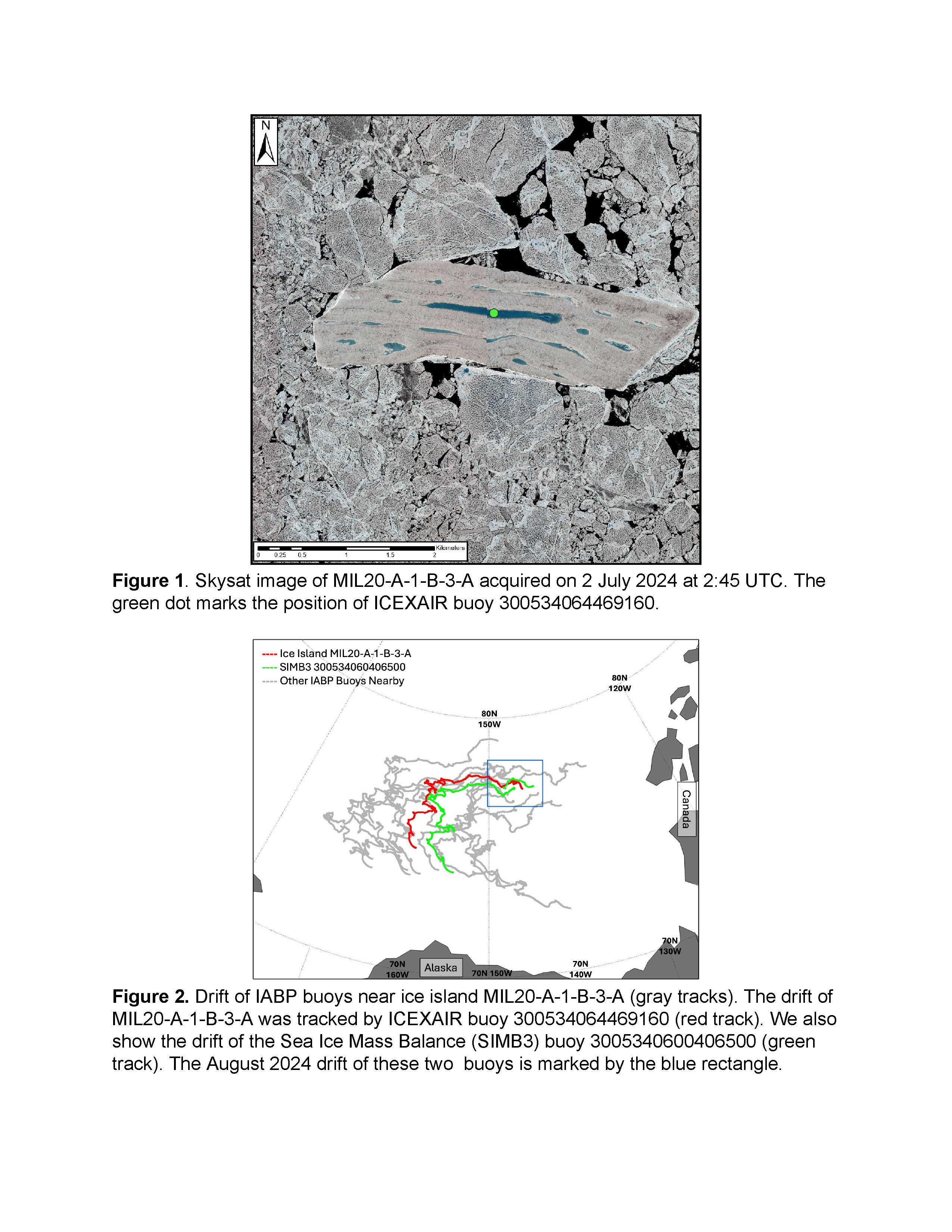
 - Indicates paper has been withdrawn from meeting
 - Indicates an Award Winner