
Thursday, 16 January 2025: 11:15 AM
203 (New Orleans Ernest N. Morial Convention Center)
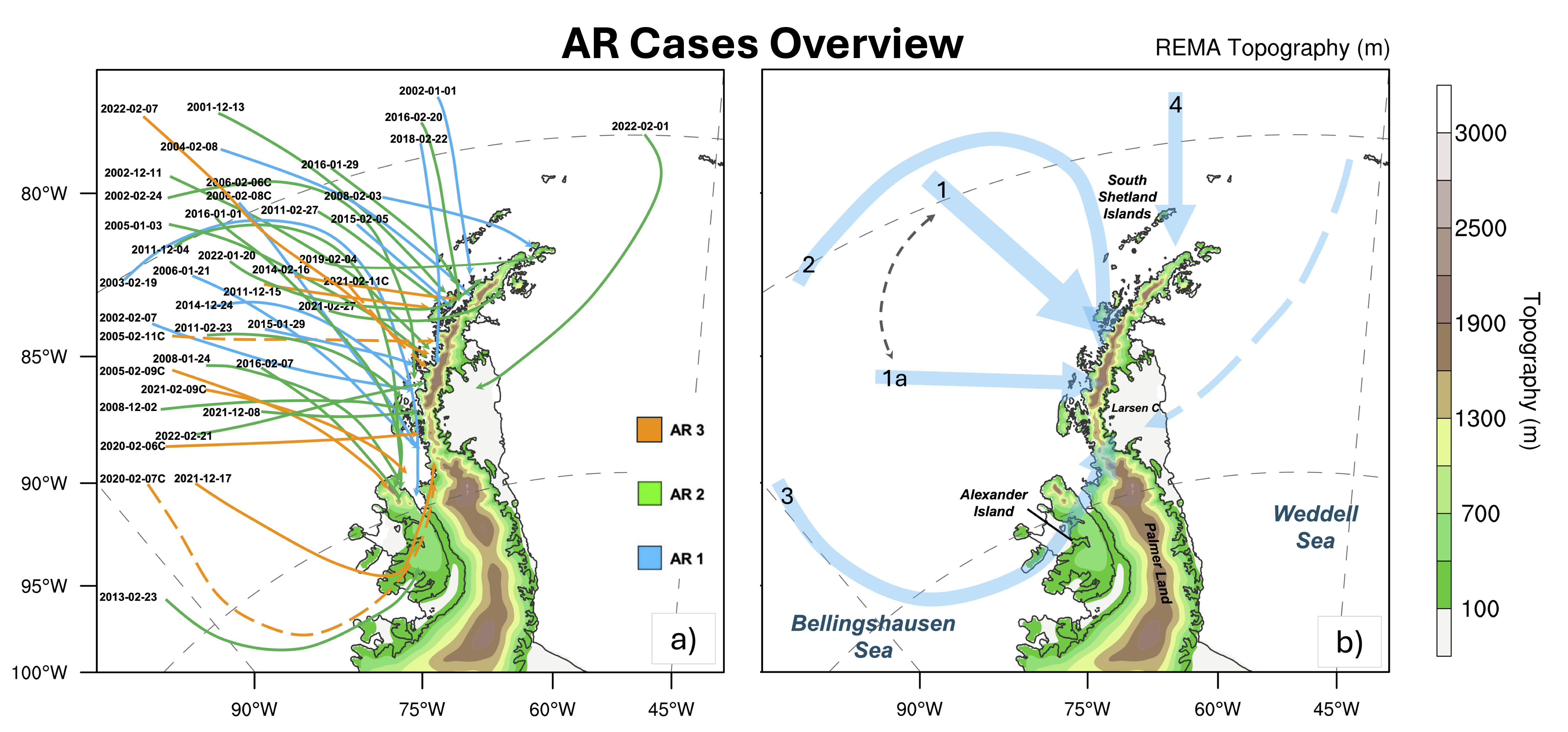
The Antarctica Peninsula (AP) has experienced extreme weather and intense surface melting in the past few decades. The combined effects of Atmospheric Rivers (ARs), amplified leeside foehn warming, and surface snow melt pose threats to the stability of ice shelves, ultimately resulting in ice loss. This study utilizes high-resolution Polar WRF simulations driven by ERA5 to analyze 38 strong AR cases, selected based on the CW3E Polar AR scale, that occurred during austral summers post-2000. The primary focus is to investigate the relationship between ARs and foehn warming, orographic precipitation, as well as the combined impact on surface energy balance. Preliminary results suggest that the strength and location of the low-pressure center, as well as the presence of a blocking high, have a significant impact on the AR pattern. Among 38 selected AR cases, 4 leading AR patterns have been identified. Different characteristics of AR, including the direction, Integrated Vapor Transport (IVT) magnitude, and duration, significantly influence foehn-induced warming mechanisms, leading to distinct patterns of surface melting on the leeside. Increased incoming shortwave radiation from foehn clearance (clear sky on the leeside) along with higher longwave radiation due to cloud formation from AR spillover, and stronger sensible heat flux towards the surface resulting from mountain waves contribute to an elevated surface energy balance and more melting. The contribution of each component varies depending on the characteristics of the AR, and we identify and quantify these contributions via trajectory analysis. Additionally, ARs can introduce orographic precipitation that enhances latent heat release and triggers rain-on-snow events, particularly on the upwind side. This study underscores the growing impacts of AR over Antarctica in the context of climate change, while also emphasizing the efficacy of high-resolution model simulations in revealing regional-scale drivers and estimating the ice loss.
 - Indicates paper has been withdrawn from meeting
 - Indicates an Award Winner