
Beginning in 1934, the National Geographic Society and the U.S. Army Air Corps co-funded upper atmospheric flights. They would use a sealed gondola suspended from a long balloon to take crew up into the stratosphere. The purpose for this effort not only involved breaking prior ascent records but also scientific experimentation and observation.
The Chief of the Air Corps approved the enterprise, save with the exception that funding for the balloon would come from outside the Air Corps. In short order, interest from the National Geographic Society was garnered. Henceforth, the program would become a joint public-private sector partnership known as the United States Stratospheric Expedition. The aerial vehicle would be constructed entirely by private corporations. Dow Chemical Company built the pressurized gondola, which could be carried up to an altitude record. Goodyear developed the three-million square foot hydrogen-filled balloon that would become known as Explorer I.
An Air Corps team scoured for an optimal spot from which to base the flights to be made. They needed unimpeded and level vistas for take-off and landing and predictably regular weather. Launching would occur from a spot located twelve miles southwest of Rapid City, South Dakota, one that would become a camp termed the Stratobowl.
The first effort occurred on 28 July 1934. Captain Albert Stevens of the Air Corps would be observer on the flight, while Major William Kepner would be the flight commander. In charge of operations on the ground was Captain Orvil Anderson, who as an alternate pilot would accompany the other two officers on the ascent. While it did reach over 60,000 feet in elevation, a tear in the balloon’s bottom lining forced the Explorer to descend. Eventually, the officers had to bail out, and much of the equipment was smashed upon impact. But some invaluable data survived.
A second effort using a larger gondola known as Explorer II as well as a larger balloon would occur in 1935. Onboard this time were just two pilots: Captains Anderson and Stevens. Again launching from the Stratobowl, and after a weather delay, Stevens and Anderson would make a try on 11 July 1935. However, the balloon collapsed during inflation.
New material for the balloon and optimal weather conditions would be available when the flight was again ready to go on 10 November. However, Explorer II’s balloon had a fabric rip during inflation. Quick patching followed. The crew of two were able to take off that next morning, with large groups of spectators watching from the Stratobowl’s rim.
At about 17,000 feet the pilots sealed the gondola. The temperature inside the craft would range from the low twenties up to the forties at higher altitudes, but it was quite comfortable for the flyers. Two hours and ten minutes later, they achieved a maximum altitude of 72,395 feet. Ninety minutes of time followed during which they initiated sixty-four experiments and made many observations. Then descent began, impacting with the ground near White Lake, South Dakota.
Having soared to 13.71 miles, this flight was considered a major success. The results from their work going up to and while in the stratosphere were impressive. The scientific benefits derived by its relatively short flight time of eight and a half hours were unparalleled in modern times.
High altitude research conducted from Explorer II provided valuable data on ozone vertical distribution, the nature of cosmic rays, electrical conductivity, biotic assay, observations on brightness, radio transmissions at maximum height, and atmospheric composition. Indeed, information from their work in the stratosphere contributed significantly to the development of the high altitude aircraft that would be used to win WWII. The Explorer program also contributed information providing contextual support to future unmanned and manned rocket flights.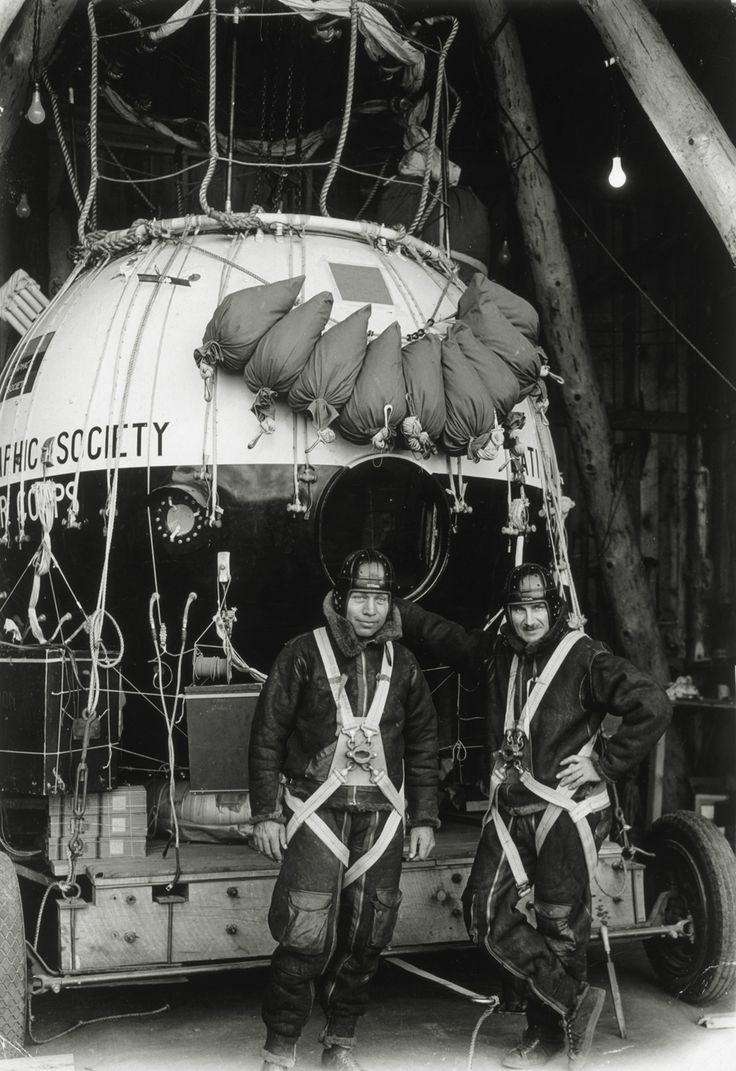
 - Indicates paper has been withdrawn from meeting
 - Indicates an Award Winner