
Monday, 13 January 2025: 11:15 AM
339 (New Orleans Ernest N. Morial Convention Center)
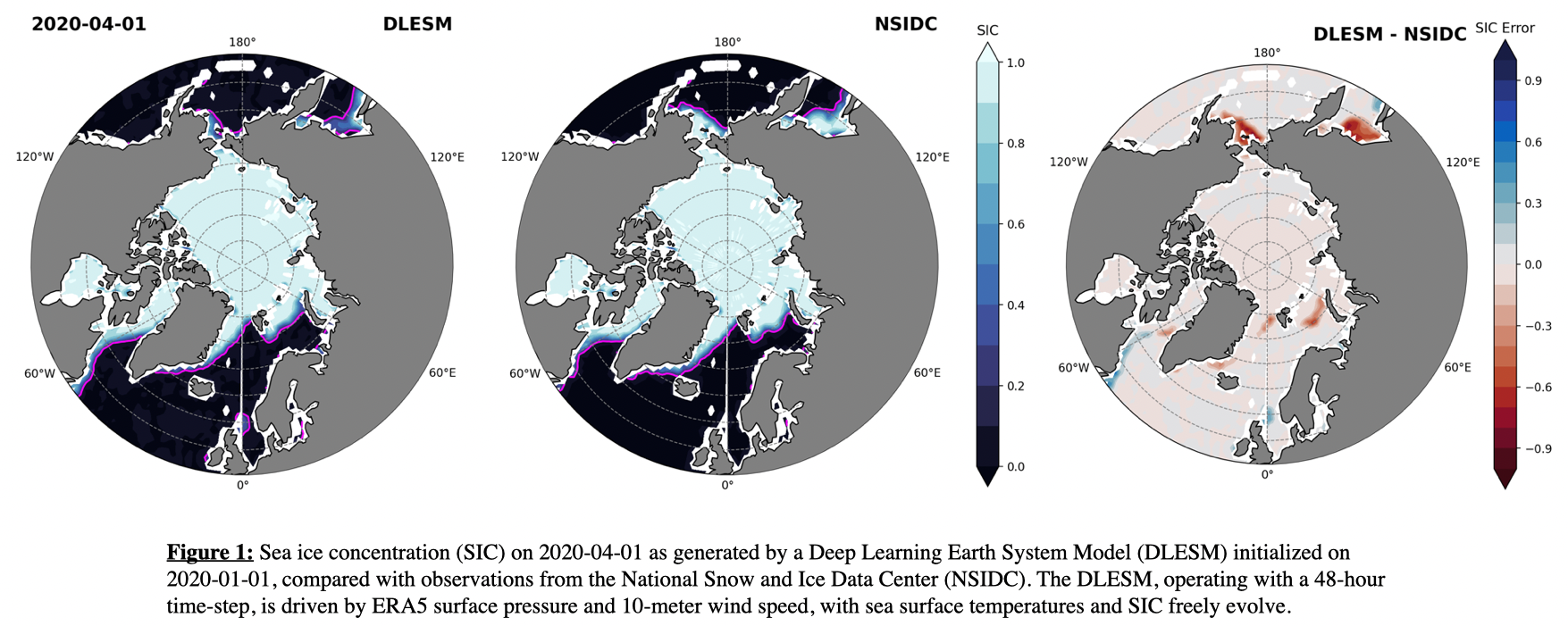
Antarctic and Arctic sea ice has reached record or near-record lows with increasing frequency in recent decades. Despite its critical role in ice shelf stability, marine ecosystems, global albedo, and midlatitude extreme weather, forecasting sea ice at subseasonal to seasonal lead times remains a significant challenge. In this study, we introduce a deep learning Earth system model (DLESM) for global sea ice forecasting. The DLESM integrates separate atmosphere and ocean components, advancing them iteratively to generate global maps of daily sea ice concentration. The system is competitive with state-of-the-art dynamical models for seasonal sea ice forecasting, but operates at a fraction of the computational cost. Using ensemble predictions, we assess it's forecast performance on recent Arctic (2024) and Antarctic (2023, 2024) sea ice extremes. Notably, the system is stable at arbitrary lead-times (< 100 years) and generates realistic modes of internal variability at high latitudes, comparable with modern global climate models. This DLESM offers a valuable tool for seasonal to subseasonal sea ice prediction and for exploring high-latitude climate variability on long-time scales, marking a significant advancement in operational sea ice forecasting and bridging the gap between weather and climate projections.
 - Indicates paper has been withdrawn from meeting
 - Indicates an Award Winner