
Open-path dual-frequency-comb spectroscopy (DCS) is a broadband, high spectral resolution, and accurate method for measuring gas concentrations over kilometer scale paths. It has been used for detection and quantification of emissions of pollutants, hazardous gasses, and greenhouse gases. To achieve high signal-to-noise ratios over long outdoor paths with DCS, comb light is targeted onto a retroreflector at the end of the measurement path, returning the light to the launch point where it is collected and used to measure concentrations integrated over the light path.
Here we submit a new application of DCS where the retroreflector is mounted on a tethered balloon and an active tracking system is used to keep comb light on the retroreflector. Mobile-target DCS measurements have a variety of potential applications, especially since DCS can be tuned to different spectral regions to target specific gas species including H2O, CH4, CO2, and a variety of VOCs. Raising and lowering a tethered balloon allows for sampling a triangular wedge area, allowing one to back out the variability of gas concentration as a function of altitude, or to measure the gas flux through the plane drawn by the wedge scan. The use of a tethered balloon as the airborne platform for a retroreflector provides access to high (kilometer) altitudes above ground and long flight times.
Here we show continuous tracking and measurement along a ground-to-balloon slant path for two flights from 20-550 m altitude conducted at Sandia National Laboratories outside of Albuquerque, New Mexico. CO2 and H2O profiles are measured for the duration of each flight. A future deployment is confirmed for October/November 2024 with FAA clearance to fly the balloon up to 1500 m.
Methods
For DCS measurements, two near-infrared, self-referenced, optically coherent fiber frequency combs are used with repetition rates of fr≈200 MHz and difference in repetition rate of Δfr=659 Hz. The combs are amplified, broadened, combined, and filtered resulting in a spectrum covering wavelengths 1.52-1.61 μm (6200 – 6600 cm-1). This range contains absorption bands for CO2 and H2O, and a similar configuration can include CH4 bands as well. The comb light is combined in fiber and connected to a launch/receive telescope held by a gimbal. Once launched from the telescope, the light travels over an open-air path to a retroreflector, which returns the signal to the same telescope to be collected on a photodetector. The DCS system generates ~670 interferograms per second, where the Fourier transform of each interferogram is a measurement of the atmospheric absorption spectrum. The interferograms are phase corrected and combined to 10 second averages in real time by a GPU. The GPU data acquisition also removes time periods where interferograms are expected but no DCS signal is measured, as well as any interferograms that don’t meet quality filtering criteria.
A 7 m diameter helium-filled tethered balloon was used to lift a payload apparatus up and down to a maximum height of 600 m above ground level (limited by Federal Aviation Administration approval for this site). The payload included a gimbal which actively steered a retroreflector, camera, and 850 nm beacon LED towards the ground station to maintain line of sight and keep comb light within the acceptance angle of the retroreflector. Also onboard the balloon was a 3D anemometer, radiosonde, air pressure sensor, air temperature sensor, and GPS. The ground station was located ~1 km from the balloon launch site making measurement path lengths on the order of 0.9-1.2 km.
Signal was maintained using feedback control of the gimbal holding the telescope and a tracking camera. An error signal was generated based on the distance (in pixels within the camera view) between the LED beacon and a pre-aligned crosshair representing the location of the DCS beam. The error signal was used as feedback to keep the DCS beam targeted on the retroreflector.
Results
Two flights above 500 m demonstrate effective target tracking despite the random motion from the balloon. Readings from the balloon-mounted anemometer show wind speeds of 0-10 m/s, with more variability and high winds occurring more frequently during flight 1. The balloon moved in all directions with velocities normally ranging 0-4 m/s and peaks up to 8 m/s. Horizontal oscillations of the balloon were frequent, with periods of 1-5 minutes and magnitudes of 10-50 m peak-to-trough.
Throughout both flights the active tracking system followed the balloon’s movement with frequent but short duration dropouts. Signal up-time can be quantified by the number of samples containing usable interferograms (each sample contains 1 interferogram if signal is up). Sampling at a rate of ~670 Hz, flight 1 had 62% signal uptime and flight 2 had 87%. During flight 1, 68% of 10-second time segments had at least 50% signal up-time, compared to 89% for flight 2. This indicates that dropouts were frequent but lasted less than a few seconds. The difference between flights is mainly due to higher and more variable wind and balloon velocities during flight 1.
Measured absorption spectra were fit to the HITRAN spectral database and averaged to one-minute resolution concentrations. For both flights, observed CO2 was near global background levels (~426 ppm) and varied little over time and as the balloon changed altitude. During flight 1, H20 concentrations decreased gradually over time but did not vary with altitude. During flight 2, humidity measured by the DCS and balloon-mounted radiosonde decreased with increasing balloon altitude, while ground level water vapor gradually increased over time.
Future measurements will attempt longer flight durations, higher balloon altitudes, and will target additional gas species such as CH4. Next flights are scheduled for October 2024, and will take place at the Atmospheric Radiation Measurement Southern Great Planes site near Billings Oklahoma, where FAA approval will allow balloon flights up to 1500 m.
This work was partially supported by the Laboratory Directed Research and Development program at Sandia National Laboratories, a multimission laboratory managed and operated by National Technology and Engineering Solutions of Sandia LLC, a wholly owned subsidiary of Honeywell International Inc. for the U.S. DOE’s NNSA under contract DE-NA0003525. 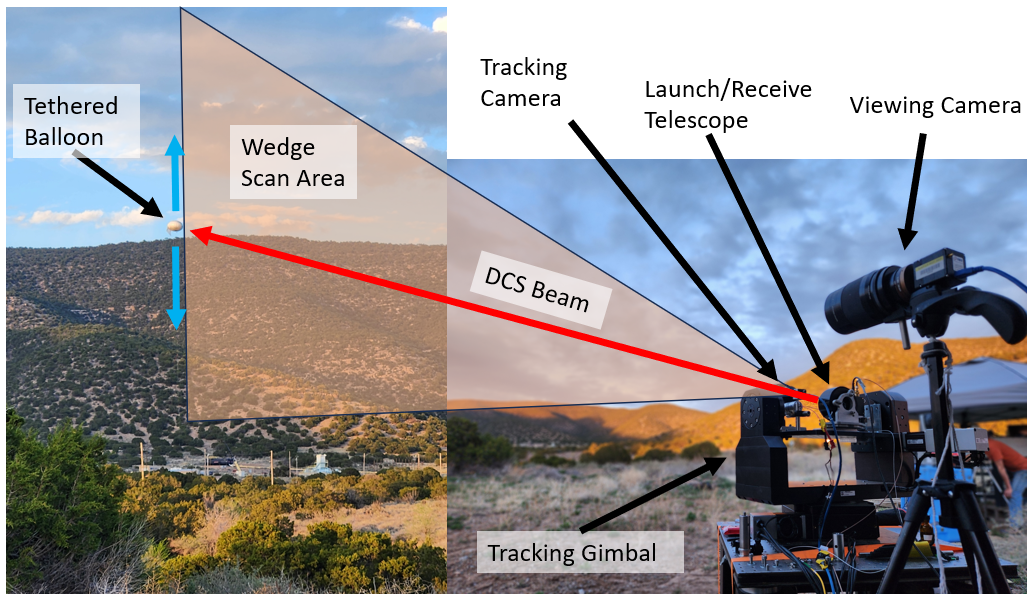
 - Indicates paper has been withdrawn from meeting
 - Indicates an Award Winner