
Four 3U CubeSats (5.4 kg each) for the TROPICS constellation mission were launched into two low-Earth orbital planes inclined at approximately 33 degrees with a 550-km altitude. Each CubeSat comprises a Blue Canyon Technologies bus and a high-performance radiometer payload to provide temperature profiles using seven channels near the 118.75 GHz oxygen absorption line, water vapor profiles using three channels near the 183 GHz water vapor absorption line, imagery in a single channel near 90 GHz for precipitation measurements (when combined with higher resolution water vapor channels), and a single channel at 205 GHz that is more sensitive to precipitation-sized ice particles. TROPICS spatial resolution and measurement sensitivity is comparable with current state-of-the-art observing platforms. Data from the three currently operational CubeSats are downlinked to the ground via the KSAT-Lite and ATLAS Space Operations ground networks with latencies better than one hour. The separate TROPICS Pathfinder mission, which launched into a sun-synchronous orbit on June 30, 2021 in advance of the TROPICS constellation mission, served as a technology demonstration and risk reduction effort. The TROPICS Pathfinder mission, now concluded, yielded useful data for 30+ months of operation and provided an opportunity to checkout and optimize all mission elements prior to the primary constellation mission. TROPICS temperature vertical profile products yield performance slightly worse than ATMS (1.5 K RMS uncertainty for TROPICS versus 1.3 K RMS uncertainty for ATMS averaged from 0-20 km in 3-km layers), and TROPICS water vapor profile products yield performance slightly better than ATMS (19% RMS uncertainty for TROPICS versus 21% uncertainty for ATMS averaged from 0-10 km in 3-km layers). TROPICS rain rate and tropical cyclone intensity products are also available with uncertainties that generally approach those of ATMS. These TROPICS products are now available with much improved median revisit rates and excellent data latencies, enabling their use in operational tropical cyclone forecasting applications.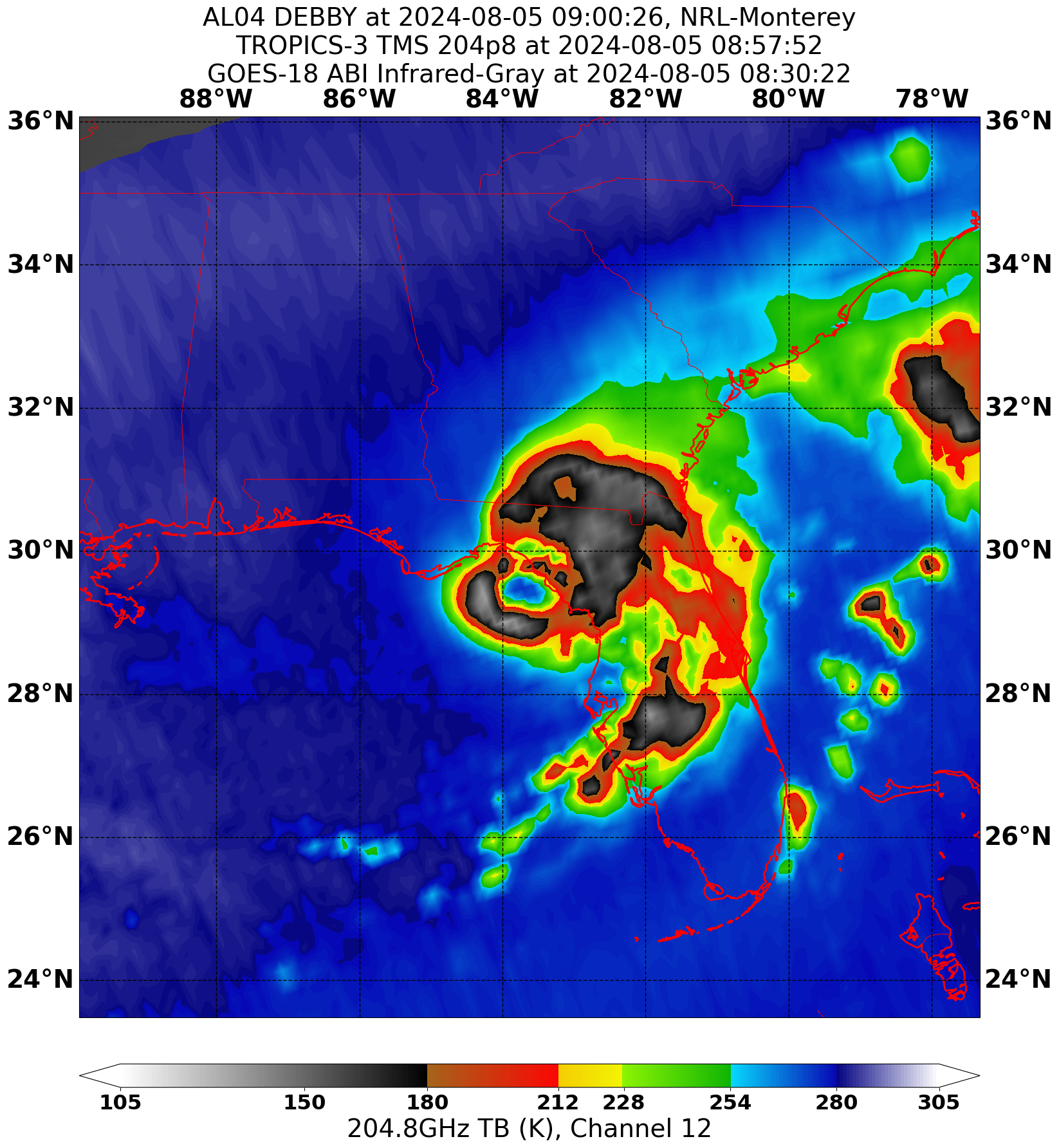
 - Indicates paper has been withdrawn from meeting
 - Indicates an Award Winner