
Wednesday, 15 January 2025
Hall C (New Orleans Ernest N. Morial Convention Center)
Tropical cyclones (TCs) are strong mesoscale phenomena that occur in the ocean, and are characterized by strong winds which have a significant impact on the upper ocean dynamic process and heat structure. Hence, upper ocean temperature response to TCs has attracted much attention over the past several decades. Current study mainly depicted sea surface cooling induced by vertical mixing through satellite observations, while “cold suction” and “heat pump” depend on the competition between vertical mixing and upwelling were documented by situ observations, respectively. On one hand, TCs generate strong vertical mixing in the upper ocean, and it directly entrains warm surface seawater into the subsurface layer. On the other hand, because of the cyclonic wind structure, TCs also trigger strong upwelling near the track, which lifts the isotherms and cools the upper ocean. “Cold suction” and “heat pump” are the main assumptions how TCs modulate thermal structure of the upper ocean. However, current research has not quantified the influence of “cold suction” and “heat pump” on heat budget of the upper ocean.
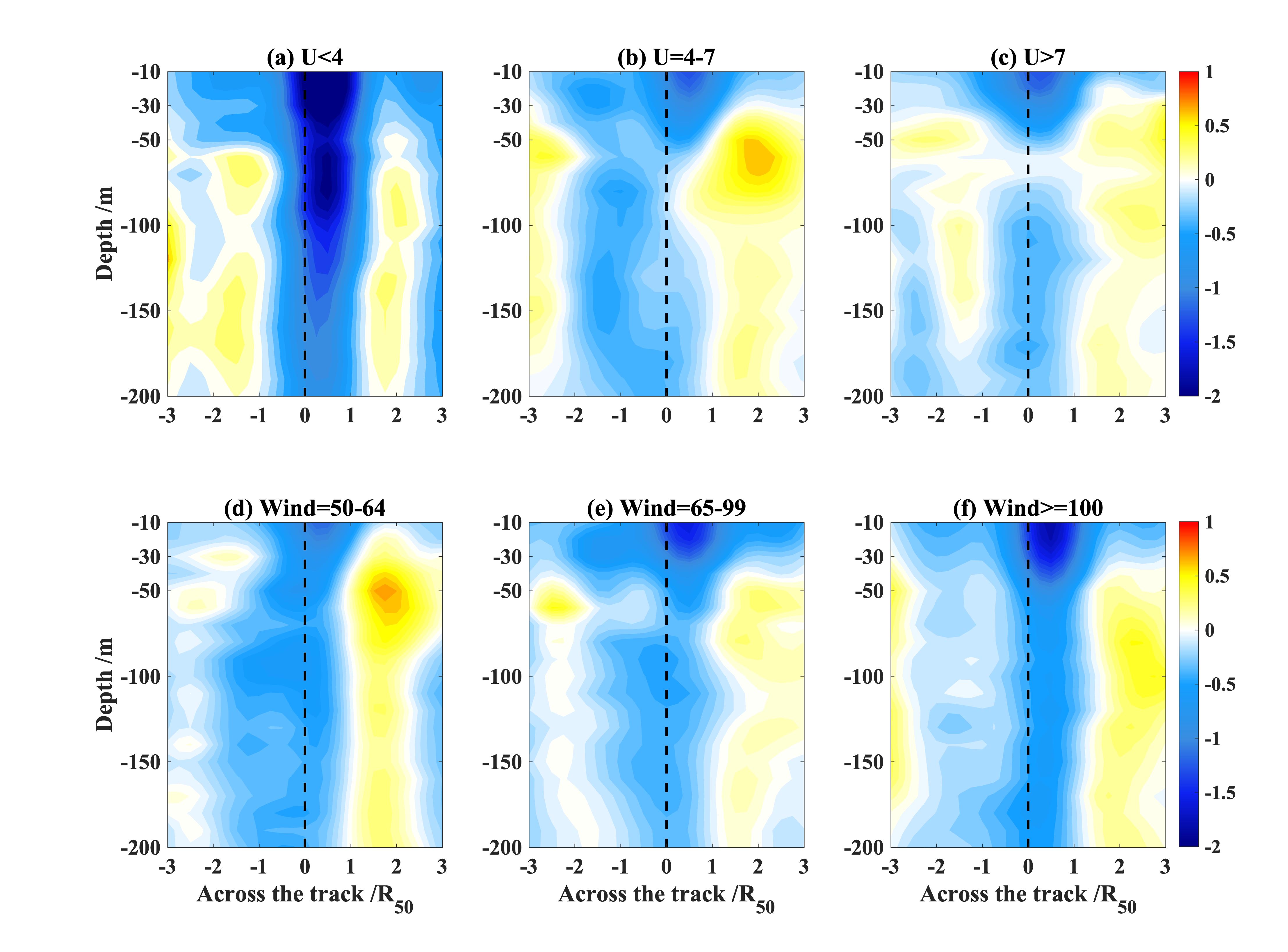
To better understand how TCs regulate the heat budget of the upper ocean, Argo profiles from 2000 to 2022 were utilized to investigate the temperature changes below surface when TCs past through the northwestern Pacific Ocean, and the information of TCs was obtained from the Joint Typhoon Warning Center. Only TCs with maximum sustained winds more 50 knots were selected, and the size of TCs was expressed in units of the longest radius of 50 knot wind (R50) Additionally, a simply mixed layer model was used here to explore the physical mechanism behind the result derived from Argo drifts.
Our study shows that translation speed of a TC plays a significant role on the competition between “cold suction” and “heat pump” in the upwelling region. Moreover, the impact of vertical advection on regulating the heat budget of the upper ocean has been always underestimated. First, slow TCs often causes stronger vertical mixing and stronger upwelling near the TC track, inducing a significant “cold suction”, and the cooling is the heaviest. As for fast TCs, the time of upwelling existing generally performs later than slow TCs, which means that subsurface warming induced by vertical mixing will dominate the subsurface temperature anomaly, thus “heat pump” was often detected among fast TCs. Compared to translation speed, TCs with stronger intensity mainly enhance the subsurface cooling induced by vertical mixing, but the influence of TC intensity on the competition between “cold suction” and “heat pump” is not obvious as expected. Second, both observations and simulations prove that the maximum of depth which deeply influenced by vertical mixing is no more than 70 meters, and exists at around X = 0.5 R50. In other words, the influence of vertical advection induced by TCs is seriously underestimated, although vertical mixing is also important. The observations depicted the seawater cooling caused by upwelling under all TCs. Slow and strong TCs often cause the intense and right-biased cooling, which means upwelling on the right side is stronger. However, this phenomenon under fast TCs or weak TCs is not evident as predicted. Beyond the upwelling region, temperature is mainly affected by downwelling which greatly enhances the downward heat transport. Interestingly, because the downwelling region is often 1 R50 away from the TC track, the vertical mixing is usually weak, which causes that the effect of downwelling is far more significant than “heat pump”. Downwelling on the right side is usually closer and stronger than that on the left side under all TCs except for slow TCs, which means that seawater warming is more significant on the right side of the TC track. After forcing stage of a TC, upper ocean gradually recovers, and the temperature anomaly caused by TCs usually remains during the recovering stage.
 - Indicates paper has been withdrawn from meeting
 - Indicates an Award Winner