
In the IMPACT (In-situ Measurement of Particles, Atmosphere, Cloud, and Turbulence) field campaign, conducted in May and June 2024 in northern Finland, we launched a novel experiment to address these challenges. We released non-spherical particles at altitudes between 2 and 7 km and tracked their dispersion until they landed on the ground.
The experiment involved particles with a fixed mass (8.5 grams) and volume, but different shapes, including icosahedrons (analogous to spheres), circular and elliptical discs with and without perforations. Up to 20 of these paperboard particles, embedded with miniaturised battery-powered electronics, were loaded into one biodegradable helium balloon that were launched to the target altitude. Once at the target altitude, the balloon burst, releasing all of the particles from a single location.
During the ascent of the particles inside the balloon and the subsequent descent of the particles after the balloon burst, we recorded the GPS position and altitude of each particle via radio to ground stations. Over the course of the campaign, we tracked up to 150 particles with six different shapes.
In this talk, we will present early results of the particle dispersion statistics and discuss how atmospheric turbulence affects the behaviour of non-spherical atmospheric particles.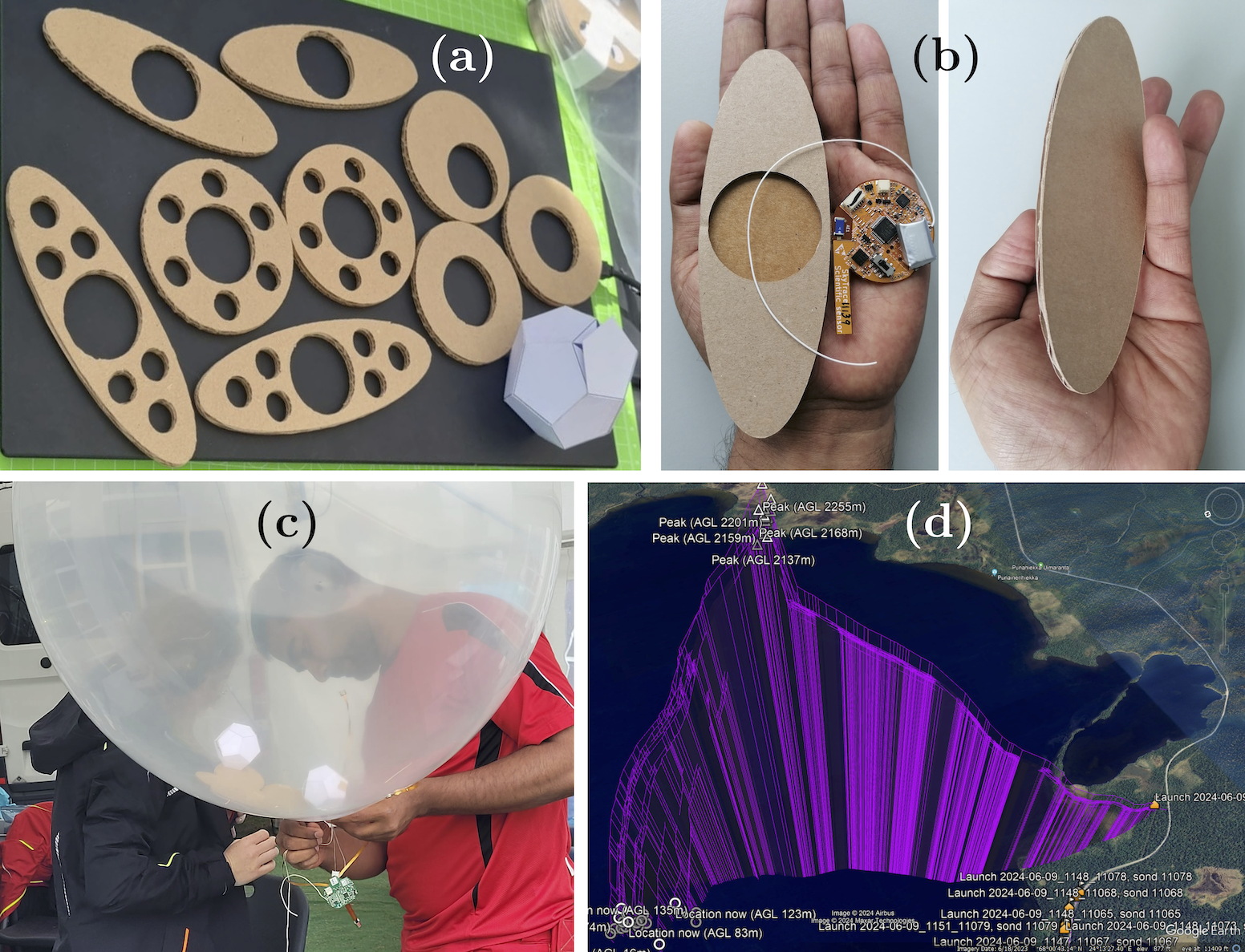
 - Indicates paper has been withdrawn from meeting
 - Indicates an Award Winner