
Monday, 13 January 2025: 4:45 PM
224 (New Orleans Ernest N. Morial Convention Center)
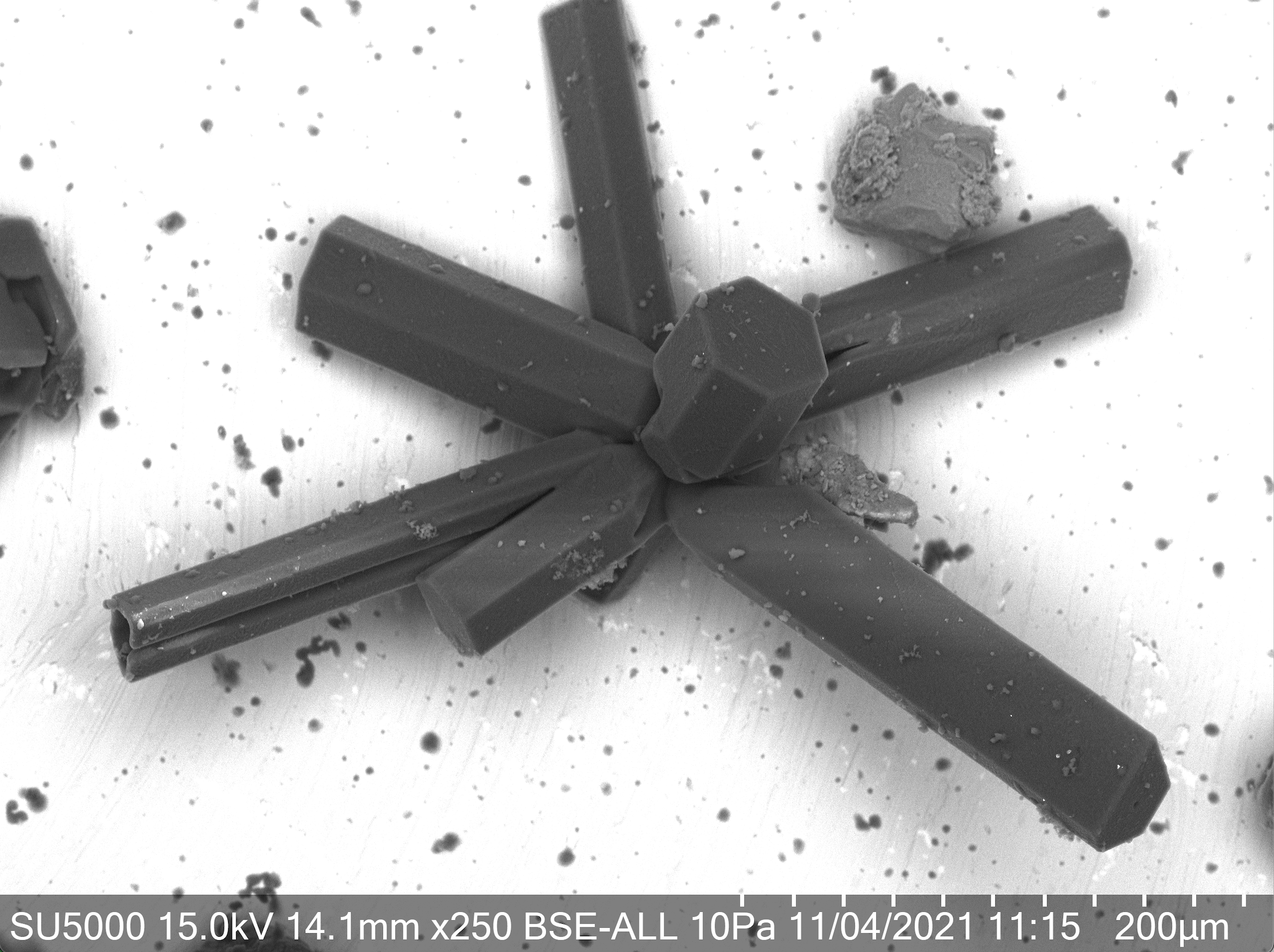
The growth of liquid droplets within clouds is thought to be well-understood, as liquid droplets grow as spheres or oblate spheroids. However, the growth of ice is vastly more complex, as the formation and density of surface steps on ice can inhibit incident vapor molecules from uniformly attaching to a growing crystal, a phenomenon known as kinetic resistance. This resistance causes the vapor density to vary across the crystal surface even in the absence of ventilation, and the solidity of ice means that this mass cannot redistribute itself symmetrically as occurs for liquid droplets. Typically, growing ice crystals are composed of facets which often consist of flat basal (hexagonal) faces, and prism (rectangular) faces, with the two faces typically having different vapor fluxes and thus growth rates. As a result, crystal aspect ratios (prism face length divided by length the basal face length) evolve with time and can deviate significantly from unity. In contrast, capacitance theory is used in weather and climate models and this theory assumes ice crystals grow with uniform surface vapor density and that all incident vapor molecules become incorporated into the crystal. As a result, this assumption produces too much mass flux to the crystal overall and does not allow for shape evolution with time. Thus, current cloud models are unable to capture the impact of environmentally-driven habit changes on growth rates, fall velocities, and radiative properties. Instead, models must approximate the impacts of habit through parameterization schemes that are not necessarily rooted in the underlying microphysics of ice. In contrast to these methods, we outline a theory for kinetically-limited crystal growth that directly accounts for the faceted structure of ice crystals by assuming hexagonal facets to be cylindrical in shape. The basal and prism faces grow at differing rates that are proportional to the faces’ deposition coefficients, which are the fractions of incident vapor molecules that become incorporated onto a given face of the crystal, and depend on critical supersaturations derived from our laboratory experiments. When combined with gas-phase diffusion derived from capacitance-based estimates, the growth rates of each of the faces can be found. The diffusion rate can also be adjusted to account for hollowing of the basal faces, a common phenomenon in which the rapid growth near the edges of the face depletes the vapor supply in the center enough that no growth can occur there. Our theory reproduces observations of columnar (prism length scale larger than the basal length scale) crystal growth from our laboratory experiments at temperatures below -40°C, for which very little data on crystal growth exists in the literature. The measurements show that crystal aspect ratios initially increasing in time but tend towards a constant value. This result is not replicable with either the capacitance model or with the adaptive habit approach of Chen and Lamb whereas our theory of facted growth with steps formed near edges can reproduce the measurements. We extend our theory so that it is appropriate for the multi-faceted growth of rosettes that commonly form in cirriform clouds at temperatures below -40°C. Initial results suggest that vapor competition among the columnar facets will result in slower mass and dimensional growth rates compared to simple columns, highlighting the importance of including polycrystalline development in crystal growth models.
 - Indicates paper has been withdrawn from meeting
 - Indicates an Award Winner